Humidifier vs Boiling Water: A Practical Comparison for Home Humidity Control
A rigorous, unbiased look at humidifier vs boiling water for indoor humidity. Learn how each method works, safety considerations, energy costs, and when to choose one over the other for healthier air at home.


In a home setting, humidifiers and boiling water are two common methods to influence indoor humidity, but they operate very differently. This humidifier vs boiling water comparison explains how each approach affects moisture levels, air quality, safety, and long-term costs. For most households, understanding the distinct mechanisms, risks, and practical limits helps you choose the option that best fits your space, budget, and maintenance willingness.
Understanding humidifier vs boiling water in everyday homes
In modern homes, the choice between using a humidifier vs boiling water to manage humidity hinges on control, safety, and convenience. The HumidifierBasics team emphasizes that while both approaches raise indoor moisture, the mechanisms, risks, and long-term implications are very different. The phrase humidifier vs boiling water isn't just a label; it signals two distinct families of moisture sources: powered devices with sensors and water pots on a stove or hot plate. For homeowners, the goal is steady comfort without overshoot, mold risk, or burns. According to HumidifierBasics, this distinction matters most in bedrooms and living areas where people spend many hours. By understanding how each method delivers moisture, you can craft a practical plan that minimizes waste, aligns with your energy budget, and maintains air quality across seasons.
How humidifier and boiling water alter humidity and air quality
Moisture delivery differs dramatically: a humidifier uses ultrasonic vibration or a heater to emit a fine mist, allowing precise control with built-in sensors or humidistats. Boiling water releases steam directly into the room, creating a rapid but less controllable humidity boost. Humidity targets depend on room size, ventilation, and occupancy. In smaller spaces, a humidifier can achieve stable relative humidity more consistently than boiling water, which can overshoot if left unattended. From an air-quality perspective, humidifiers may include filtration or mineral-removal components that reduce dust and mineral residues, while boiling water tends to increase humidity quickly but can raise mineral particulates if hard water is used. The HumidifierBasics analysis shows that sustained humidity above 60% RH can foster mold growth, especially in poorly ventilated rooms, so control mechanisms matter more than the source alone. For most households, a powered humidifier is the safer, more predictable option for everyday moisture management.
Safety, health, and regulatory considerations
Safety is a central concern for both methods. An electric humidifier carries risks of electrical faults, tip-overs, and surface moisture around electronics or bedding. Regular cleaning reduces the risk of mold and bacteria buildup inside the device, especially in poorly maintained units. Boiling water presents a different risk: hot surfaces, steam burns, and scalding hazards, particularly around children or pets. Steam can condense on windows and walls, potentially creating damp patches if ventilation is insufficient. Water quality also matters; using hard water can spread mineral dust with humidifiers; boiling water can deposit minerals on nearby surfaces if ventilation is not adequate. In practice, safety improves with sensible placement, supervision for boiling scenarios, and adherence to product instructions. The HumidifierBasics guidelines emphasize using devices with auto shutoff, child-safety features, and an accessible cleaning schedule to protect occupants and home materials.
Energy use, costs, and lifecycle considerations
From an energy perspective, humidifiers draw electricity to power fans or ultrasonic transducers and may require filters or cartridges for mineral control. Boiling water consumes energy to heat water, which can be substantial if you are trying to humidify a large room for an extended period. The ongoing operating costs depend on usage patterns, room size, and climate. In general, humidifiers offer a more energy-efficient path for sustained humidity when used with proper water systems and humidity targets. However, if you only need a brief humidity lift during dry weather or when guests arrive, boiling water can provide a temporary boost without the need for a powered device—though this comes at the cost of safety monitoring and manual operation. HumidifierBasics analysis suggests that the economics favor a single, well-maintained humidifier for most homes, paired with water quality controls to minimize mineral buildup and maintenance overhead.
Practical scenarios: choosing by space and activity level
In a compact apartment bedroom, a small humidifier with a built-in humidistat performs well, maintaining comfort while reducing dry skin and nasal irritation. For a kitchen or living room with frequent activity and open doors, you may prefer boiling water as a temporary, supervised tool when you notice humidity dips during intense cleaning or winter heating, but it is not ideal for continuous use. If you share your home with infants or seniors, safety concerns make a humidifier the preferred long-term option, especially models with automatic shutoffs and easy cleaning access. In multi-room homes, consider zoning via multiple devices or strategic placement near moisture needs, rather than relying on a single source. The take-home message: pick the approach that aligns with your room size, occupancy pattern, and maintenance willingness, and be prepared to adjust as seasons change.
Water quality and maintenance considerations
Water quality matters for both methods. A humidifier that uses hard water can distribute mineral dust if deposits build up in the reservoir or humidifier chamber, so many users opt for distilled water or use filters and demineralization cartridges. Boiling water also introduces minerals into steam and can deposit mineral clusters on nearby surfaces if not managed. Regular cleaning and descaling prevent bacterial growth and mineral buildup in either approach. The HumidifierBasics guidelines emphasize: always follow the manufacturer's cleaning schedule, use water that minimizes mineral content when possible, and monitor room humidity with a reliable hygrometer to avoid over-humidification.
Myths vs. reality: common misconceptions clarified
A frequent misconception is that boiling water is inherently safer or more natural than a humidifier. In reality, both methods require careful handling; one involves heat and open steam, the other electrical devices and moisture delivery. Another myth is that higher humidity always means healthier air; excessive RH creates a breeding ground for mold and dust mites. The truth is that humidity needs are scenario-specific: bedrooms, nurseries, and living rooms each have optimum ranges, usually achieved through controlled devices rather than ad hoc boiling. Finally, some assume that only expensive devices provide reliable humidity; in practice, mid-range humidifiers with quality water management and hygiene can meet most households' needs. Understanding these myths helps you evaluate options more objectively and avoid unsafe or inefficient practices.
Step-by-step implementation plan
- Measure baseline humidity in each room with a reliable hygrometer. 2) Pick your primary method based on room size, occupancy, and safety profile. 3) If choosing a humidifier, select one with a built-in humidistat, auto shutoff, and washable filter. 4) Use distilled or demineralized water when possible. 5) If you occasionally boil water, do so in a controlled, supervised manner away from electrical outlets and flammable materials. 6) Combine with proper ventilation to prevent mold growth. 7) Monitor humidity after changes and tune the device accordingly. 8) Schedule regular cleaning and descaling. 9) Replace filters on the recommended timeline. 10) Reassess seasonally to adjust for changes in indoor activity.
Final practical guidance and next steps
The choice between humidifier vs boiling water isn't about one method being universally better; it's about matching the method to your space, safety preferences, and maintenance readiness. For ongoing humidity management, a well-chosen humidifier with proper water quality controls tends to offer the most reliable results. If you need a temporary humidity boost, boiling water can help in emergencies or when an immediate, short-term spike is desired. In all cases, prioritize safety, monitor humidity, and maintain your equipment to protect your home's air quality.
Comparison
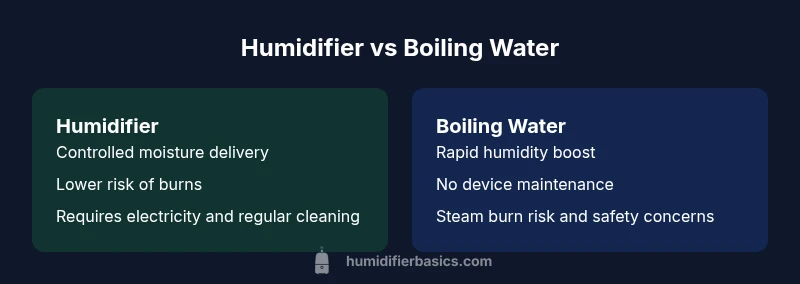
| Feature | humidifier | boiling water |
|---|---|---|
| Moisture delivery method | device-based mist or vapor via powered unit | steam released directly from heated water |
| Humidity control precision | high with sensors and humidistat | low to moderate; depends on boil rate and ventilation |
| Energy use | moderate electricity for operation | variable; energy mainly for heating water |
| Safety considerations | electric, spill, and surface moisture considerations | burn risk from hot steam; scald danger |
| Maintenance | regular cleaning; potential filter replacement | minimal device maintenance; mineral buildup possible on surfaces |
| Best for | steady humidity in homes; rooms with sensors | short-term boost when supervised; small- to mid-size spaces |
What's Good
- Offers precise, continuous humidity control with proper equipment
- Low risk of accidental burns when used as designed
- Cleaner air and reduced dust with proper water quality and filters
- Quiet operation and low ongoing effort with good maintenance
- Can be integrated with smart-home systems for scheduling
Negatives
- Requires regular cleaning and filter maintenance
- Initial cost can be higher; requires space and plug access
- Boiling water is not a long-term humidity solution
Humidifier generally provides safer, more controllable humidity; boiling water is for occasional boosts under supervision
For most homes, a properly chosen humidifier offers steady RH with safer operation. Boiling water can supplement humidity temporarily but carries higher safety risks and less precise control.
FAQ
What’s the main difference between using a humidifier and boiling water to increase humidity?
A humidifier provides controlled moisture delivery through a powered device with sensors, while boiling water adds humidity via steam with less precise control and higher safety considerations. The humidifier route is typically safer for long-term use in occupied spaces.
The main difference is control: a humidifier offers steady humidity with sensors, while boiling water delivers steam quickly but less predictable results. For daily use, the humidifier is usually safer and easier to manage.
Is boiling water a safe method to humidify a room?
Boiling water can increase humidity quickly, but it carries burn risks from steam and hot surfaces and can create runaway humidity if not supervised. It is not recommended as a primary method for occupied rooms.
Boiling water can humidity a room fast, but it also creates burn and scald risks. Use it with extreme caution and never unattended.
Can boiling water damage walls or electronics?
Excess humidity from any source can lead to condensation, which may affect walls and electronics if ventilation is poor. Boiling water increases the risk due to sudden humidity spikes and steam exposure.
Yes, if humidity gets too high or is uneven, condensation can form on walls and electronics, especially in poorly ventilated spaces.
How does water quality affect humidifier use?
Hard water can cause mineral buildup in humidifiers, leading to white dust. Using distilled water or demineralized water helps minimize residue and keeps devices running efficiently.
Hard water can leave mineral dust in the air. Distilled water helps keep the humidifier clean and the air clearer.
Should I boil water for humidity in a large room?
Boiling water for a large room is generally impractical due to energy needs, safety concerns, and uncontrolled humidity. It’s better to rely on a humidifier for sustained humidity in larger spaces.
Boiling for a big room is usually impractical and risky; a humidifier is a better long-term solution.
What maintenance is needed for a humidifier vs boiling water approach?
A humidifier requires regular cleaning, filter replacement, and mineral management. Boiling water requires careful handling, cleaning of pots or kettles, and attention to ventilation to manage humidity levels.
Clean the humidifier regularly and use clean water. If you boil water, keep an eye on the steam and ensure good ventilation.
The Essentials
- Choose humidifier for consistent humidity control
- Boiling water offers quick humidity but higher safety concerns
- Monitor humidity with a hygrometer to avoid mold
- Water quality matters for both methods
- Regular cleaning extends device life and air quality