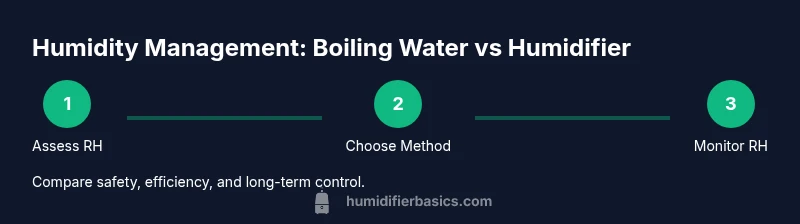
Can You Boil Water Instead of Using a Humidifier? A Practical Guide
Explore whether boiling water can substitute for a humidifier, its safety risks, and practical, safer approaches to managing indoor humidity in homes.


You can technically raise room humidity by boiling water, but it is not a safe or reliable substitute for a humidifier in most homes. Boiling creates steam that can burn, drive uneven humidity levels, and waste energy. For consistent, safe humidity, a properly sized humidifier is the better option in many situations.
The core question: can you boil water instead of using a humidifier?
Many homeowners ask whether simple boiling water can substitute a dedicated humidifier for adding moisture to a dry room. The quick answer is: it can temporarily raise humidity, but it is not a reliable or safe long-term solution. According to HumidifierBasics, relying on boiling water introduces unpredictable humidity swings, creates heat and scald risks, and wastes energy compared with purpose-built devices. In this section we unpack why boiling water is not equivalent to a real humidification strategy and when you might consider it as a short-term stopgap.
First, how humidity works in indoor spaces: humidity is the measure of water vapor in the air. When you boil water, you produce steam that increases the air's moisture level. But the effect is highly localized near the source and can quickly dissipate or accumulate unevenly in a room, depending on airflow, room size, and ventilation. A humidifier, by contrast, is designed to distribute moisture more evenly and maintain a target relative humidity (RH) over time. That difference matters for comfort and for preventing mold or damage to wood, electronics, and fabrics.
If you are trying to ease dry skin, congestion, or static, boiling water may appear tempting because it is simple and inexpensive upfront. However, it lacks safety features and duration controls found in humidifiers, and it cannot maintain RH within a safe range for extended periods. In practical terms, a humidifier sized to your space will regulate humidity more consistently, run with safeguards against over-humidification, and use energy more efficiently over the course of a day. The HumidifierBasics team has observed that most households experience better comfort, fewer humidity fluctuations, and lower risk of mold when using a properly chosen humidifier rather than relying on repeated boiling sessions.
Why it matters for different rooms and seasons
The humidity goal for most homes sits in a comfortable range that minimizes health issues and material damage. Boiling water can temporarily push RH higher, but without a controlled system, you risk overshooting the target or creating damp pockets around windows, ceilings, or corners. In spaces with wood furniture, books, or electronics, inconsistent humidity levels can cause warping, cracking, or condensation. Humidifiers, especially those with built-in humidistats, help maintain a safe, stable RH even as outdoor air shifts with weather and heating cycles.
When boiling might be considered as a stopgap
In rare cases—if you absolutely cannot access a humidifier for a day or two—shallow boiling can provide a short-term relief for extremely dry air. Treat it as a temporary measure, keep steam away from walls and electronics, ventilate the room afterward, and monitor RH closely. This is not a substitute for a calibrated humidification strategy and is not recommended as a regular practice.
Tools & Materials
- Kettle or pot for boiling water(Use a heat-safe vessel with a lid if possible; avoid overfilling.)
- Hygrometer or room RH monitor(Place away from direct heat sources; use to track RH changes.)
- Water (clean, safe to boil)(Prefer clean, potable water; distilled water is optional.)
- Heat source (stove, electric kettle)(Keep a safe distance from children and pets.)
- Heat-resistant mitts or towels(For safe handling of hot pots/kettles.)
- Ventilation option (fan or window)**(Facilitates air exchange and helps control humidity levels.)
Steps
Estimated time: 30-60 minutes
- 1
Measure current humidity in the space
Use a hygrometer to determine the room’s current RH. Aiming for a comfortable range (roughly 30-50% RH) helps you decide how aggressively to raise humidity. Avoid guesswork—unmeasured humidity is a frequent cause of over- or under-humidification.
Tip: Place the hygrometer away from heat sources or direct airflow to get a stable reading. - 2
Choose a safe boiling setup
Select whether you will boil water on the stove or in an electric kettle. Ensure the vessel is ventilation-friendly and won’t tip easily. If possible, keep the setup in a kitchen or open area with good air movement.
Tip: Never leave boiling water unattended; steam can cause burns and accidental spills. - 3
Boil water and release steam
Boil a modest amount of water and allow steam to disperse into the room. Keep the pot lid ajar to reduce pressure buildup and monitor the space for condensation on surfaces.
Tip: Maintain a safe distance and keep children and pets away from the steam path. - 4
Distribute steam and monitor RH
Ventilate the room with a fan or window to encourage even distribution and prevent hotspots. Recheck RH after a few minutes to see how much the humidity has changed.
Tip: Don’t over-humidify; steady, moderate changes are safer than rapid spikes. - 5
Adjust and decide on long-term approach
If RH remains consistently above 50%, stop boiling and switch to ventilation-first strategies or a properly sized humidifier. If RH is still low, consider a humidifier or alternative humidity sources.
Tip: Keep humidity in a safe range to prevent mold and condensation. - 6
Safe cleanup and documentation
Turn off the heat, carefully remove the vessel with heat-resistant mitts, and ventilate the space to normalize humidity. Note the RH trend for future reference.
Tip: Document your RH readings to inform future decisions.
FAQ
Is boiling water a safe method for humidifying a nursery?
Boiling water in a nursery introduces burn risks and uneven humidity. It is not recommended for a nursery; use a properly sized humidifier or ventilation strategies designed for child-safe environments.
Boiling water in a nursery is risky due to burns and uneven humidity; prefer a safe humidifier or good ventilation.
What humidity range should I aim for in a living room?
Aim for roughly 30-50% RH in living spaces. Use a hygrometer to monitor and adjust with controlled humidification or ventilation.
Keep humidity around thirty to fifty percent for comfort and mold risk reduction.
Can boiling water cause mold or mildew?
Yes. Prolonged high humidity can foster mold. Use ventilation and moderate humidity levels to prevent mold growth.
Yes, high humidity over time can lead to mold; ventilate and monitor RH.
Are there risks to electronics when boiling water to humidify?
Steam can condense on surfaces and near electronics, potentially causing damage. Keep humidification sources away from sensitive devices.
Steam can reach electronics; keep steam away from gadgets and outlets.
What about using distilled water for boiling?
Distilled water reduces mineral buildup in the kettle but does not inherently improve humidity control. It’s optional for those who boil regularly.
Distilled water helps prevent mineral buildup, not humidity control.
When is it better to use a humidifier instead of boiling water?
For consistent, safe humidity in occupied spaces, especially bedrooms and nurseries, a properly sized humidifier is the better choice.
A humidifier designed for your room size is usually the safer, more stable option.
Watch Video
The Essentials
- Measure RH before and after; don’t guess.
- Boiling water is temporary and risky—prefer a humidifier for long-term use.
- Ventilate and monitor to maintain safe, stable humidity.
- Use proper safety gear when handling hot water.