Are Humidifiers or Vaporizers Better? A Practical Comparison
Compare humidifiers and vaporizers to decide which keeps your air comfortable and safe. This HumidifierBasics guide analyzes effectiveness, safety, maintenance, and real-world use for homes with kids, pets, and varying room sizes.


Are humidifiers or vaporizers better? The answer is: it depends on your needs and safety priorities. Humidifiers typically provide cooler mist, run quietly, and minimize burn risk, making them versatile for bedrooms and living spaces. Vaporizers boil water to produce warm steam, which can feel more effective in small spaces but carries higher burn risk and more mineral buildup to manage.
Core differences: humidifiers vs vaporizers
Are humidifiers or vaporizers better? The question invites nuance. In practical terms, the core difference lies in output temperature, mechanism, and maintenance. Humidifiers may be evaporative or ultrasonic; vaporizers produce warm steam through boiling. The HumidifierBasics team notes that most homes benefit from a humidifier that offers cool mist, especially in bedrooms, since it minimizes burn risk and disperses evenly. Vaporizers can feel effective for quick relief in small spaces, but the heated element introduces burn hazards and higher energy use. Another layer is humidity control: evaporative and ultrasonic devices handle humidity differently as the ambient RH changes. In evaluating performance, you should consider room size, occupant age, and whether you have pets. During data synthesis, HumidifierBasics Analysis, 2026 indicates that cool-mist devices tend to be easier to operate for beginners and manage in multi-room scenarios, while steam-based devices may feel more reassuring to people with sensitive airways when mineral buildup is addressed properly. This block sets the stage for deeper evaluation of how each device meets typical home needs.
How each device works: mechanics and outputs
Humidifiers work by adding moisture to the air; they can be evaporative (wick filter with a fan) or ultrasonic (vibration that creates a cool mist). Vaporizers heat water to boiling and emit steam. Each method has different implications for energy use, noise, and mineral discipline. Evaporative humidifiers tend to self-regulate humidity because evaporation slows as humidity rises, which can reduce risk of over-humidification. Ultrasonic devices are typically quiet but can release a fine mist that some spaces consider too visible. Vaporizers, especially older units, often emit visible steam and may require more frequent cleaning to manage mineral buildup from tap water. Understanding these mechanics helps you pick a model that fits your space, noise tolerance, and maintenance willingness.
Safety considerations you should weigh
Safety is a deciding factor when choosing between humidifiers and vaporizers. Cool-mist humidifiers generally pose less risk of burns and are safer around children and pets, but they can disseminate minerals as fine dust if you use hard water. Warm-mist vaporizers boil water, which reduces some bacteria but introduces real burn hazards, especially for curious toddlers or pets that might tip a unit. Mineral buildup can also affect both types, translating to white dust in rooms or clogged steam paths. To mitigate risk, always place units on hard, level surfaces away from the edge of furniture, use clean water, and follow manufacturer cleaning schedules. If you prioritize safety, a cool-mist humidifier with a sealed water reservoir and a simple filtration system often delivers reliable performance with less maintenance per day.
Humidity performance: measuring and achieving target levels
A healthy indoor RH range is typically around 40–60%. Humidifiers and vaporizers vary in how quickly and steadily they move RH toward that target. Ultrasonic humidifiers can reach the target rapidly but may overshoot if left unattended in larger rooms. Evaporative models tend to stabilize more gradually, reducing the chance of overshoot. Vaporizer steam can feel effective in small spaces, but high air exchange or poor room sealing can push humidity too high in adjacent rooms. For homeowners, investing in a simple hygrometer and placing it near the primary living area yields actionable feedback. The HumidifierBasics guidance emphasizes monitoring RH over time and adjusting settings rather than chasing a fixed on/off pattern. In spaces like nurseries or bedrooms, a conservative approach—set-and-wait, then recheck after a few hours—helps avoid issues with condensation on walls or windows.
Maintenance, cleaning, and long-term costs
Maintenance is a practical constraint that often decides which device you keep. Humidifiers with filters require regular filter changes; ultrasonic devices demand mineral residue cleaning and occasional descaling to prevent white dust. Vaporizers require frequent cleaning to remove mineral deposits from the boiling chamber and to prevent mineral aerosols from entering the air. Distilled water dramatically reduces mineral buildup, but it adds ongoing supply costs. A maintenance-friendly approach includes: rinsing reservoirs daily, performing a thorough weekly clean with vinegar or a manufacturer-recommended cleaner, and replacing filters on schedule. Over the long term, a model with a washable reservoir and a straightforward cleaning routine saves time and reduces the risk of contamination. The talk here is not to chase the newest feature, but to favor reliability and ease of upkeep for steady, safe operation.
Room-by-room guidance: bedroom, living spaces, nurseries
In bedrooms, especially those used by children, a cool-mist humidifier is typically preferred due to lower burn risk and strong versatility. For living rooms and home offices, the choice hinges on noise tolerance and visibility of the mist. Vaporizers can work well in small, quiet spaces where you want a quick humidity boost without adding a lot of noise, but their heat element makes them less ideal for kids who might reach them. In nurseries, safety and simplicity are key: pick a model with auto-shutoff, a sealed reservoir, and no exposed heating element. Regardless of room, ensure the device size matches the space. A 400–600 square foot area benefits from mid-range units with robust output; larger rooms might require multiple devices or a unit designed for whole-house performance. HumidifierBasics recommends starting with one dependable device and evaluating its effect over 48–72 hours before expanding to more rooms.
Choosing features that matter: filters, energy, noise, water type
Your feature checklist should include filtration (whether the device uses true HEPA-like filtration or simple wick filters), energy consumption, noise level, and water type compatibility. Ultrasonic humidifiers are often very quiet but can disperse mineral dust if you do not use distilled water. Evaporative units are still relatively quiet, but the fan adds a noticeable hum in smaller rooms. Vaporizers that rely on boiling water tend to be louder than typical cool-mist units and demand careful handling, particularly in homes with toddlers. Look for auto-humidistat, anti-mite and anti-bacterial coatings, and a simple maintenance cycle that fits your household schedule. If you plan to use tap water, verify how the device handles mineral content and whether a descaling program is recommended by the manufacturer. Overall, the best choice aligns with your routine, room size, and willingness to perform regular cleaning while maintaining safe humidity.
Myths vs reality: debunking common misconceptions
There are several myths that can mislead buyers. Some people believe warm-mist vaporizers sanitize air simply by boiling water; while boiling water can reduce some pathogens, it does not replace air purification or proper cleaning. Others assume cool-mist humidifiers release no minerals; in reality, mineral dust can become airborne if you use hard water and neglect cleaning. A frequent misconception is that higher humidity always improves health outcomes; prolonged high humidity can promote mold growth and dust mites, especially in poorly ventilated spaces. Humidity should be managed with measured care, not by chasing “the strongest mist.” The HumidifierBasics approach emphasizes using low-to-mid mist settings, verifying room RH, and performing regular cleaning to minimize contamination risks.
Quick-start checklist for buyers
To shorten the path to a safe, effective choice, use this practical checklist:
- Determine room size and target RH range (40–60%).
- Decide on safety priorities (burn risk vs. mineral dust risk).
- Choose a model type (cool-mist humidifier or warm-mist vaporizer) with auto-shutoff and stable humidity output.
- Assess maintenance tolerance (filters, mineral deposits, cleaning frequency).
- Confirm water source compatibility and consider distilled water to reduce mineral buildup.
- Plan for noise tolerance, especially in bedrooms and nurseries.
- Verify placement rules (away from walls, on a stable surface, out of reach of children).
- Test RH after 24–72 hours and adjust settings as needed.
This plan helps you avoid common missteps and ensures your device genuinely improves air quality without introducing new issues.
Practical decision framework and next steps
A structured approach helps you decide are humidifiers or vaporizers better for your home. Start by listing your top needs: safety (burn risk), space constraints, noise, and maintenance willingness. Then map those needs to the two device families. If safety and ease of use top the list, a cool-mist humidifier with a simple reservoir and a filter is often the best starting point. If you live in a small, dry space and are willing to manage safety, a warm-mist vaporizer could be appropriate, but ensure it has a stable base and auto-shutoff. Finally, use a hygrometer to quantify humidity and adjust accordingly. The HumidifierBasics framework stresses that prototype trials, careful monitoring, and gradual scaling across rooms deliver the most reliable results for improving air quality without over-humidifying the home.
Comparison
| Feature | Humidifier | Vaporizer |
|---|---|---|
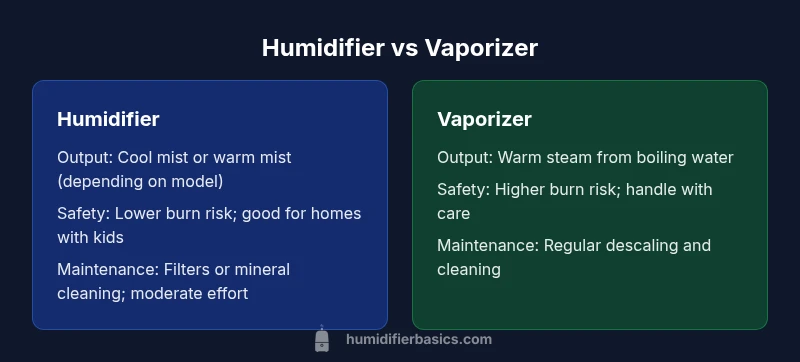
| Output type | Cool mist (ultrasonic or evaporative) or warm mist (depending on model) | Warm steam from boiling water |
| Safety risk | Lower burn risk overall; safer for kids and pets in typical bedrooms | Higher burn risk due to exposed heating element and hot water |
| Maintenance effort | Filter changes or mineral dust management; some models self-regulate humidity | More frequent cleaning to remove mineral buildup from mineral-laden water |
| Energy consumption | Moderate to low, varies by type and features | Often higher due to heating water, especially in larger rooms |
| Best for | Rooms with children or pets; general humidity needs | Small spaces needing quick relief; high humidity can be achieved fast |
| Noise level | Low to moderate; ultrasonic units are very quiet | Can be louder due to boiling and fan systems, depending on design |
| Water type impact | Distilled water reduces mineral dust; filters mitigate impurities | Tap water is common but may require more descaling and cleaning |
What's Good
- Lower burn risk with cool-mist humidifiers
- Quieter operation for many ultrasonics
- Wide availability and price range across models
- Vaporizers can feel more effective in small spaces
Negatives
- Potential mineral dust with hard water in humidifiers
- Vaporizer heating element poses burn risk
- Mineral buildup requires regular cleaning in both types
- Water quality directly impacts performance and maintenance
Humidifiers generally win for safety, versatility, and easier maintenance; vaporizers can be useful in small, dry spaces if handled carefully
For most homes, a cool-mist humidifier offers safer, more predictable performance with fewer hazards. Vaporizers may suit very small rooms where quick humidity is desired, but they demand attentive cleaning and burn-safety precautions. HumidifierBasics recommends starting with a cool-mist unit and only adding a vaporizer if you have a controlled environment and clear need for warm mist.
FAQ
What is the key difference between humidifiers and vaporizers?
Humidifiers add moisture to air via cool or warm mist, depending on type, while vaporizers boil water to emit warm steam. The safety profile, maintenance needs, and output temperature drive their best-use scenarios.
Humidifiers add moisture with cool mist or warm mist, while vaporizers boil water to emit steam. Each has different safety and maintenance needs.
Are humidifiers safer for children than vaporizers?
Generally yes, cool-mist humidifiers carry less burn risk than vaporizers with hot steam. Place units on stable surfaces and keep cords away from children.
Yes, humidifiers—especially cool-mist types—are typically safer around kids due to lower burn risk.
Can humidifiers spread mold or bacteria?
Any humidifier can spread contaminants if not cleaned regularly. Use clean water, clean reservoirs, and follow maintenance schedules to minimize this risk.
Yes, but proper cleaning and using clean water dramatically lowers the risk.
What maintenance steps ensure safe operation?
Rinse and clean reservoirs daily, descale mineral buildup weekly, replace filters as recommended, and use distilled water when possible. Empty and dry units when not in use.
Clean the unit regularly, descale mineral buildup, and use distilled water when you can.
Which is better for allergies?
Humidifiers that maintain stable humidity and use clean filters can help asthma and allergy symptoms if humidity is controlled. Avoid over-humidification which can worsen mold spores.
If humidity is kept stable and cleaning is consistent, humidifiers can help with allergies.
How do I set humidity targets safely?
Aim for 40–60% relative humidity. Use a hygrometer, adjust mist output gradually, and check rooms after 24–72 hours to avoid over-humidification.
Keep humidity around 40–60% and verify with a hygrometer.
The Essentials
- Know the room size and humidity target before buying
- Choose cool-mist humidifiers for safety and versatility
- Use distilled water to minimize mineral dust
- Maintain regular cleaning schedules to prevent mold and bacteria
- Test humidity with a hygrometer and adjust settings accordingly