Cold vs Warm Humidifier: Which Is Better for Your Home?
A practical, evidence-based comparison of cold-mist and warm-mist humidifiers, safety considerations, maintenance tips, energy use, and guidance to choose the right option for your home’s air quality.


Both cold-mist and warm-mist humidifiers add humidity to dry indoor air, but which is better depends on safety, room size, and climate. For most homes, cold-mist models provide a safer, energy-efficient option with fewer burn risks and broader feature choices. Warm-mist units offer comfort for very dry air and throat relief but come with a higher burn risk and energy use.
which is better a cold or warm humidifier
According to HumidifierBasics, the question of which is better a cold or warm humidifier matters for safety, maintenance, and how it fits your climate. In dry homes, either type can improve comfort, but the decision should rest on three practical dimensions: safety (especially with kids and pets), energy use, and the volume of moisture needed. When you start exploring, remember that the phrase which is better a cold or warm humidifier? is not a riddle but a guide to matching your space to a reliable solution. This guide uses HumidifierBasics insights to explain how these two types differ in operation, upkeep, and real-world performance, and what that means for your everyday life.
You’ll see how the two options compare in terms of safety, humidity output, noise, cleaning needs, and cost, along with a simple framework to help you decide which is better for your specific room and routines.
The core question remains practical: how much moisture do you need, where will the unit sit, and who might be nearby? The answer isn’t one-size-fits-all, but a set of clear criteria that help you pick confidently.
How cold-mist and warm-mist humidifiers work
Cold-mist humidifiers (often ultrasonic or evaporative) create moisture without heating the water, relying on vibrations or airflow to disperse fine droplets. Warm-mist humidifiers boil water to produce steam, which then cools before leaving the unit. This fundamental difference affects safety, energy use, and maintenance. For example, cold-mist models typically produce a higher output per hour for comparable sizes and are generally safer around children because there’s no boiling water. In contrast, warm-mist devices may feel more comforting in very dry climates because the steam carries warmth and can feel more substantial in small spaces. Understanding these mechanisms helps you gauge real-world performance, including how quickly a room approaches your target humidity and how much care each type requires to prevent mineral buildup or mold growth.
Safety considerations for households with kids and pets
Safety is a central factor when comparing cold-mist and warm-mist humidifiers. With kids and pets, the risk of accidental burns from boiling water makes warm-mist units less desirable in many households, even if they offer some comfort benefits. Cold-mist humidifiers eliminate this hazard but require proper maintenance to avoid mold growth and mineral dust, especially if you live in an area with hard water. Always place units on stable surfaces away from edges and avoid covering grills or openings. If you have toddlers who like to reach into appliances, a cool-mist model is often the safer choice. Regular cleaning and using distilled water can further reduce the risk of airborne irritants and ensure dependable performance over time.
Performance and comfort: moisture output, noise, and climate fit
A key difference between cold-mist and warm-mist humidifiers is how they feel in a living space. Cold-mist devices tend to be quieter and more energy-efficient, making them a better fit for bedrooms and living rooms where a calm atmosphere matters. They also tend to have flexible output options and broader feature sets, such as built-in humidistats and timers. Warm-mist humidifiers can deliver a comforting plume of moisture in very dry environments and are sometimes favored in rooms without good air circulation. However, their heating element adds energy cost and a burn risk, which can impact safety in households with curious children or curious pets. Selecting the right model means balancing these factors: room size, humidity targets, noise tolerance, and how easily you can maintain the unit to prevent mineral buildup and odors.
Maintenance and cleaning: upkeep differences
Maintenance is a practical differentiator. Cold-mist humidifiers, especially ultrasonic types, can release mineral dust if you use hard water unless you choose models with proper filtration or use distilled water. Regular cleaning is essential to prevent mold and bacterial growth in both types, but warm-mist units may require more frequent descaling due to mineral deposits formed during the boiling process. Regardless of type, follow manufacturer cleaning schedules, replace filters as recommended, and avoid letting water sit in the tank for long periods. Simple steps—daily emptying, weekly scrubbing with a mild cleaner, and thorough drying—extend the unit’s life and keep air quality high.
Costs, energy use, and environmental impact
Price and energy use are practical realities when weighing cold versus warm humidifiers. Cold-mist models generally have a lower upfront cost and lower ongoing energy use because there’s no heating element. Warm-mist units may cost more initially and run hotter, consuming more electricity. Both types benefit from efficient water-use practices and regular filter maintenance. If you live in a climate with high humidity fluctuations, a humidifier with smart features and a reliable humidistat helps avoid over-humidification, which can contribute to mold or dust mite issues. In most homes, selecting a model that emphasizes energy efficiency, auto-shutoff features, and easy cleaning reduces long-term costs while supporting better air quality.
Space, placement, and integration with HVAC systems
Placement matters for effective humidification. Cold-mist units work well in bedrooms, living rooms, or home offices with stable tables or dressers, while avoiding direct exposure to air vents or drafts. Warm-mist units generate more moisture per hour in smaller spaces but require careful placement to avoid heat exposure to nearby fabrics or electronics. For larger homes, consider a multi-room approach or a whole-home humidifier that integrates with your HVAC system. Ensure adequate clearance around the device and that the surface is level to prevent spills. If you share living spaces with people who have asthma or allergies, prioritize models with easy-to-clean reservoirs and filters to minimize irritants in the air.
Practical decision framework: choosing the right type for your room and needs
A structured approach makes choosing easier. Start by assessing room size, occupancy (children or pets), climate, and whether you want silent operation or added warmth. If safety and simplicity are your priorities, a cold-mist humidifier with a built-in humidistat and automatic shutoff is often best. If warmth, perceived comfort, and potential relief from very dry throat symptoms are your main concerns—and you can manage heat safety—warm-mist could be right. Finally, factor in maintenance capacity: can you clean a reservoir easily, and are you comfortable using distilled water to reduce mineral buildup? This framework helps you map your needs to a suitable model and avoid common missteps such as buying too-large units or ignoring water quality.
Common mistakes and red flags to avoid
One frequent mistake is picking the wrong size unit for a room, which leads to ineffective humidity or over-humidification. Another is using tap water without consideration for mineral deposits, especially with ultrasonic cold-mist units. A third is neglecting cleaning schedules, which increases the risk of mold and odors. A final caveat is assuming all warm-mist humidifiers are safe around kids; while some are, many still pose burn risks and should be kept out of reach. By focusing on room size, water quality, and maintenance, you can avoid these pitfalls and maintain a healthier indoor environment.
The science of humidity and why it matters for your home
Maintaining indoor humidity within a comfortable range—typically around 30-50% relative humidity—can reduce respiratory irritation, protect wooden furniture, and improve overall comfort. Both cold-mist and warm-mist humidifiers help achieve this range, but the path differs. Cold-mist devices often maintain steady humidity levels with less risk of accidental burns, while warm-mist units can provide rapid humidity in very dry climates but require more diligent safety measures. Humidifier effectiveness also depends on room ventilation, air exchange rates, and the quality of water used. A practical rule of thumb is to monitor humidity with a hygrometer and adjust the humidifier’s output to avoid condensation on walls or surfaces.
Comparison
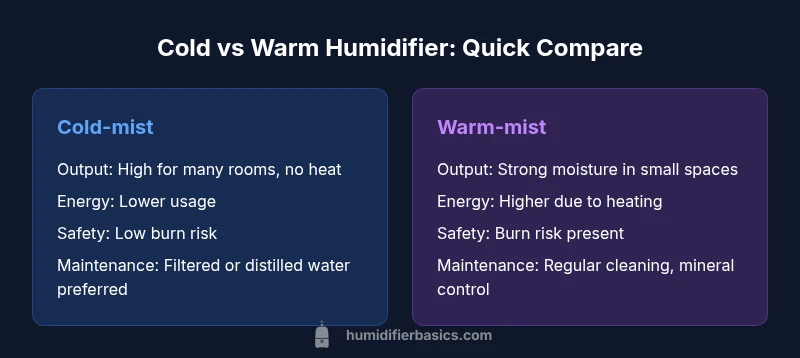
| Feature | Cold-mist humidifier | Warm-mist humidifier |
|---|---|---|
| Output mechanism | Ultrasonic or evaporative (no heating) | Boils water to produce steam |
| Energy use | Generally lower energy consumption | Higher energy use due to heating element |
| Safety in households with kids/pets | Lower burn risk | Boiling water creates burn risk |
| Noise level | Typically quiet; varies by model | Can be quiet but some boiling sounds possible |
| Maintenance effort | Regular cleaning; mineral dust possible with hard water | Descale and clean; mineral deposits from water can occur |
| Best room size | Small to medium rooms; scalable in multi-room setups | Small spaces or zones needing rapid humidity |
What's Good
- Lower burn risk for homes with children or pets
- Typically lower energy use and running costs
- Wider selection of models and features
- Quieter operation in many settings
Negatives
- Potential mineral dust with ultrasonic cool-mist without proper filtration
- Cool-mist can cause condensation on surfaces if overused
- Warm-mist carries burn risk and higher energy use
- Warm-mist models often have fewer high-tech features in mid-range options
Cold-mist humidifiers are generally the safer, cost-effective default for most homes; warm-mist is a niche option.
The HumidifierBasics team recommends cold-mist humidifiers for households prioritizing safety, energy efficiency, and ease of maintenance. Warm-mist units may suit very dry climates or throat comfort needs but come with higher burn risk and energy use.
FAQ
Which humidifier is safer for homes with children?
Cold-mist humidifiers are generally safer for homes with kids because there is no exposed heating element and no boiling water. Regular cleaning remains essential to reduce mold and mineral buildup. Always supervise and place devices out of reach from curious hands.
Cold-mist models are safer for families; just keep the unit clean and out of reach from children.
Can I use tap water in both types of humidifiers?
Tap water is acceptable in many cases, but minerals can accumulate in the tank and on heating elements. If you notice white dust or scale, switch to distilled water or use a model with a built-in mineral filter. Regular cleaning helps prevent buildup in both types.
Tap water can work, but distilled water reduces mineral buildup.
Do warm-mist humidifiers kill bacteria?
Warm-mist humidifiers boil water, which can reduce some bacteria, but they are not a substitute for cleaning and filter maintenance. Bacteria can still grow in reservoirs if not cleaned regularly. Follow manufacturer cleaning guidelines.
Boiling helps, but you still need to clean regularly.
Are warm-mist humidifiers better for allergies?
Allergies respond to humidity levels and particle presence. Cold-mist units with proper filtration often reduce dust-mite activity and pollen aerosolization more readily, but the best choice depends on the specific allergen profile and room conditions.
It depends, but cold-mist with filters is often better for allergies.
What should I consider for pet owners?
Keep the distance between pets and the unit, avoid hot surfaces near pets, and maintain regular cleaning to prevent mold and odors that could affect animal airways. Both types can work, but safety and maintenance matter more with pets.
Keep the humidifier away from pets and clean it regularly.
The Essentials
- Choose cold-mist for safety and efficiency
- Use distilled water to minimize mineral buildup
- Monitor humidity with a hygrometer for best comfort
- Avoid warm-mist around small children unless safety measures are in place
- Regular cleaning prevents mold and odors