Humidifier Warm or Cool: A Comprehensive 2026 Comparison
An in-depth comparison of warm-mist versus cool-mist humidifiers, covering safety, maintenance, energy use, noise, and ideal use cases for homeowners and renters in 2026.


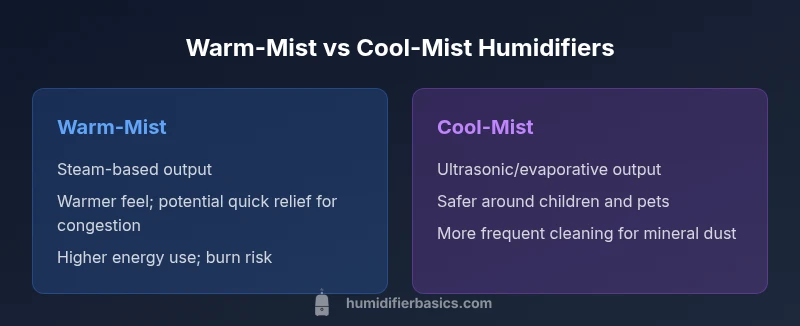
Choosing between humidifier warm or cool comes down to safety, humidity goals, and daily maintenance. Warm-mist units boil water to emit steam, delivering warmer humidity that can feel soothing for congestion—but they carry burn risks and higher energy use. Cool-mist models emit a cooler mist, which is generally safer for households with kids and pets, though they may require more frequent cleaning to prevent mineral buildup. In 2026 guidance, both types can effectively raise indoor humidity when sized correctly for the room.
What Warm-Mist and Cool-Mist Humidifiers Are
Humidifier warm or cool decisions hinge on how water is transformed into moisture for the air. Warm-mist humidifiers boil water to create steam, releasing a warm, damp mist that some users find comforting in dry winter environments. Cool-mist humidifiers rely on ultrasonic vibration or evaporation to distribute a cooler mist, which can feel refreshing in warm weather or in rooms where heat from steam is undesirable. The HumidifierBasics team notes that both types can effectively improve indoor humidity if sized appropriately for the room and used with clean water. For families weighing humidifier warm or cool options, several practical considerations—such as safety, energy use, maintenance, and the specific humidity targets you have—will guide the choice. This article keeps the focus on real-world use cases, with a balanced look at how each type performs in 2026 households.
Key takeaway: humidity control is more important than chasing the perfect “warm” or “cool” label, and both types can help reach a healthy indoor range when used correctly. The discussion below continually references humidifier warm or cool to anchor decisions in concrete, everyday scenarios.
How They Work: Mechanisms and Output
Warm-mist humidifiers heat water until it boils, then releasing steam into the room. This process can kill some bacteria present in the water and may feel warmer to the touch, which some users find comforting during dry winters. Cool-mist devices operate either via ultrasonic transducers that vibrate water into a fine mist or via evaporation through a wick or fan mechanism. In practice, warm-mist units tend to produce a higher perceived temperature in the room, while cool-mist units distribute a broader, cooler cloud of moisture. The HumidifierBasics analysis shows that the choice between warm-mist and cool-mist often hinges on how you prioritize heat, noise, and maintenance needs. In most homes, both types are able to achieve target humidity levels when paired with a properly sized room and well-maintained filters or wicks. When weighing humidifier warm or cool, consider room size, occupant safety, and cleaning routines as the main inputs to decision-making.
Safety Considerations for Families and Pets
Safety is a core factor when deciding between humidifier warm or cool. Warm-mist units boil water, which creates a burn risk if children or pets reach into the tank or nozzle. This risk can be mitigated with secure lids, anti-tip designs, and supervised use, but it remains a consideration for households with young kids or curious pets. Cool-mist models, by contrast, present a lower burn risk but require diligent cleaning to prevent mineral dust dispersion and mold growth, especially in hard water areas. For many homes, the safer option becomes the default unless congestion relief or warmth is a higher priority. The HumidifierBasics team emphasizes using distilled or demineralized water when available to reduce mineral buildup in either type and to support steadier humidity control. If you are considering humidifier warm or cool for a nursery or child’s room, weigh safety features, footprint, and ease of sealing the unit from little hands.
Additionally, ensure the device has a humidistat and an auto shut-off feature when the desired humidity range is reached. Keeping humidity between roughly 30% and 50% reduces the likelihood of mold growth and dust mites, regardless of the chosen mist type.
Performance, Energy, and Maintenance Demands
Energy consumption and maintenance workload often guide the humidifier warm or cool decision. Warm-mist devices must heat water, which consumes more energy and may require longer operation times to achieve the same humidity rise as some cool-mist models. Maintenance considerations include regular cleaning of the water tank and mechanism to prevent mineral buildup, with distilled water recommended to minimize scaling. Cool-mist devices, particularly ultrasonic models, can release mineral dust if you use hard water. In both cases, routine cleaning, proper storage, and replacing filters or wicks on schedule are essential for odor control and safe operation. A careful maintenance routine reduces the risk of bacteria and mold growth, making either option more effective in the long run. Humidifier warm or cool choices should align with your cleaning capacity and willingness to monitor humidity levels daily.
For 2026 households, setting a simple weekly cleaning cadence—emptying, rinsing, and drying the tank, then performing a deeper clean every two weeks—helps keep both types performing optimally.
Use-Case Scenarios: When to Choose Warm or Cool
Understanding use cases helps translate the theory of humidifier warm or cool into action. In bedroom environments where you want quick warmth and potentially soothing congestion relief, a warm-mist unit may feel more comforting. For households with children, elderly residents, or a desire to minimize burn risk, a cool-mist humidifier is often the safer default. In living rooms or large areas, cool-mist models with adequate output can cover space more evenly, while warm-mist units are often preferred in smaller rooms or channels where the perceived warmth is desirable. In spaces with high mineral content in water, consider a cool-mist design (especially ultrasonic) and invest in distilled water to limit mineral deposition. The choice is ultimately a balance between safety, comfort, and ongoing maintenance.
Cleaning and Maintenance Best Practices
Regardless of humidifier warm or cool, consistent maintenance is the core of reliable performance. Always start with a clean tank and base, remove scale with a mild solution recommended by the manufacturer, and ensure air intakes are free of dust. Distilled water helps prevent mineral buildup in both types, but a cool-mist ultrasonic model may still require periodic descaling in hard-water areas. Replace any filters or wicks as advised, and periodically inspect seals and gaskets for signs of wear. For families with kids or pets, place units on stable surfaces, use cord management, and ensure the device is out of reach. In all cases, monitor room humidity with a hygrometer to prevent over-humidification, which can lead to mold or mildew.
Quick-Start Checklist for Your Home
If you’re deciding between humidifier warm or cool, start with a practical checklist: 1) Measure the room size and choose a model rated for that space; 2) Decide on safety priorities (burn risk vs. maintenance burden); 3) Check for a built-in humidistat and auto shut-off; 4) Plan for regular cleaning with a/distilled water approach; 5) Set a humidity target (roughly 30-50% for most homes) and adjust as needed; 6) Keep the device away from electronics, heat sources, and direct sunlight. Following these steps helps you get the most from your humidifier, whether you select warm-mist or cool-mist, and ensures comfortable, breathable air throughout the year.
Common Myths About Warm-Mist vs Cool-Mist Humidifiers
Myth: Warm-mist units always sanitize water better than cool-mist. Reality: Boiling can kill some bacteria, but many microbes survive in tank surfaces; cleaning remains essential. Myth: Cool-mist humidifiers are universally better for kids. Reality: Safety depends on design, placement, and maintenance. Myth: Any humidifier improves air quality without cleaning. Reality: Humidity control helps, but mold and bacteria can thrive if you don’t maintain the unit. The truth is that a well-maintained humidifier, chosen to fit your space and safety needs, delivers the best overall results regardless of mist type.
Comparison
| Feature | Warm-mist humidifier | Cool-mist humidifier |
|---|---|---|
| Primary mechanism | Boils water to create steam | Ultrasonic vibration or evaporation to create a mist |
| Safety considerations | Burn risk; keep out of reach of children and pets | Lower burn risk; ensure proper cleaning to prevent mold and mineral buildup |
| Maintenance needs | Regular cleaning; potential scale but steam can reduce some contaminants | Frequent cleaning to control mineral dust and microbial growth |
| Energy use | Typically higher due to water boiling | Generally lower, depending on model and output settings |
| Noise level | Often moderate; some boiling sounds possible | Often quiet with ultrasonic models; fans may add some noise |
| Best use case | Smaller rooms or when warmth and congestion relief are priorities | Living rooms or spaces where safety and easy maintenance are valued |
What's Good
- Improves humidity and comfort in dry indoor environments
- Cool-mist models are safer for households with children and pets
- Warm-mist can help with congestion relief and feels warmer
- With proper maintenance, both types are effective for long-term use
Negatives
- Warm-mist poses burn risk and uses more energy
- Cool-mist requires more frequent cleaning to prevent mineral buildup
- Both require regular water quality management to prevent odor and mold
No single winner; pick based on safety, climate, and maintenance willingness
If safety around kids matters most, lean toward cool-mist. If you want warmth and congestion relief, warm-mist may be preferable. Always target about 30-50% humidity and maintain the unit regularly.
FAQ
What is the fundamental difference between a warm-mist and a cool-mist humidifier?
Warm-mist humidifiers boil water to produce steam, delivering a warmer output and potentially quick relief from congestion. Cool-mist humidifiers use ultrasonic or evaporation methods to create a cooler mist and are typically safer around children. Both types can achieve target humidity when properly sized and maintained.
Warm-mist boils water to emit steam, giving warmer humidity but with burn risk. Cool-mist uses ultrasonic or evaporation for a cooler mist and is safer around kids, though maintenance matters.
Is one type safer for households with children or pets?
Cool-mist humidifiers generally present a lower burn risk, making them a common choice for households with kids and pets. Warm-mist units carry a burn risk due to heated water, so they require careful placement and supervision. Regardless of type, use together with a humidistat and regular cleaning.
Cool-mist is usually safer for kids and pets, while warm-mist has burn risk—place and supervise accordingly.
How do I prevent mold and mineral buildup in both types?
Regular cleaning is essential for both warm- and cool-mist humidifiers. Use distilled water when possible to reduce mineral deposits, empty and dry the tank daily, and perform a deeper clean weekly. Replace filters or wicks as recommended by the manufacturer.
Clean regularly, use distilled water when possible, and keep the tank dry when not in use.
Which type is quieter in typical use?
Quiet operation is often associated with ultrasonic cool-mist models, though some warm-mist units also run quietly. Evaporative cool-mist units can be a bit noisier due to the fan. Model choice and room acoustics largely determine perceived noise.
Ultrasonic cool-mist models tend to be very quiet; warm-mist can be a bit louder due to boiling.
Should I use distilled water?
Using distilled or demineralized water reduces mineral buildup in both warm- and cool-mist devices. It also minimizes the white dust that can occur with hard water in some cool-mist units. Always follow the manufacturer’s water recommendations.
Distilled water helps prevent mineral buildup and dust in both types.
What humidity target should I aim for in a home?
Aim for an indoor relative humidity around 30% to 50%, depending on season and comfort. Use a hygrometer to monitor levels and adjust the humidifier output to stay within this range. Avoid over-humidifying, which can promote mold growth.
Keep humidity roughly between 30% and 50% for comfort and safety.
The Essentials
- Evaluate safety vs warmth before choosing humidifier warm or cool
- Cool-mist is generally safer for households with kids or pets
- Warm-mist offers warmth and potential congestion relief
- Regular cleaning and distilled water minimize mold and mineral buildup
- Maintain humidity in the 30-50% range for best comfort and air quality