Warm vs Cool Air Humidifiers: A Practical Comparison
Compare warm-mist and cool-mist humidifiers for safety, efficiency, maintenance, and room suitability. Learn which type fits bedrooms, nurseries, and living spaces, with practical guidance from HumidifierBasics to maximize comfort and air quality in 2026.


Deciding between a warm or cool air humidifier comes down to safety, humidity performance, and room context. For many homes, a cool-mist model offers safer operation in kids’ spaces, while a warm-mist unit can feel more comfortable in very dry winter rooms. This guide explains practical criteria to help you choose the right type.
Overview: What warm or cool air humidifiers do and why people use them
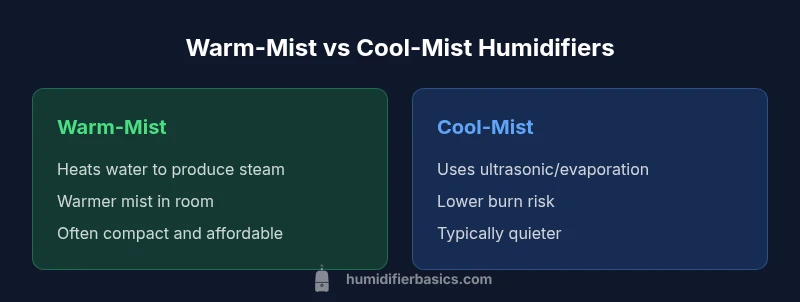
Humidifiers are designed to add moisture to indoor air, improving comfort and reducing the dryness that can irritate skin, throat, and nasal passages. When you hear the phrase warm or cool air humidifier, you are comparing two core approaches to generating that moisture. A warm-mist humidifier boils water to create steam, which is discharged into the room, while a cool-mist humidifier uses ultrasonic vibration or evaporation to release a cooler, breathable mist. The choice often hinges on the desired room temperature, safety concerns, and maintenance preferences. In many homes, the decision is influenced by the climate and how the space is used; for example, a cooler climate may benefit from the added warmth that a warm-mist unit can provide, whereas a child’s bedroom often favors the lower burn risk of a cool-mist option. According to HumidifierBasics, pairing the right type with careful water quality management yields the most reliable humidity control and comfort in daily life.
-note-for-seo-usage-
words-count:approx-180
Comparison
| Feature | Warm-mist humidifier | Cool-mist humidifier |
|---|---|---|
| Mist Type | Heated steam from boiled water | Cool mist produced by ultrasonic vibration or evaporation |
| Heating/Technology | Heats water to near boiling; steam is released | No heating; relies on ultrasonic plate or wick filter |
| Energy Use | Typically higher energy due to heating | Typically lower or similar energy, depending on model |
| Maintenance/Descaling | Regular cleaning; minerals can concentrate; distilled water helps | Regular cleaning; some models use filters; mineral buildup can occur without distilled water |
| Safety Considerations | Burn risk from hot surfaces; keep away from children | Lower burn risk; surfaces stay cool, but avoid tipping and overflow |
| Noise Level | Can be quiet but steam release may create subtle noise | Generally very quiet with ultrasonic models |
| Cost Range (Upfront) | Often affordable basic models; price varies by features | Wide range; cheaper starter units and premium options available |
| Best For | Small rooms or spaces where warmth is desired; winter comfort | Homes with kids or pets; ease of maintenance; allergy-control options |
What's Good
- Lower upfront cost for basic cool-mist options
- Quieter operation in many ultrasonic models
- Lower burn risk in homes with children or pets
- Better suited for open-plan living areas without added heat
- Broad availability of distilled-water compatible units
Negatives
- Warm-mist can pose a burn risk; require supervision around kids
- Warm-mist uses more energy due to heating
- Cool-mist models can disperse mineral dust if water isn’t distilled
- Some cool-mist units are noisier or require filters that need regular replacement
Cool-mist humidifiers are generally the safer, more versatile choice for most homes, while warm-mist units excel in very dry spaces or where a touch of warmth is desired.
Choose cool-mist if you prioritize safety around children and pets, low odor, and easy maintenance. Warm-mist is worth considering in extremely dry climates or when a warm room feel is preferred, but it requires more caution and energy use.
FAQ
What is the main difference between warm-mist and cool-mist humidifiers?
Warm-mist humidifiers boil water to create steam, delivering a warm mist, while cool-mist humidifiers rely on ultrasonic or evaporation to emit a cooler mist. The choice affects safety, energy use, and maintenance. Both aim to raise indoor humidity to comfortable levels without overdoing it.
Warm-mist uses heated water to emit steam; cool-mist uses ultrasonic vibration or evaporation for a cooler mist. Both add humidity, but safety and care differ. Choose based on room usage and household needs.
Is one type safer for children and pets?
Cool-mist humidifiers are generally considered safer around children and pets due to the absence of hot surfaces. Warm-mist units can pose scalding risks if tipped or touched, so extra precautions and supervision are important in homes with kids or curious pets.
Cool-mist is usually safer with kids and pets because there’s no hot water or steam surface.
Do warm-mist humidifiers help with cold symptoms?
Both types can relieve dryness that aggravates throat and nasal passages. Warm-mist units may feel comforting in winter, but they do not cure colds. Keep humidity in a healthy range (roughly 30-50%).
Both humidifiers add moisture; warm-mist can feel warmer in cold weather, but humidity levels matter more than the device type.
Can I use tap water in these humidifiers?
If possible, use distilled or demineralized water to minimize mineral dust and buildup. Tap water can leave mineral deposits in the tank and on internal components, requiring more frequent cleaning.
Distilled water reduces mineral residue; tap water can be used but may need more cleaning.
How do I decide which is best for a small bedroom?
For a small bedroom, a cool-mist humidifier is usually preferred due to safety and quieter operation. If you want warmth along with humidity, a warm-mist unit can work, but ensure it has a stable surface and is placed away from the bed.
In small bedrooms, cool-mist is typically safer and quieter; warm-mist works if you really want warmth but take safety into account.
The Essentials
- Assess room safety before choosing warm-mist models
- Prefer cool-mist for nurseries and kids’ rooms
- Consider energy use and noise in model selection
- Use distilled water to minimize mineral dust
- Plan regular cleaning to maintain performance