When to Use Warm vs Cool Humidifiers: A Practical Guide
Compare warm and cool humidifiers to decide which is best for your home. Learn safety, maintenance, room suitability, and practical guidance to choose the right humidifier type for winter comfort and daily use.


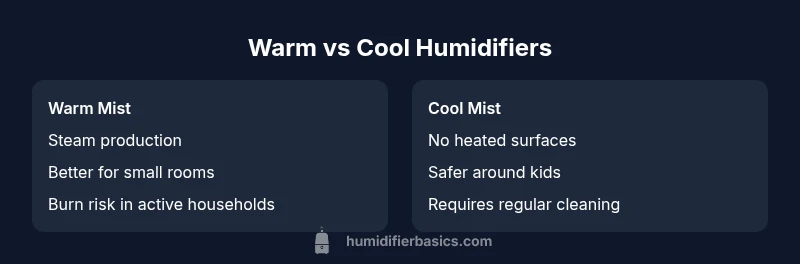
Warm mist humidifiers heat water to create steam, while cool mist units disperse cooled, atomized water. Warm models are often favored for winter comfort and odor reduction in smaller spaces, but carry burn risks around kids and pets. Cool mist units offer safer operation and broad room coverage, though they may require more frequent cleaning. In short, choose based on room size, safety priorities, and maintenance tolerance, then refine by personal preference.
when to use warm vs cool humidifier: Core Differences
According to HumidifierBasics, the core distinction between warm and cool humidifiers is how they generate humidity. Warm mist units boil water to emit steam, which can feel comforting in cold weather and may help soothe nasal passages. Cool mist models rely on evaporation or ultrasonic atomization, which generally provides cooler output and a lower perceived risk of burns. Both types aim to raise indoor humidity to an optimal range, but the path they take and the scenarios they suit differ. When deciding, weigh room size, occupant safety, cleaning effort, and energy considerations. This section will map the decision criteria to everyday environments and practical use cases, helping you answer the question: when to use warm vs cool humidifier in your home.
In practice, many households start with a primary consideration: safety for children and pets, or comfort for winter congestion. The HumidifierBasics team found that safety priorities often push families toward cool mist for shared spaces, while warm mist can offer a targeted option for bedrooms or small living areas where steam feels more soothing. The choice is rarely binary—many homes benefit from a hybrid approach that uses one type in specific rooms and another in others. By understanding the fundamental physics and the practical implications, you can tailor humidity strategies to your home’s layout and routines.
How each type affects humidity behavior and perceived comfort
- Warm mist humidifiers produce a tangible steam lift, which can feel warmer in a closed room and may help with nasal irritation during dry winter air. This can translate into a perceived reduction in dryness-related symptoms for some users.
- Cool mist humidifiers typically spread a fine mist through a fan or ultrasonic vibrations, delivering humidity more quickly over larger areas and often with quieter operation. They’re generally safer to leave running around kids and pets, especially in bedrooms and nurseries.
- In both cases, humidity levels should be monitored with a hygrometer to avoid over-humidification, which can promote mold or dust mite growth. The goal is a balanced indoor RH (relative humidity) range rather than maxing out moisture.
The practical takeaway is that the best humidifier type aligns with the occupant mix, room design, and daily routines. If you frequently have kids present or sleep in a shared space, cooling options with straightforward cleaning become highly attractive. If you’re prioritizing winter comfort and a more compact footprint, a warm mist unit in a dedicated room can be a strong fit. The ultimate decision rests on your sensitivity to heat, tolerance for cleaning, and how you manage risk in your household.
Comparison
| Feature | Warm mist humidifier | Cool mist humidifier |
|---|---|---|
| Heat source | Heated water producing steam | Atomized or evaporated water (cool mist) |
| Best for | Smaller rooms in cold climates; potential congestion relief in winter | Larger spaces; safety-focused setups; open floor plans |
| Safety considerations | Burn risk from hot surfaces or steam; supervision recommended in homes with children | Lower burn risk; generally safer around kids and pets |
| Maintenance effort | Cleaning to prevent mineral buildup and possible steam residues; careful handling required | Regular cleaning; some models require more frequent filter or wick maintenance |
| Noise level | Typically quiet at steady operation but may have hot-water boil sounds in some units | Often very quiet, especially ultrasonic models; some evaporative units have a perceptible fan noise |
| Room suitability | Best for small-to-medium rooms or bedrooms in winter | Versatile for bedrooms, living rooms, and nurseries; good for multiple rooms with one unit per space |
What's Good
- Safer around children and pets (cool-mist options)
- Faster humidity spread in larger rooms (cool-mist)
- Warm mist can feel comforting and may help with congestion in winter
- Some models self-regulate humidity through evaporation dynamics
Negatives
- Warm mist carries burn risk and requires careful supervision
- Higher energy use due to heating water
- Mineral buildup and potential odors require regular cleaning in warm units
- Cool-mist units may distribute minerals more visibly if water is hard
Cool mist is the safer, more versatile default for most homes; warm mist is advantageous in select winter-focused setups.
For households with kids or pets, cool-mist humidifiers are typically the better baseline choice. If you primarily need winter comfort or congestion relief in a single room, warm mist can be advantageous, provided you manage burn risks and cleaning discipline.
FAQ
What is the main difference between warm and cool humidifiers?
Warm humidifiers boil water to emit steam, while cool humidifiers disperse water through evaporation or ultrasonic means. Warm units can feel warmer and may aid congestion, but carry burn risk; cool units are generally safer and suitable for larger spaces, though cleaning can be more frequent due to mineral wear.
Warm humidifiers boil water to create steam, while cool humidifiers use evaporation or ultrasonic methods. Warm units feel warmer but have burn risks; cool units are safer for kids and pets and work well in larger spaces.
Which humidifier type is better for a nursery?
In a nursery, safety and legibility matter most. Cool mist humidifiers are typically preferred because they minimize burn risk. Choose a model with a reliable filter or sturdy antimicrobial features and operate under supervision when possible.
For nurseries, opt for a cool mist humidifier with easy cleaning and a sealed water tank to minimize risk.
Are warm-mist humidifiers safe around children?
Warm-mist humidifiers present a burn risk due to heated water and surfaces. If you choose this type, place the unit out of reach, use in a supervised space, and ensure stable placement and lids are secure.
They can be safe when kept away from kids and pets and used with careful placement.
Do humidifiers kill bacteria in the water?
No humidifier kills all bacteria. Heated mist can reduce some microbial content but can still propagate biofilm if not cleaned regularly. Regular cleaning and using distilled water can reduce microbial growth.
They don’t kill everything. Clean regularly and use clean water to minimize microbes.
How often should I clean a humidifier?
Clean the humidifier at least once a week during regular use and more often if you notice mineral buildup, a musty smell, or cloudy mist. Always follow the manufacturer’s cleaning instructions.
Clean weekly, and more often if you see buildup or odor.
Can I run a humidifier all night?
Yes, both types can run overnight if humidity is kept in the safe range. Use a humidity monitor to avoid over-humidification, and select a model with auto-shutoff or humidity sensing if available.
You can run it overnight, just watch humidity levels so it stays comfortable.
The Essentials
- Prioritize safety in rooms used by children or pets
- Choose cool mist for versatility and safer operation
- Use warm mist for targeted comfort in winter, with strict handling
- Monitor humidity with a hygrometer to avoid mold risk
- Maintenance consistency is key for both types