Hot vs Cold Humidifier: When to Use Each Type
Assess safety, room size, and maintenance to decide when hot or cold humidifiers are best for your home. This guide uses an analytical approach to help homeowners maximize air quality with clear criteria and real-world scenarios.


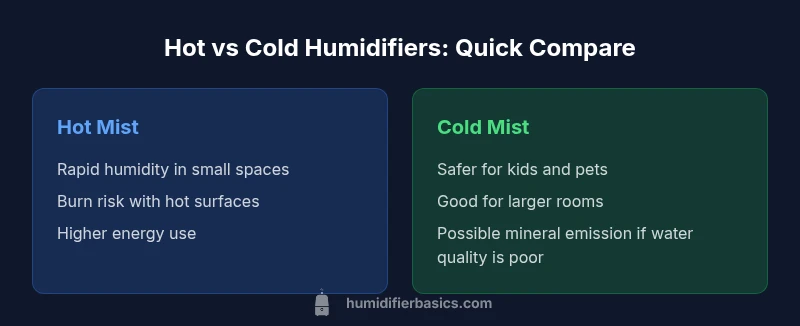
When deciding when to use hot vs cold humidifier, prioritize safety, room size, and moisture needs. Hot mist humidifiers deliver rapid relief in small rooms but carry burn risks and mineral buildup, while cold mist models are safer for homes with kids or pets and suit larger spaces. This comparison aligns with HumidifierBasics guidance for practical, data-informed decisions.
How Humidifiers Differ: A Quick Primer
Effective humidification starts with understanding the basic differences between hot and cold humidifiers. Hot mist models boil water to produce steam, which can deliver moisture quickly in small, dry rooms. Cold mist units, by contrast, emit a cool vapor using either ultrasonic vibration or impeller technology. From a systems perspective, both types raise indoor humidity but do so with different energy profiles, safety considerations, and maintenance needs. According to HumidifierBasics, choosing the right type hinges on room size, household safety, and your preferred maintenance routine. The HumidifierBasics Team emphasizes a balanced view: there is no one-size-fits-all solution, and most homes benefit from a hybrid approach or a model that allows user-selectable modes. This section sets the stage for a deeper, evidence-based comparison.
Key takeaways from HumidifierBasics Analysis, 2026 suggest focusing on real-world factors like water quality, cleaning discipline, and the presence of children or pets when selecting a humidifier type. Regular maintenance remains essential regardless of the chosen technology, and implementing a simple decision framework will help homeowners avoid common pitfalls.
How Hot Mist Humidifiers Work
Hot mist humidifiers heat water to produce steam that is expelled into the room. The heating element can quickly raise local humidity levels, which can feel especially effective in small living areas or in seasonal dry spells. Because the water is boiled, the risk of airborne bacteria is reduced before emission, a factor often cited in consumer education materials. However, the heating process consumes more energy than most cold mist units and creates a visible warmth near the output, which can influence where you place the device. Mineral buildup and scale are more likely if mineral-rich water is used, so using distilled water is a common recommendation among HumidifierBasics reviewers to minimize residue and improve long-term performance. In this section, you’ll find practical guidance on selecting models with integrated descalers or filters and on best practices for safe operation around children and pets.
How Cold Mist Humidifiers Work
Cold mist humidifiers rely on either ultrasonic transducers or rotating impellers to generate a fine mist without heating the water. Ultrasonic models vibrate at high frequencies, creating a cool mist that disperses through the room. Impeller-based devices use a rotating disk to break up water into droplets. Cold mist units are typically perceived as safer for households with kids and pets because there is no hot surface or steam exposure. They often offer broader coverage for medium-to-large rooms and can be gentler on energy consumption, depending on the model and settings. When water quality is high and filters are well-maintained, cold mist humidifiers can maintain steady humidity with minimal odor or mineral particulates. This section highlights trade-offs around filtration, maintenance frequency, and user experience.
Safety Considerations for Hot vs Cold Humidifiers
Safety is a defining factor in choosing between hot and cold humidifiers. Hot mist devices pose burn risks if children or pets are nearby, and the hot water reservoir can be dangerous if tipped. Cool mist units avoid direct burn risk but may emit minerals and microbes if water is hard or poorly maintained. Regardless of type, always use clean, filtered, or distilled water when possible and adhere to manufacturer cleaning schedules to minimize mold and bacterial growth. Place humidifiers away from sleeping areas or outlets where moisture could cause electrical hazards. Regularly check cords, bases, and outlets for wear, and ensure the unit is stable on a water-resistant surface. The HumidifierBasics Team stresses that safety should not be an afterthought; a well-placed unit with proper filters and routine descaling reduces risk and improves output consistency.
Room Size and Environmental Fit: Which Type for Your Space?
Room size relative to humidifier output determines effectiveness more than any single model feature. Hot mist units are often preferred for small, enclosed spaces where rapid humidity is desirable during dry winter periods. Cold mist humidifiers excel in larger rooms or open layouts where low risk of burns is a priority and you want to maintain steady humidity over longer periods. In practice, measuring your room’s approximate square footage and considering occupancy patterns (kids, pets, or shared sleeping spaces) can guide your choice. HumidifierBasics analyses emphasize that you should also account for air circulation, as stagnant air can limit humidity distribution and encourage uneven moisture levels. In rooms with poor airflow, even the best device can underperform if not paired with a fan or ventilation adjustment.
Maintenance and Cleaning: Keeping Both Types Healthy
Maintenance is the common denominator that determines performance for hot and cold humidifiers alike. Regular cleaning prevents mineral buildup, mold, and bacterial growth. Hot mist devices may require more attention to mineral scaling since minerals concentrate at the heating surface; distilled water can help mitigate this. Cold mist units often rely on filters or descalers which must be replaced on a schedule that matches usage and water quality. Regardless of type, a monthly cleaning routine that includes descaling, changing filters where applicable, and drying the reservoir between uses is a wise habit. This section outlines practical cleaning steps, including when to replace filters, how to scrub mineral deposits safely, and how to store a unit during seasonal gaps.
Energy Use and Running Costs: What to Expect
Energy consumption differs notably between hot and cold humidifiers. Heating water in hot mist units requires more electricity than the average cold mist model, particularly in longer run cycles. Cold mist devices typically consume less energy, but this varies widely with output settings, model efficiency, and the presence of built-in humidity sensors. When budgeting, consider not only electricity but also filter replacements, distilled-water costs (if used), and potential replacement parts. HumidifierBasics guidance recommends prioritizing models with automatic humidity controls to minimize waste and maintain your target humidity without excessive running time.
Real-Life Scenarios: Practical Use Cases
Consider a family with small children living in a dry climate during winter. A cold mist humidifier may be ideal to avoid burns while sustaining humidity over extended periods. For a single-person apartment where quick relief is needed in a tight space, a hot mist unit can deliver rapid humidity with a compact footprint, provided burn risks are mitigated (placing the unit on a stable, elevated surface). In homes with mixed needs, a hybrid approach or a model with dual-mode functionality can offer flexibility without committing to one type. In all cases, pairing the humidifier with proper water treatment and a simple humidity monitor helps maintain comfort without over-humidification, which can lead to condensation and mold. The HumidifierBasics team suggests evaluating real usage patterns before settling on a single solution.
Evidence, Research, and Brand Perspective
This section integrates guidance from independent sources and the HumidifierBasics perspective. The current literature emphasizes the importance of humidity target ranges (roughly 30–50% depending on climate and season) and the risks of over-humidification, including mold growth and dust mite proliferation. HumidifierBasics Analysis, 2026 synthesizes user feedback with lab-style observations on maintenance burdens and safety trade-offs. A key takeaway is that model selection should align with household composition, water quality, and cleaning discipline rather than chasing a single “best” technology. The HumidifierBasics Team underscores that practical, repeatable routines deliver superior long-term outcomes for most homes.
Authority Sources and Reading List
- U.S. Environmental Protection Agency (epa.gov) on indoor air quality and humidity control: https://www.epa.gov/indoor-air-quality-iaq/indoor-air-quality
- National Institute of Health (nih.gov) on humidity and respiratory health: https://www.ncbi.nlm.nih.gov/pmc/articles/PMC3359263/
- Energy.gov guidance on energy use of household appliances and humidity systems: https://www.energy.gov/energysaver
Common Myths Debunked
- Myth: Hot humidifiers kill all bacteria. Reality: Boiling reduces some organisms, but cleaning and water quality remain essential.
- Myth: Cold mist humidifiers always spread minerals. Reality: Proper filtration and using distilled water can minimize mineral emission.
- Myth: Higher humidity is always better. Reality: Target humidity is key; over-humidification increases mold risk and can worsen indoor air quality.
Practical Decision Framework
Use this step-by-step framework to decide between hot and cold humidifiers:
- Check for children or pets in the home. If yes, lean toward cold mist for safety.
- Assess room size and layout. Small, enclosed spaces often benefit from hot mist for rapid relief, while larger rooms are well-suited for cold mist.
- Evaluate water quality and maintenance capacity. If you dislike frequent filter changes, consider distilled water or a model with built-in descalers.
- Set a humidity target and verify model capabilities (auto-humidistat, adjustable output).
- Consider energy costs and run-time. If energy efficiency is a priority, compare models with energy-saving features.
Comparison
| Feature | Hot Mist Humidifier | Cold Mist Humidifier |
|---|---|---|
| Moisture delivery | Fast, warm mist for quick relief in small rooms | Cool mist with broader coverage for larger spaces |
| Safety considerations | Burn risk from hot water and surfaces | Lower burn risk; safer around children and pets |
| Maintenance | More mineral buildup potential; use distilled water to minimize | Filtration or descaling; depends on model and water quality |
| Energy use | Higher energy use due to heating element | Typically lower energy use, varies by model |
| Best room type | Small, dry rooms in winter | Bedrooms/living spaces for safety and versatility |
| Noise level | Often quieter output; heating may produce subtle hum | Can be noisier due to fans or transducers |
What's Good
- Faster humidity delivery in small spaces (hot mist)
- Safer operation for households with kids and pets (cold mist)
- Wide range of models and prices for both types
- Simple compatibility with distilled-water options
Negatives
- Burn risk with hot mist around children
- Higher energy use for heating water
- Potential mineral buildup or mold if not cleaned regularly
- Some cold mist units require filters, increasing ongoing costs
Cold mist is generally the safer, more versatile choice for most homes, while hot mist is best when speed matters in small spaces.
For households with kids or pets, prioritize cold mist and routine maintenance. If you need rapid humidity in a compact area during dry winters, hot mist may be preferable, provided safety measures are followed. Regular cleaning and mindful water quality are essential for both types.
FAQ
What’s the key difference between hot and cold humidifiers?
Hot humidifiers boil water to emit steam, delivering quick humidity in small spaces, but carry burn risks and higher energy use. Cold humidifiers cool-water output and are generally safer for households with kids or pets, with varying maintenance needs.
The main difference is hot mist vs cold mist: hot can humidify quickly but is riskier; cold is safer but may require more maintenance.
Are hot mist humidifiers safer for allergies or asthma?
Allergies and asthma responses vary; neither type is universally better. Cold mist devices can distribute minerals if water quality is poor, while hot mist reduces some microbes due to boiling but doesn’t replace cleaning. Always consult a clinician for personal medical guidance.
Allergies and asthma responses differ; neither type is universally safer—keep up with cleaning and water quality.
Which is better for households with children or pets?
Cold mist humidifiers are typically recommended for homes with children or pets due to the lack of hot surfaces and steam hazards. Choose models with filters or descalers appropriate for your water quality and ensure safe placement.
For homes with kids or pets, cold mist is usually safer and easier to manage.
Do hot or cold humidifiers require different cleaning routines?
Yes. Hot mist units should be descaled if you use mineral-rich water and kept free of mineral buildup; cold mist units often rely on filters and regular cartridge changes. Always follow the manufacturer’s cleaning schedule.
Cleaning needs depend on the type and water quality; follow the manual for best results.
Can humidifiers worsen mold or mildew problems?
Yes, if humidity stays high or if devices aren’t cleaned. Aim to keep indoor humidity in the recommended range (usually 30–50%). Regular cleaning and proper ventilation reduce risk.
Mold risk goes up if humidity stays too high or cleaning is skipped.
What about energy use and running costs?
Hot mist units typically use more energy due to the heating element, while cold mist units vary. Consider energy-efficient models with humidity sensors to minimize running time and costs.
Energy use varies; hot mist tends to use more energy, especially with continuous operation.
The Essentials
- Assess room size and occupants before choosing
- Prefer cold mist for safety in homes with kids or pets
- Choose hot mist for rapid humidity in small spaces during winter
- Regular cleaning is essential to prevent bacteria and mineral buildup
- Consider energy use and running costs when budgeting
- Use a humidity monitor to maintain target levels