What's Best: Humidifier or Purifier? A Practical Guide
Explore what's best: humidifier or purifier. This analytical comparison covers when to humidify, when to purify, and how to pair devices for balanced indoor air quality in any home.


In most homes, the best solution is not a single device but a targeted approach: humidifiers address dry air, while purifiers reduce airborne pollutants. The optimal choice depends on climate and air quality data; start with the device that solves your most urgent problem and consider a hybrid or paired setup for balanced results. This comparison helps you decide which path to take.
The Core Difference: Humidifier vs Purifier
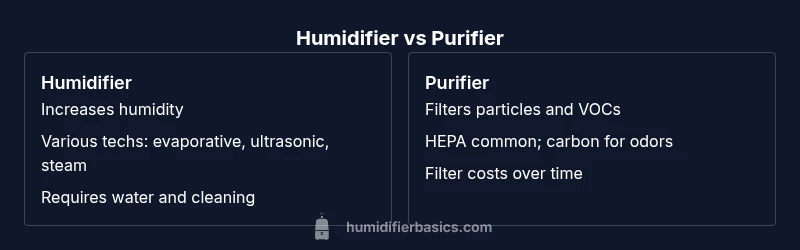
If you're asking what's best humidifier or purifier, the quick answer is that they address different problems in indoor air. A humidifier adds moisture to dry air, which can reduce nosebleeds, dry skin, and irritation. A purifier removes airborne particles and some VOCs, improving allergies and overall air cleanliness. According to HumidifierBasics, understanding these distinct roles is essential before you buy. In most homes, the right choice depends on your climate and air quality data rather than personal preference alone. The HumidifierBasics team emphasizes that humidity control and filtration are both important parts of a healthy indoor environment. This article compares the two devices, highlights when to choose one over the other, and explains how to combine them effectively for balanced air quality.
When to humidify vs when to purify
Humidity and air cleanliness address different problems, but both matter for comfort and health. Use a humidifier when indoor air feels dry—especially in winter, in heated homes, or in arid climates. Dry air can irritate eyes, skin, and nasal passages, and it can worsen respiratory symptoms. A purifier is preferable when residents suffer from allergies or when the space contains smoke, pet dander, pollen, or strong odors. The goal is to reduce irritants while maintaining comfortable humidity levels. Humidifiers and purifiers each contribute to a healthier home, but relying on one device to solve everything often leads to suboptimal results. A practical approach is to identify the dominant problem first and address it with a purpose-built device.
How to measure your indoor air health
Effective decision making starts with data. Use a reliable hygrometer to track relative humidity (RH); ideal indoor RH sits around 30–50%. For air quality, an inexpensive AQ sensor or a smart air monitor can reveal PM2.5 and VOC levels. Baseline measurements help you set realistic targets and avoid overcorrecting. If RH drifts above 60%, you may need to vent or dehumidify rather than purify. If PM2.5 spikes, a purifier with a true HEPA filter is a strong initial step. HumidifierBasics data shows that most homes benefit from measuring both humidity and indoor air quality before purchasing, so you choose the right device from the start.
Humidifier types: evaporative, ultrasonic, warm-mist
Humidifiers come in several technologies, each with trade-offs. Evaporative units use a wetted wick and a fan to add moisture and naturally limit over-humidification. Ultrasonic models spray a fine mist, which can be quiet and efficient but may release mineral dust if you use hard water; using distilled water mitigates this issue. Warm-mist (steam) humidifiers boil water to release sterile steam, which can feel comforting in very dry rooms but uses more energy and requires careful cleaning to prevent mineral buildup. Safety notes include avoiding source water contamination and keeping units away from carpets or fabrics that could wick moisture.
Purifier types: HEPA, activated carbon, ionizers
Purifiers remove contaminants from the air using different technologies. True HEPA filters capture at least 99.97% of particles as small as 0.3 microns and are a strong baseline for allergen reduction. Activated carbon filters help absorb odors and some VOCs, particularly from cooking and cleaning products. Some purifiers include ionizers or photocatalytic oxidation, but these options can produce ozone or require careful model selection. When choosing a purifier, prioritize a true HEPA filter, verified CADR (clean air delivery rate) appropriate for your room size, and easy filter replacement. The goal is to reduce irritants without introducing new risks.
Hybrid devices and paired setups
If your climate or health needs are mixed, a hybrid device or paired setup may offer the best balance. Hybrid units combine humidity control with filtration and can be space-efficient for apartments or small homes. For larger spaces, consider placing a purifier in primary living zones and a humidifier in rooms where humidity is consistently low. Budget considerations include upfront costs and ongoing filter replacements. For many households, a staged approach—starting with one device and expanding to a second—delivers the most practical, data-driven result.
Comparison
| Feature | Humidifier | Purifier |
|---|---|---|
| Primary Function | Add moisture to the air | Remove contaminants from the air |
| Typical Room Coverage | Small-m to mid-size rooms (roughly 150–400 sq ft) | Medium to large rooms (roughly 300–600 sq ft) or whole areas with multiple units |
| Key Technologies | Water-based humidification: evaporative, ultrasonic, or steam | Filtration (HEPA), adsorption (carbon), and sometimes ionization |
| Maintenance Frequency | Refill water daily, clean weekly; replace filters per spec | Replace filters every 6–12 months; periodic cleaning |
| Noise Level | Low to moderate depending on model and mode | Low to moderate; higher fan speed may increase noise |
| Energy Use | Moderate, varies with water output and speed | Low to moderate, influenced by fan and filtration load |
| Best For | Dry air relief and comfort | Air cleanliness and allergen reduction |
| Limitations | Can over-humidify if misused; mineral dust with hard water | Requires regular filter maintenance; some models emit ozone |
What's Good
- Addresses a specific indoor air need effectively
- Widely available and easy to source replacements
- Simple operation and maintenance at modest cost
- Can be added in stages across different rooms
Negatives
- Only addresses humidity or cleanliness, not both at once
- Ongoing filter and maintenance costs can add up
- Overuse or wrong placement can cause moisture issues or air residue
- Some purifiers may emit small amounts of ozone (in rare models)
Balanced approach wins: use a purifier for air quality and a humidifier for humidity; consider a hybrid or paired setup when possible.
For most homes, a purifier helps with allergens and odors, while a humidifier tackles dry air. A single device rarely covers both perfectly; plan a staged or hybrid solution based on climate and air quality data.
FAQ
Can I use a humidifier and purifier at the same time?
Yes. The two devices address different issues and can be used jointly. Make sure to maintain appropriate humidity and ensure filters are changed as recommended, and avoid over-humidifying the space.
Yes, you can use both at once. They tackle different needs and should be maintained accordingly.
Which is better for allergies: humidifier or purifier?
Purifiers are generally more effective for allergy relief because they reduce airborne pollen and dust. Humidifiers help symptoms when air is dry but won’t remove allergens. Consider a purifier first, then add humidity if needed.
Purifiers usually help allergies more by filtering particles.
Do humidifiers spread bacteria?
If not cleaned regularly, humidifiers can harbor bacteria and mold. Use distilled water when possible, clean parts weekly, and replace filters as recommended to minimize risk.
Regular cleaning prevents bacteria growth in humidifiers.
What should I look for in a room-size humidifier?
Look for an appropriate output for your room size (check coverage in square feet), ease of cleaning, self-cleansing features, and a hygrometer to monitor humidity. Quiet operation and non-ozone-emitting models are ideal.
Check room size, cleaning ease, and noise when picking a humidifier.
Do purifiers remove odors and chemicals?
Many purifiers with activated carbon filter odors and some VOCs, but effectiveness varies by model. HEPA handles particulates; carbon handles odors. For strong smells, consider ventilation plus filtration.
Carbon filters help with smells; HEPA handles particles.
Are there health risks with humidifiers?
Risks include mold growth from standing water and mineral dust from hard water. Regular cleaning and using distilled water mitigate these issues. Avoid over-humidifying to prevent mold growth.
Keep it clean and monitor humidity to stay safe.
The Essentials
- Define your primary goal first (humidity vs cleanliness)
- Measure your environment before buying
- Consider a hybrid or paired setup if budget allows
- Choose devices with washable filters and low ozone risk
- Regular maintenance preserves performance and safety