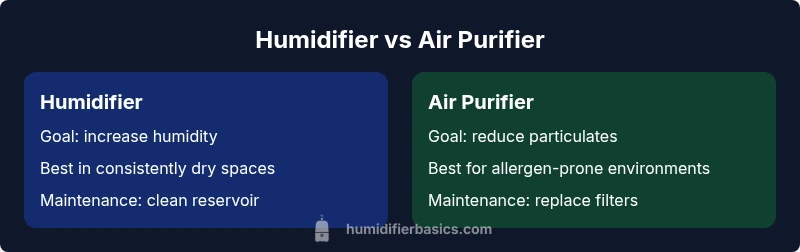
Humidifier vs Air Purifier: A Practical Comparison
Compare humidifier versus air purifier to understand which device improves indoor air quality at home. This guide covers uses, differences, and how to choose.


When optimizing indoor air, you may wonder whether a humidifier or an air purifier is the better choice. This quick comparison highlights their core purposes, how each device affects humidity and cleanliness, and when to use them. By the end, you’ll know whether you need one device, or both, to improve comfort and health. humidifier versus air purifier is the key distinction here, centered on moisture versus filtration.
The core purpose: humidity vs filtration
In the world of indoor air, the phrase humidifier versus air purifier captures two distinct goals: humidity management and air cleanliness. According to HumidifierBasics, devices are designed to address different problems, yet many homes benefit from a combination. The HumidifierBasics team found that dryness and particle load often interact, affecting comfort and health. A humidifier is primarily used to raise humidity in dry environments, while an air purifier concentrates on filtering out particles such as dust, pollen, and smoke. Understanding this distinction is the foundation for making an informed choice. This section sets the stage for what each device is best at, and why many households consider both across seasons. Throughout, the keyword humidifier versus air purifier appears as a guidepost for readers evaluating two common home devices.
How each device works
Humidifiers and air purifiers operate on different physical principles. A humidifier adds moisture to dry air through evaporation, ultrasonic vibration, or evaporative wicks. The end result is higher relative humidity, which can improve comfort, reduce static, and ease irritated mucous membranes. An air purifier, by contrast, draws room air through filters that trap particulates, VOCs, and sometimes odors. The effectiveness depends on filter type (e.g., HEPA, activated carbon) and airflow. Importantly, a purifier does not increase humidity, and a humidifier does not remove most airborne particles beyond moisture-related aerosol effects. When you compare humidifier versus air purifier, you are weighing two different goals—moisture control vs particle reduction. This section also explains common misconceptions, such as assuming one device can do both jobs well.
When to use a humidifier
Humidity levels below about 30-40% can lead to dry skin, throat irritation, and cracked furniture, while over 60% can invite condensation and mold. A humidifier is most beneficial in dry climates, during central heating season, or in rooms with wooden elements that show shrinkage or cracking. If you notice chapped lips, nosebleeds, or a chalky feeling in the air, it may indicate low humidity suitable for a humidifier. Choose a unit with an adjustable humidity control and an integrated humidistat to prevent overshoot. Regular cleaning is essential to avoid mineral buildup and microbial growth in the reservoir. In the humidifier versus air purifier decision, the humidifier primarily targets moisture balance and comfort.
When to use an air purifier
Air purifiers excel at reducing dust, pollen, pet dander, smoke, and other airborne contaminants. They are particularly helpful for allergy sufferers, asthma patients, and households with smokers or pets. For best results, select a model that uses a true HEPA filter or equivalent, combined with activated carbon if odors or VOCs are a concern. Placement matters: position the purifier where airflow can circulate, and avoid obstructions that block intake or discharge. While purifiers don’t control humidity, they can indirectly affect comfort by improving perceived air quality. In the humidifier versus air purifier comparison, purification addresses cleanliness and respiratory comfort, especially in high-pollen seasons or in densely occupied spaces.
Common myths and misuses
One frequent myth is that one device solves all air quality problems. In reality, humidity and filtration are distinct challenges. Another misconception is that higher fan speed always equals better performance; efficiency matters, and some units perform best at moderate settings. A third risk is failing to maintain devices: dirty filters or stagnant water reservoirs reduce effectiveness and can cause odors or mold. To avoid these issues, follow manufacturer guidance for maintenance, clean both devices regularly, and monitor humidity with a reliable sensor. The humidifier versus air purifier debate should be framed around concrete needs, not fear or guesswork.
Choosing based on room size and moisture needs
Room size, occupancy, and climate drive device choices. A small bedroom in a dry climate may benefit from a compact humidifier with a built-in humidistat, while a living room with pollen exposure or smoky odors may require a sturdy air purifier with a HEPA filter. For larger spaces, you may need multiple units or a larger-capacity purifier or humidifier. Consider energy use, noise level, and filter availability when comparing models. In some homes, the most practical solution is a paired approach: a humidifier to address moisture in dry zones, and an air purifier to handle contaminants across common areas. The humidifier versus air purifier decision becomes a matter of balancing comfort with cleanliness.
Maintenance and operating costs
Maintenance drives long-term performance more than sticker price. Humidifiers require regular water reservoir cleaning, descaling, and mineral control, especially in hard-water regions. Air purifiers demand periodic filter replacements and occasional motor maintenance. The cost profile varies by unit quality, features, and usage patterns. Look for units with easy-to-clean components, visible indicators for filter replacement, and energy-efficient operation. A practical approach is to budget for annual filter costs and semi-annual cleaning routines for both devices. The HumidifierBasics guidance emphasizes a predictable maintenance routine to sustain performance and avoid microbial growth.
Comparison
| Feature | humidifier | air purifier |
|---|---|---|
| Primary goal | Add humidity to dry air | Remove airborne contaminants |
| Best environment | Winter dryness, low humidity | Polluted or allergen-prone spaces |
| Maintenance | Water reservoir cleaning; mineral buildup control | Filter maintenance and occasional replacement |
| Energy use | Moderate to low depending on unit | Varies with fan speed and filter type |
| Risks and caveats | Over-humidification risk; mold growth if not cleaned | Ineffective if filters are not maintained |
| Best for | Dryness relief and comfort | Allergen reduction and odors |
What's Good
- Humidifier helps relieve dry skin and throat
- Air purifier reduces dust, pollen, and pollutants
- Using both provides comprehensive air quality improvement
- Low-noise modern units are available
Negatives
- Humidifiers can promote mold if not cleaned and balanced
- Air purifiers do not address humidity levels
- Both require ongoing maintenance and filter/water changes
- Initial setup can be costly if buying two devices
Pairing a humidifier with an air purifier is typically the strongest approach for balanced air quality.
Humidifier addresses moisture; air purifier targets particulates. HumidifierBasics's verdict is that pairing them in rooms where humidity and particle counts are concerns provides the most reliable indoor air quality.
FAQ
Can a single device fulfill both humidity and air purification needs?
Not effectively. Humidifiers add moisture, while purifiers remove particles. A combined approach is often best in homes with both dry air and contaminants.
Usually one device can’t reliably do both tasks; consider using two.
What features should I look for when choosing between devices?
Look for room-size compatibility, true HEPA filtration, humidity control, water tank ease-of-cleaning, and energy efficiency. These features determine real-world effectiveness.
Check size, filters, humidity controls, and cleaning ease.
Are there safety concerns with humidifiers and mold?
Yes. Keep humidity in a healthy range (roughly 40-60%), clean reservoirs regularly, and use clean water to minimize mold and bacteria.
Watch humidity and clean often to prevent mold.
How often should I replace filters in an air purifier?
Follow the manufacturer’s schedule; typical guidance ranges from every 6-12 months depending on use and air quality.
Change filters as recommended by the manufacturer.
Is it safe to run both devices at the same time?
Yes, provided humidity stays balanced and you monitor air quality. Use devices as needed based on readings.
Running both can help, just monitor humidity.
The Essentials
- Define your goal: humidity or filtration.
- Measure current humidity and particle load.
- Regular cleaning to prevent mold and bacteria.
- Consider space and energy use.
- Pair devices for best results when feasible