Difference Between Humidifier and Purifier: A Practical Comparison
Explore the difference humidifier and purifier, how each works, and how to choose the right device for humidity or air-quality needs in your home.


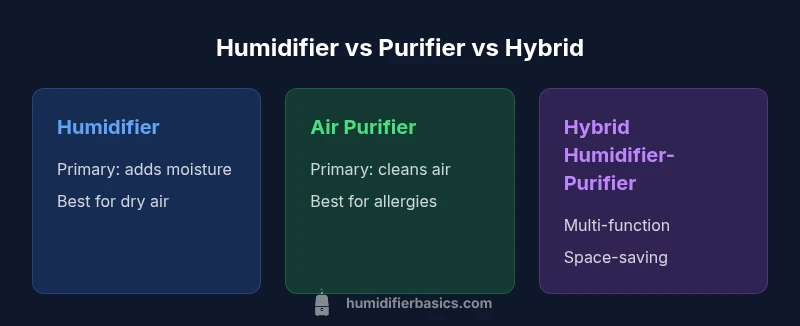
According to HumidifierBasics, the difference humidifier and purifier comes down to goal: humidity vs air cleanliness. A humidifier adds moisture to dry air to improve comfort and reduce static. An air purifier removes particulates and gases to improve indoor air quality. Some models combine both functions, but most homes benefit from addressing the primary concern first.
What are humidifiers and purifiers? Understanding the difference humidifier and purifier
At first glance, a humidifier and a purifier perform opposite jobs in your home. A humidifier adds moisture to dry air, while a purifier removes particles and pollutants to improve air quality. The phrase difference humidifier and purifier captures this contrast, helping homeowners decide which device to buy for a given problem. According to HumidifierBasics, identifying your primary goal—humidity vs. clean air—guides every purchase and setup decision. In practice, you’ll often see devices marketed as “hybrid” solutions that attempt to do both; these can be convenient but may not excel at either function in every space. Before shopping, map out your main concern and the room where you’ll use the device. If your climate or season produces dry air, humidity improvement is usually the priority; if you notice dust, odors, or allergy symptoms, air cleaning takes precedence. This quick framing sets the stage for a deeper look at how each device works, what to expect in real-world performance, and how to choose based on room size, maintenance, and budget.
How humidifiers work: mechanisms and technology
Humidifiers introduce moisture into indoor air through different mechanisms. Evaporative models rely on a wick or filter that wicks water into a gentle airflow; ultrasonic units vibrate water to create a fine mist; warm-mist humidifiers boil water to release steam. Each method has trade-offs: evaporative units tend to be self-regulating, ultrasonic units are quiet but may disperse minerals if water isn’t clean, and warm-mist units add warmth but require careful handling near children or pets. Regardless of mechanism, most humidifiers share common maintenance needs: regular water refills, mineral buildup management, and periodic cleaning to prevent bacterial growth. The HumidifierBasics team stresses that choosing the right type depends on your priorities—quiet operation, energy use, and how you plan to clean and maintain the device. In homes with low humidity, a humidifier can raise relative humidity to a more comfortable range, reducing dry skin, nasal irritation, and static. Use a simple hygrometer to monitor humidity and avoid over-humidification, which can create condensation and mold risk.
How purifiers work: filtration and purification methods
Purifiers remove pollutants rather than adding moisture. Most household purifiers use filters—HEPA filters capture particles, activated carbon adsorb gases, and some models include pre-filters or UV-C light as supplemental steps. The effectiveness of a purifier is often described by CADR (clean air delivery rate) and the recommended room size; higher CADR means faster filtration for a given space. Maintenance involves regular filter replacements and periodic cleaning of the unit; neglecting filters can reduce performance and even introduce contaminants back into the air. The best purifiers address common indoor pollutants like dust, pollen, pet dander, smoke, and odors. For allergy-prone households, a true HEPA purifier with sealed filters is typically preferred. As with humidifiers, the best results come from matching the purifier’s capacity to the room and using it consistently during times of high activity, poor outdoor air quality, or seasonal allergies. HumidifierBasics notes that air cleaning is usually the priority where there is visible dust, coughing, or stuffy noses. Remember that purifiers do not add humidity, so you often need a separate solution if humidity is low in your space.
When to use a humidifier vs a purifier: scenarios and decision criteria
In rooms where the air feels dry—especially during heating seasons—a humidifier is often the first line of defense. Dry skin, irritated nasal passages, and cracked lips are common signals. In spaces with dust, odors, smoke, or seasonal allergies, a purifier becomes more important. The difference humidifier and purifier becomes especially clear when considering the root cause: moisture balance versus contaminant removal. If you live in a desert climate or the heating system runs constantly, you may prioritize humidity. If someone in the household experiences asthma or allergic rhinitis, you’ll likely focus on filtration. In some homes, both issues appear together; in those cases, consider a two-device approach or a hybrid device that includes both functions. The HumidifierBasics methodology emphasizes testing conditions: measure humidity with a hygrometer, assess sources of indoor pollutants, and plan for maintenance costs over time. Start with one device, observe the impact for two to four weeks, and adjust as needed.
Hybrid devices: when a combo makes sense
Hybrid devices combine humidity control and air purification in a single unit. They can be appealing for space-constrained homes or apartments, offering a simpler setup and fewer cords. However, hybrids may compromise on the depth of performance in each function compared with dedicated devices. If your primary concern is humidity and you also want some filtration, a reliable humidifier with a built-in filtration add-on can be a good compromise. Conversely, if air quality is the leading issue, a standalone purifier with optional humidification feature can provide a more robust solution. Budget, noise tolerance, and maintenance willingness are key when evaluating hybrids. In practice, many users find success by pairing a dedicated purifier in living areas with a compact humidifier in bedrooms or nurseries. The HumidifierBasics perspective is to balance convenience with effectiveness; never sacrifice core performance for the sake of a single-device highlight.
Maintenance, safety, and common pitfalls
All devices require routine upkeep to prevent problems like bacterial growth or mineral dust. For humidifiers, use clean water (preferably distilled) and empty the tank daily; perform a thorough cleaning weekly and replace filters as recommended by the manufacturer. Purifiers demand seal integrity and timely filter replacements; check for air leaks and ensure the filter is properly seated. A common pitfall is running a humidifier in humid environments without humidity controls, which can lead to mold growth; another is running a purifier with a dirty filter that disperses contaminants. A practical safety practice is to place devices off the floor, away from walls, and out of reach of children. HumidifierBasics emphasizes following the user manual and using a hygrometer to keep humidity in a safe range, typically around 40-60% in most homes; this range also reduces the risk of mold and dust mite proliferation. Regular professional cleaning is rarely necessary, but annual checks help confirm safe operation.
Choosing the right device for your space: size, noise, energy, cost
Selecting between a humidifier and a purifier begins with room size and usage patterns. For small bedrooms, a compact humidifier can alleviate overnight dryness with minimal noise. Living spaces with pets or heavy dust may benefit from a purifier with a sizable filter and quiet operation. Consider noise levels at your typical night or work times, as some devices run very quietly while others introduce noticeable hum or fan sounds. Energy consumption tends to scale with motor speed and fan operation, so estimate ongoing costs by comparing running hours and setting usage. Water type matters for humidifiers; distilled or demineralized water reduces mineral dust and maintenance. For long-term value, calculate the total cost of ownership, including filters over time for purifiers and potential energy savings from efficient humidifiers. In the end, the choice should align with your primary goal, your tolerance for maintenance, and the space constraints of your home.
Practical usage examples: nursery, living room, bedrooms
A nursery needs stable humidity to reduce respiratory irritation for infants; a purifier can help minimize airborne allergens in a child's room. In living rooms, a purifier with a larger CADR and a humidifier option can help with both cleanliness and comfort, especially in dry climates. In bedrooms, prioritizing quiet operation and reliable humidity control supports better sleep. When pets are present, consider a purifier designed to handle pet dander; if humidity fluctuates due to weather, a dedicated humidifier with a simple control helps stabilize the air. The HumidifierBasics guidance is to place units away from direct sunlight and away from heat sources, rotate units between rooms to distribute air treatment evenly, and use a room thermometer and hygrometer to tailor operation. By tailoring device placement and operation to real-life routines, you maximize benefits with minimal daily effort.
Budget considerations and long-term value
Upfront costs vary: humidifiers are generally affordable entries, while purifiers with advanced filtration or larger rooms command higher prices. But total cost of ownership includes filter replacements, energy use, and maintenance supplies. For households with persistent allergies or smoke exposure, investing in a high-quality purifier may offer longer-term savings by reducing medical symptoms and improving comfort. Hybrid devices fall in between, offering convenience at a higher upfront price. HumidifierBasics recommends evaluating both immediate needs and long-term costs, and to monitor performance with simple metrics like humidity levels and air quality readings. When price is a driver, start with a single device focused on your top priority and expand only if needed. Maintaining a mindful approach to maintenance and usage often yields the best balance of cost and benefit.
Environmental considerations: humidity, mold risk, and ventilation
Humidity levels influence mold and dust mite growth; too much moisture can be as risky as too little. Humans usually feel comfortable in a humidity range of roughly 40-60%, depending on climate and personal sensitivity. A humidifier helps reach that target, but without proper ventilation and regular cleaning, it can create damp spots that encourage mold. Purifiers reduce airborne contaminants and odors but do not address humidity directly. When combined, they should be used with appropriate monitoring to prevent over-correcting room conditions. Practical monitoring tools include simple hygrometers and air quality monitors that measure PM2.5 and CO2 levels. The HumidifierBasics guidance emphasizes a holistic approach: manage humidity, limit moisture sources, ventilate when outdoors are safe, and maintain devices regularly to optimize indoor air quality.
Practical implementation checklist
- Determine primary goal: humidity or air purification.
- Measure room size and choose device accordingly.
- Consider a separate purifier in high-traffic areas if allergies are a concern.
- Use distilled water for humidifiers to reduce mineral residue.
- Install and run devices with humidity/air-quality monitoring.
- Schedule regular maintenance and filter replacements.
- Keep devices away from walls and heat sources; ensure adequate ventilation.
- Reassess the setup after 2-4 weeks and adjust.
Feature Comparison
| Feature | Humidifier | Air Purifier | Hybrid Humidifier-Purifier |
|---|---|---|---|
| Primary function | Add moisture to air | Clean air by removing contaminants | Combine both moisture and purification |
| Core technology | Water mist generation (evaporative/ultrasonic/warm-mist) | Filtration (HEPA/activated carbon) and sometimes UV | Dual-stage: humidification plus filtration |
| Ideal room outcomes | Improve humidity and comfort | Reduce airborne contaminants for cleaner air | Improve humidity and air quality simultaneously |
| Room size suitability | Best for small to medium rooms | Effective across a range; larger spaces with strong CADR | Versatile for many room sizes depending on model |
| Maintenance | Refill water, mineral deposits management | Filter replacements and periodic cleaning | Water refill plus filter maintenance; annual service |
| Noise level | Typically quiet at low settings | Can be noticeable at higher CADR | Depends on mode; designed to balance noise and performance |
| Cost considerations | Low to moderate upfront; water cost adds little | Filter costs over time; energy use varies | Higher upfront for integrated features; ongoing filter costs |
| Best for | Comfortable humidity, prevention of dry air symptoms | People seeking cleaner air or allergies, odors | People needing both humidity control and air purification |
What's Good
- Improved comfort in dry environments
- Ability to support respiratory comfort and skin health
- Hybrid devices save space and simplify setup
- Provides a clear decision framework when prioritizing needs
- Promotes proactive air quality management
Negatives
- Purifiers require ongoing filter replacements
- Humidifiers can promote mold if not cleaned properly in damp spaces
- Hybrid devices may have higher upfront costs and complex maintenance
- Could underperform if not sized correctly for the room
Prioritize based on your primary goal: humidity or air cleanliness; most homes benefit from a dedicated device for the main issue and a secondary device if needed.
If humidity is the main problem, start with a humidifier. If air quality is the priority, start with a purifier. For complementary needs, consider a hybrid or pairing two dedicated devices and maintain them diligently to maximize comfort and health.
FAQ
What is the primary difference between a humidifier and a purifier?
The main difference is function: a humidifier adds moisture to air, while a purifier removes contaminants. Humidifiers address dryness and comfort; purifiers target air cleanliness and allergy relief. Some models blend both capabilities, but they often trade off performance in each role.
Humidifiers add moisture to air; purifiers remove contaminants. Some models mix both features, but you usually choose based on whether you need humidity or clean air.
Can I use both devices at the same time?
Yes. Using a humidifier and a purifier in different rooms or in the same space can address both dryness and air quality. For best results, monitor humidity and air quality and adjust settings to avoid over-humidifying or under-filtering.
Absolutely. You can use both, especially in spaces with dry air and pollutants; just monitor to keep things in balance.
Do humidifiers help with allergies?
Humidifiers improve comfort in dry air but do not remove airborne allergens. Purifiers are more effective for allergy relief since they filter dust, pollen, and dander. In allergy-prone homes, prioritize filtration and consider humidity control to prevent dust mite issues.
Humidifiers help with dryness, but purifiers are better for allergies. You may need both in some homes.
What features should I look for in a purifier?
Look for true HEPA filtration, sealed filter compartments, appropriate CADR for your room, and simple maintenance schedules. Additional filters for gases (activated carbon) help with odors, while UV options are optional. Ensure the unit fits your room size and noise tolerance.
Choose HEPA, sealed filters, and a size that matches your space; consider gas filters for odors.
How do I choose the right size device for my room?
Start with the room’s square footage and ceiling height, then match to the device’s recommended room size rating. If in doubt, choose a unit slightly larger to ensure adequate performance, and adjust based on humidity and air quality readings.
Measure the room and pick a device rated for that size, then monitor performance.
Are there safety concerns with humidifiers?
Safety concerns include mold growth from standing water, mineral dust if using hard water, and hot-water burns with warm-mist units. Use distilled water, empty tanks daily, clean regularly, and keep devices out of reach of children.
Humidifiers can be safe with regular cleaning and using distilled water.
The Essentials
- Define your priority: humidity vs. air purification
- Match device capacity to room size and usage
- Budget for ongoing maintenance (filters, cleaning)
- Consider hybrids only if space is limited and both functions are needed
- Regularly monitor humidity and air quality for best results