Warm Humidifier vs Cool: A Practical Guide for Homes
A detailed, evidence-based comparison of warm humidifiers and cool humidifiers. Learn how each type works, maintenance needs, safety considerations, and which is best for different homes and scenarios.


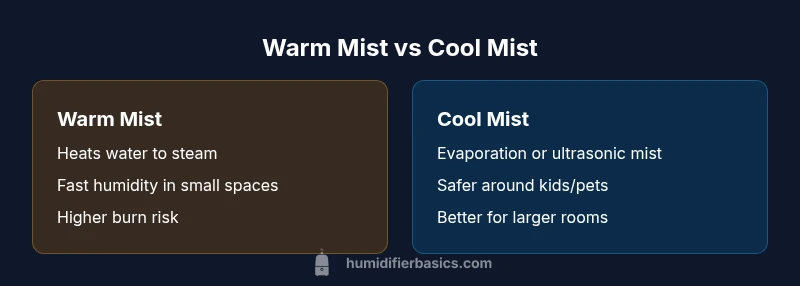
Warm humidifier vs cool humidifier comparison boils down to safety, room size, and maintenance. Warm mist heats water to produce steam, delivering humidity quickly in small spaces but with burn risk. Cool mist uses evaporation or ultrasonic tech for a cooler output, generally safer around kids and pets and adaptable to larger rooms.
Core differences at a glance
When weighing warm humidifier vs cool, you should look beyond the surface features to how each mode delivers humidity, safety, and maintenance. The HumidifierBasics lens emphasizes practical considerations: room size, user safety, water quality, and long-term running costs. This overview sets the foundation for a deeper dive into the two categories and helps homeowners and renters decide which path aligns with their living situation and priorities. According to HumidifierBasics, the choice often comes down to balancing rapid humidity delivery with safety concerns and ongoing care. By the end of this article, you’ll have a clear, evidence-based framework for selecting the right humidifier type for your home and lifestyle.
How warm mist works and why some people prefer it
Warm mist humidifiers heat water to boiling, releasing steam into the air. This process can feel immediately comforting in very dry climates or during winter months when you want both humidity and a hint of warmth. Proponents appreciate the straightforward approach: fewer mineral particles in the mist when clean water is used, and often a simpler design with fewer filters. However, the heating element means a small portion of the unit becomes hot to the touch, creating a potential safety concern for households with curious pets or small children. Maintenance tends to center on mineral buildup and occasional cleaning of the boiling chamber.
From a practical standpoint, warm mist can deliver noticeable humidity relief in compact rooms more quickly than some cool mist models. If you frequently run a humidifier in a bedroom or home office where space is limited, warm mist may offer a faster path to comfortable humidity levels. Still, you’ll need to place the unit away from the bed and ensure supervision if children are nearby.
How cool mist works and its advantages
Cool mist humidifiers operate without heating water, using either evaporation or ultrasonic vibration to disperse a mist. Evaporative models pull air through a moisture-wicking wick filter, releasing cooled moisture into the room, while ultrasonic units use a high-frequency disk to create a fine mist. The result is a cooler output, which reduces the risk of burns and makes cool mist a popular choice for households with kids or pets. Cool mist appliances often come with broader compatibility with larger rooms and can run quietly, depending on the design. Maintenance typically emphasizes regular cleaning to prevent mold or bacteria growth and, in some cases, periodic filter replacements.
If you’re balancing noise, energy use, and color of the mist, cool mist models usually offer more flexibility for shared living spaces or open-floor apartments. In scenarios where a gentle, cool humidity is preferred for sleep or comfort, cool mist can be the better baseline option.
Health considerations for sensitive households
Humidity affects comfort, nasal congestion, and overall air quality. For people with allergies or asthma, controlled humidity can reduce symptoms by keeping mucous membranes moist and thinning mucus. Warm mist can sometimes feel more therapeutic for congestion due to the warm, visible steam, but it can also harbor more mineral buildup if the water is not properly filtered. Cool mist—especially evaporative or certain ultrasonic models—tends to have fewer concerns about bacteria growth when cleaned regularly and when using clean water. Both types require vigilance against mold growth in damp environments, particularly if the unit is left running for extended periods in poorly ventilated rooms.
In households with infants, elderly residents, or pets, the cool mist option is commonly preferred for its lower burn risk and easier remote monitoring, while ensuring adequate humidity to ease throat irritation and dryness without overheating the room.
Maintenance, hygiene, and cleaning routines
Maintenance is a central factor in any humidifier decision. Regardless of warm or cool operation, regular cleaning prevents mineral deposits, mold, and bacteria. A practical routine includes emptying the reservoir daily, rinsing, and drying between uses, and performing a deeper clean weekly with a mild vinegar solution or a manufacturer-recommended cleaner. Mineral buildup is more noticeable in warm mist units when mineral-rich tap water is used, which underscores the value of distilled water or demineralization cartridges for those models. Cool mist units also benefit from clean water and periodic filter changes if the design uses filters. Consistency in cleaning directly affects air quality, device longevity, and odor in the room.
Noise, warmth, and comfort: user experience
User experience varies by model and technology. Warm mist units often produce a gentle boil-sound and a visible steam plume, which some users find comforting in dry rooms but may be distracting at night. Cool mist models tend to be quieter, especially ultrasonic variants, though evaporative designs include a fan that creates a slight hum. Temperature in the room can subtly shift with warm mist, adding perceptible warmth alongside humidity. For bedrooms or study spaces where quiet operation matters, a well-designed cool mist model can provide steady humidity with minimal audible distraction. Consider room placement, such as away from direct airflow paths or heat sources, to optimize comfort and efficiency.
Energy use, operating costs, and water considerations
Energy consumption is a practical factor in choosing warm vs cool humidifiers. Heating water to produce a warm mist typically consumes more energy than evaporative or ultrasonic cooling methods. If running a humidifier in a small space overnight, warm mist could be efficient for rapid humidity, but the energy cost may offset the benefit in larger homes. Water quality remains important for both types—mineral-rich water can lead to mineral dust and deposits that affect comfort and device performance. Distilled or filtered water reduces mineral buildup and often improves mist quality for both warm and cool models. In climates with very dry air, either option can be effective; your choice may hinge on safety preferences and maintenance willingness.
Safety concerns and handling hot water
Hot water, hot surfaces, and exposed heating elements raise safety considerations. Warm mist humidifiers use heat to boil water, which can pose burn risks if the unit is reachable by children or pets or placed too close to furniture or bedding. Safety practices include using models with secure lids, placing units on stable, heat-resistant surfaces, and keeping them out of high-traffic zones. Cool mist humidifiers avoid exposed heating elements, reducing burn hazards but sometimes expose users to mineral dust if the water isn’t properly filtered. Regardless of type, never run a humidifier in an unventilated space for extended periods and monitor for condensation on walls or ceilings, which could indicate over-humidification.
Use-case scenarios: households, apartments, kids, pets
Choosing between warm humidifier vs cool humidifier often comes down to who shares the space and how the space is used. In small apartments with limited airflow or where a quick humidity boost is desirable, a warm mist unit in a dedicated room can be effective. In households with young children or curious pets, cool mist generally provides a safer default. For open-concept living areas and bedrooms, consider a model with adjustable output and a timer to prevent over-humidification. If you frequently move the humidifier between rooms, a compact, easy-to-clean unit with a simple fill mechanism reduces daily friction and maintenance time.
Water quality and filtration: distilled vs tap water
Water choice matters for both warm and cool humidifiers. Distilled water minimizes mineral buildup and reduces the risk of mineral dust in the room, which is especially noticeable in areas with hard water. If you must use tap water, ensure your unit’s reservoir is thoroughly cleaned on a regular basis, and consider a demineralization cartridge if the model supports it. Some cool mist models require replacement filters that trap minerals; others rely on the inherent design to minimize deposits. In all cases, frequent emptying and drying help reduce microbial growth. Regular checks on the water source and storage container are essential to maintain air quality and device longevity.
Myths, misperceptions, and quick tips
A common misconception is that warm mist always cures colds or congestion better. While warmth can provide symptom relief for some, humidity alone does not replace medical treatment. Similarly, the idea that cool mist is inherently safer is tempting but depends on supervision and maintenance. Practical tips include using distilled water, cleaning weekly, placing units away from beds and walls, and using a humidistat or smart device to maintain target humidity levels. Remember that both types benefit from consistent upkeep and proper use in well-ventilated spaces.
How to install and maintain safely: a practical checklist
- Choose a stable surface away from walls and electronics.
- Place the humidifier on a water-safe tray to catch drips.
- Use distilled water to minimize mineral buildup.
- Clean weekly with a manufacturer-approved cleaner; perform deeper cleaning monthly.
- Use a humidistat to avoid over-humidification (target 30-50% humidity is commonly recommended).
- Regularly inspect filters (if applicable) and replace per the schedule.
- Keep cords away from high-traffic areas to avoid tipping hazards.
- Store or unplug when not in use to prevent mold growth during idle periods.
Comparison
| Feature | Warm mist humidifier | Cool mist humidifier |
|---|---|---|
| Method of humidification | Heats water to steam (warm mist) | Evaporation or ultrasonic mist (cool mist) |
| Ideal room size | Best for small to medium rooms | Suitable for medium to large spaces |
| Safety considerations | Burn risk from hot water; place away from children | Lower burn risk; safer around kids and pets |
| Maintenance | Regular cleaning; mineral buildup manageable with distilled water | Regular cleaning; some models use filters; follow manufacturer guidance |
| Energy use | Typically higher energy due to water heating | Generally lower steady-state energy, depends on model |
| Water quality impact | Mineral deposits can form; distilled water reduces residue | Mineral dust possible; distilled water recommended for best results |
What's Good
- Flexibility in choosing based on room size and needs
- Cool mist generally has lower burn risk
- Both work well with distilled water to reduce residue
- Wide range of models and price points
Negatives
- Warm mist carries burn risk in households with kids or pets
- Mineral buildup possible with tap water in either type
- Cool mist models may require filters or regular cleaning
- Some models can be noisier or less intuitive to operate
Cool mist is typically safer for households with children or pets, while warm mist is advantageous for quick humidity in small spaces.
Choose cool mist when safety and long-term maintenance are priority. If you need rapid humidity in a small room and can manage heat exposure, warm mist is a practical option.
FAQ
What is the main difference between warm humidifier and cool humidifier?
The warm humidifier heats water to produce steam, delivering humidity quickly in smaller spaces but with a burn risk. The cool humidifier disperses a cooler mist via evaporation or ultrasonic tech, better suited for larger rooms and households with kids or pets. Both require regular cleaning and proper water quality.
Warm humidifiers boil water for steam and heat; cool humidifiers use evaporation or ultrasonic mist. Both need cleaning and careful placement to stay safe and effective.
Is warm mist safer for households with children?
Warm mist humidifiers pose a higher burn risk due to exposed hot water and heating elements. If you choose warm mist, place the unit out of reach and on a stable surface. Cool mist options generally present a lower burn risk when used properly.
Warm mist can burn if touched; keep it away from kids and pets. Cool mist is typically safer, especially around young children.
Do warm humidifiers kill bacteria?
Heated steam can reduce some bacteria in the immediate mist, but it does not guarantee sterilization. Proper cleaning and water quality are essential for both types to minimize microbial growth.
Heating helps reduce some microbes, but it isn’t a replacement for regular cleaning.
What water type should I use?
Distilled or demineralized water is generally best for both warm and cool humidifiers to minimize mineral buildup and dust. If you use tap water, expect more frequent cleaning and potential residue.
Distilled water reduces mineral residue and is the safer default for both types.
How often should I clean a humidifier?
Clean the humidifier weekly with a mild cleaner and rinse thoroughly. Empty and dry the reservoir daily when not in use. Deeper cleanings may be needed monthly depending on water quality and usage.
Clean weekly, empty daily when not in use, and do a deeper clean monthly.
Which humidifier is better for allergies?
Both types can help with dryness-related symptoms, but allergy management relies on clean water, regular cleaning, and proper air filtration. Avoid mold growth by preventing excess humidity and maintaining a clean environment.
Regular cleaning and good water quality are key for allergy relief, regardless of type.
The Essentials
- Measure room size before choosing a model
- Prioritize safety in homes with kids or pets
- Use distilled water to minimize mineral dust
- Regular cleaning is essential for air quality
- Consider maintenance and model-specific requirements