Is a Humidifier the Same as an Air Conditioner? A Practical Comparison
Explore the key differences between humidifiers and air conditioners, when to use each, energy and maintenance considerations, and a decision framework to optimize indoor comfort and air quality.


Is a humidifier the same as an air conditioner? Not at all. Humidifiers add moisture to dry air to improve comfort and health, while air conditioners cool air and typically dehumidify it. The HumidifierBasics team emphasizes that these devices serve distinct purposes, and using them for the wrong goal can lead to humidity imbalances and wasted energy.
Is humidifier the same as air conditioner? A practical distinction
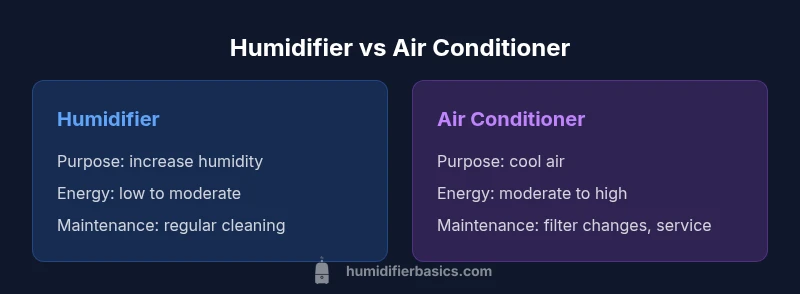
Is humidifier the same as air conditioner? Not in function or purpose. According to HumidifierBasics, the humidifier and AC are designed to fix different problems in indoor climate: dryness versus heat. A humidifier adds moisture to the air to raise relative humidity (RH) when it falls below comfortable levels, typically in dry indoor environments. An air conditioner removes heat from the space, cooling air and often dehumidifying as a natural byproduct of condensation. This makes the two devices complementary in some contexts, but not interchangeable. Understanding this distinction is essential for homeowners who want to optimize comfort, health, and energy use. The HumidifierBasics Team notes that misusing either device can lead to unintended effects, such as overly humid rooms or excessive cooling that leaves the space damp or chilly.
How humidifiers work and why they differ from AC units
Humidifiers operate by introducing water vapor or mist into indoor air. Three common technologies are evaporative (wick filters), ultrasonic (sound vibrations producing a cool mist), and warm-mist (boiled water). Each type has its own humidity delivery profile, maintenance needs, and mineral dust considerations. The key point is that a humidifier directly affects relative humidity without changing air temperature. In contrast, an air conditioner cools air by absorbing heat, and during the process often dehumidifies as a secondary effect. This dual action reduces moisture by decreasing the air’s capacity to hold water at the new cooler temperature. The result is a different pathway to comfort: humidity control is a feature, not a guaranteed outcome, with energy use linked to cooling loads.
How air conditioners manage humidity and why that matters
Air conditioners primarily cool spaces by transferring heat to the outside. As the air cools, its ability to hold moisture decreases, so condensation forms on the evaporator coil and moisture is removed from the room. This dehumidification effect can reduce RH, sometimes too aggressively in humid climates. Many modern systems include humidity sensors and dehumidification modes, but the device’s main job remains temperature control. Because of this, an AC may not be the best solution if your goal is simply to raise RH in a dry home. In humid environments, overshoot can also occur, leading to dampness and mold risk if humidity is not balanced.
Common myths about humidifiers and ACs
Myth 1: A humidifier cools the room. Reality: Humidifiers add moisture but do not significantly lower temperature; any perceived cooling is a side effect of evaporative processes or improved airflow. Myth 2: An AC will fix all humidity problems. Reality: An AC can reduce humidity but also risks over-drying or running inefficiently if used without a humidification plan. Myth 3: You should run both devices at all times. Reality: Balanced indoor humidity requires monitoring RH and using devices as needed rather than continuously running both. In practice, many homes benefit from targeted use of each device during different seasons or weather patterns.
When a humidifier is the right tool (vs AC) in real homes
During dry winter months or in climates with low outdoor humidity, a humidifier can significantly improve comfort, skin hydration, and nasal moisture. For households with wood floors or drywall prone to cracking, maintaining RH in the 40-60% range can help structural integrity and asset longevity. For people with allergies or asthma, optimal humidity can reduce irritants, but excessive humidity increases mold risk. In these situations, a humidifier is a targeted tool for moisture management, not a substitute for cooling or climate control. Real-world usage often involves pairing a humidifier with a dehumidifier or AC to maintain RH within the comfort zone across seasons.
Types of humidifiers and what they deliver
Evaporative humidifiers use a wick to draw water into air; ultrasonic models vibrate to create mist; warm-mist units boil water for a gentle heat component. Each type has pros and cons visible in energy use, maintenance, and the potential for mineral dust in the air. Evaporative units tend to be self-regulating, releasing more moisture as the air dries; ultrasonic units can be quieter but may disperse minerals if not cleaned or using distilled water. Warm-mist humidifiers can provide more noticeable moisture output but require caution around young children and hot surfaces. The choice depends on room size, noise tolerance, and water quality.
Cost, energy, and maintenance considerations
Running costs for a humidifier are usually modest compared to air conditioning, but many variables matter: room size, humidity targets, and water quality. Humidifiers generally consume less energy than ACs, but high-capacity models and those with fans may add operating costs. Maintenance is a recurring task: clean weekly to prevent mold and bacteria; replace filters as recommended; use distilled water to reduce mineral buildup; empty and dry components between uses. In hot climates, the energy footprint of an AC can be substantial due to compressor operation; in dry climates, you may see a large difference between occasional AC use and continuous humidification.
Practical decision framework and quick start checklist
Begin with a humidity target: aim for 40-60% RH, measured with a reliable hygrometer. If RH is below 40%, consider a humidifier. If RH is above 60%, a dehumidifier or AC may be appropriate. Consider climate, season, room size, and the presence of moisture-sensitive materials. Use distilled water to minimize mineral dust; place devices away from sleeping areas; ensure proper cleaning. Use the checklist to decide which device to deploy in a given room and avoid duplication.
Authoritative sources and caveats
Note about claims: This article uses synthesized guidance and industry best practices. See the following sources for climate and humidity guidelines:
- EPA Indoor Air Quality: Indoor Humidity — https://www.epa.gov/indoor-air-quality/indoor-humidity
- CDC Healthy Habits: Humidity and Health — https://www.cdc.gov/healthywater/hygiene/environmental/humidity.html
- OSHA Indoor Air Quality — https://www.osha.gov/indoor-air-quality
For further reading, the HumidifierBasics team encourages readers to consult professional HVAC guidance when integrating multiple climate-control devices in larger spaces or whole-house systems.
Comparison
| Feature | Humidifier | Air Conditioner |
|---|---|---|
| Primary purpose | Adds moisture to dry indoor air for comfort and health | Cools air to lower room temperature and typically dehumidifies |
| Humidity impact | Directly increases RH when needed | Manages humidity indirectly through cooling/dehumidification cycles |
| Energy use | Low to moderate; depends on model and features | Moderate to high; driven by cooling load and compressor operation |
| Maintenance | Regular cleaning; filter changes depend on model | Filter changes and periodic professional service; refrigerant checks if applicable |
| Best for | Dry environments, winter comfort, and nasal moisture support | Hot/humid climates or spaces needing reliable cooling |
What's Good
- Lower upfront and running costs than major cooling systems
- Directly improves comfort in dry environments
- Flexible, room-by-room deployment options
- Portable options suitable for renters
Negatives
- Does not cool rooms; cannot replace AC for heat relief
- Requires monitoring to avoid over-humidification
- Mineral dust risk without distilled water or frequent cleaning
- Limited whole-house control without integrated systems
Humidifier and air conditioner serve different goals; neither is a perfect substitute for the other.
Use each device for its primary function: humidity management vs cooling. In many homes, a layered approach—seasonal or zone-specific—delivers the best comfort and energy efficiency.
FAQ
Is a humidifier a replacement for an air conditioner?
No. Humidifiers add moisture to the air, while air conditioners cool and dehumidify. They address different climate concerns, so they’re not interchangeable. Use each device for its intended purpose to avoid humidity or temperature imbalances.
No—humidifiers add moisture, not cool the room. They’re not substitutes for air conditioners.
Can a humidifier cool a room like an AC?
Humidifiers do not cool rooms in the way air conditioners do. Some temporary perception of cooling may occur due to evaporation, but the actual temperature stays the same. Humidity can affect comfort, not temperature.
No, humidifiers don't cool rooms; they add moisture.
When should I use a humidifier vs an AC?
Use a humidifier when indoor RH is below 40%, particularly in dry climates or winter. Use AC for cooling and, when needed, dehumidification in hot, humid conditions. Many homes benefit from both across seasons, but they should be used for their primary purposes.
Use a humidifier for dry air; use AC for cooling and humidity control as needed.
Do humidifiers use energy?
Humidifiers generally use less energy than air conditioners, but energy use varies with model, capacity, and features like fans. Expect lower running costs overall, especially for standalone or room-based units.
Yes, but usually less energy than an air conditioner.
How should I maintain a humidifier safely?
Clean the device regularly, use distilled water when possible, replace filters as recommended, and empty the reservoir daily if not in use. Regular cleaning helps prevent mold, bacteria, and mineral buildup.
Clean it often and use clean water to stay safe.
Are humidifiers safe for bedrooms and pets?
Humidifiers can be safe in bedrooms and households with pets when used correctly. Avoid over-humidification (RH over 60%), keep devices out of reach of children and pets, and ensure proper cleaning to reduce mold and bacterial growth.
They’re generally safe if used carefully and kept clean.
The Essentials
- Use humidity control as the primary goal for humidifiers
- Target 40-60% RH for most homes
- Energy and maintenance vary by device and model
- Monitor water quality to minimize mineral dust
- Consider a layered strategy for year-round comfort