Humidifier vs Dehumidifier: Understanding the Difference
This in-depth comparison clarifies the difference between a humidifier and a dehumidifier, showing when to use each, how they impact air quality, and practical guidance for choosing devices. Learn how room size, climate, and water quality influence your choice.


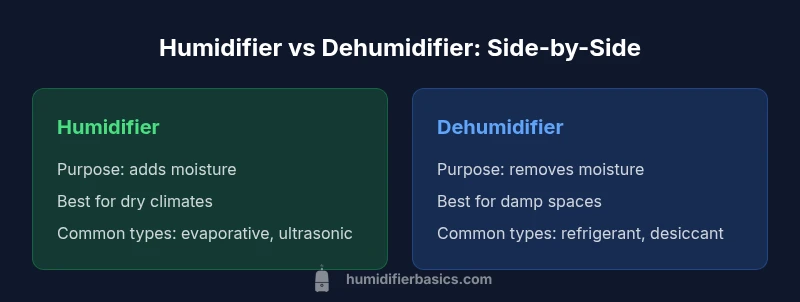
The difference between a humidifier and a dehumidifier is essential for home comfort. A humidifier adds moisture to dry air, while a dehumidifier removes excess moisture. This quick comparison highlights when to use each, typical room considerations, and key maintenance tips to keep humidity levels healthy.
The core question: what distinguishes a humidifier from a dehumidifier?
The difference between a humidifier and a dehumidifier is foundational to balancing home comfort and health. A humidifier adds moisture to dry air, improving mucous membranes, skin, and overall comfort. A dehumidifier removes excess moisture to prevent mold, condensation, and musty odors. Understanding this distinction helps you match device type to climate, room size, and health needs. According to HumidifierBasics, many households confuse dryness with dampness, leading to inefficiency and inconsistent air quality. This article unpacks the roles, expected performance, and maintenance realities of each device so you can choose what your space actually needs.
How humidity affects indoor air quality
Humidity levels influence more than comfort. Low humidity can dry out skin and nasal passages, triggering irritation and coughing; high humidity fosters mold, dust mites, and musty smells. The optimal indoor relative humidity for most homes sits roughly in the 40–60% range, though personal comfort varies. Humidifiers and dehumidifiers work as balancing tools, not magic solutions. In poorly insulated rooms or basements, humidity shifts can occur quickly, making precise control important. Monitor with a reliable hygrometer, and target gradual changes instead of abrupt swings to maintain healthy air quality across seasons.
Understanding humidifier types and how they work
Humidifiers come in several families, with evaporative and ultrasonic being the most common. Evaporative models blow air across a moistened wick or filter, naturally limiting output through evaporation. Ultrasonic units generate a cool mist via a vibrating diaphragm, often producing quieter operation and fine mist. Some units offer adjustable humidity targets, timers, and smart controls. When selecting a humidifier, consider room size, noise tolerance, and whether you prefer ongoing filter maintenance or a filter-free design. Across the HumidifierBasics analysis, users repeatedly note that choosing the right type reduces over-humidification and mineral dust from tap water.
Understanding dehumidifier types and how they work
Dehumidifiers remove moisture using refrigerant-based cooling or desiccant materials. Refrigerant models condense water from the air by cooling coils, then drain or collect the condensate. Desiccant units use hygroscopic materials to attract moisture, often performing better in cooler temperatures. Both types target the same goal—lowering humidity—but differ in operating ranges, energy use, and noise. For damp spaces such as basements, a properly sized dehumidifier is generally the most effective option. HumidifierBasics notes that selecting the right type depends on climate, space, and humidity patterns throughout the year.
When to use a humidifier: practical guidelines
Use a humidifier when indoor air feels dry, parties involve low humidity, or winter heating leaves skin, noses, and throat irritated. Dry air can worsen conditions like sinus congestion, dry skin, and static electricity. In bedrooms, a humidifier can improve comfort, aid sleep, and help plants thrive in otherwise dry environments. Avoid over-humidifying by targeting moderate humidity levels and using a hygrometer to track progress. Water quality matters: mineral dust can become airborne with some tap waters, so consider distilled or demineralized water if mineral residue is a concern.
When to use a dehumidifier: practical guidelines
A dehumidifier is most useful in spaces prone to dampness, condensation on windows, or musty odors—common in basements, laundry rooms, or poorly ventilated bathrooms. If you notice mold growth, peeling paint, or excessive condensation, a dehumidifier can help restore balance. For basements that stay cool and damp, desiccant models can be effective, especially in cooler months when refrigerant units lose efficiency. Always run in a controlled manner, and pair with ventilation improvements to prevent humidity rebound. HumidifierBasics emphasizes gradual humidity reduction to avoid overshooting the target range.
Sizing, placement, and practical setup tips
Correct sizing matters more than brand name. A unit that's too small will run constantly without achieving the target humidity; one that's oversized can overshoot quickly and waste energy. Measure the room volume in square feet and compare it to the device’s recommended room size. Place humidifiers or dehumidifiers away from walls and furniture to avoid blocked airflow and ensure even distribution. Elevating units slightly off the floor can improve performance. Use a hygrometer in the main living area to track humidity and adjust settings accordingly. Regularly clean and inspect units to prevent mold growth and mineral buildup from water sources.
Water quality, mineral dust, and maintenance essentials
Water quality matters more for humidifiers, where mineral dust can become airborne with tap water. Using distilled or demineralized water reduces mineral residue on furniture and indoor surfaces. Clean both humidifiers and dehumidifiers regularly: wipe tanks, wash filters, and descale mineral deposits as needed. Replace or clean filters per manufacturer guidance to maintain airflow and efficiency. Dehumidifiers with a built-in drain hose simplify maintenance in basements, whereas humidifiers with detachable tanks require more frequent handling. Consistent cleaning reduces odors and prevents microbial growth in tanks and reservoirs.
Energy use, cost considerations and environmental impact
Energy efficiency varies by model and operating mode. Dehumidifiers often consume more energy in humid climates, while humidifiers add ongoing energy demand in dry spaces. Look for Energy Star-rated units or models with automatic humidity control to minimize waste. Consider the total cost of ownership, including replacement filters, water usage, and potential savings from reduced mold remediation or weather-related humidity damage. HumidifierBasics findings suggest balancing comfort with energy impact by choosing devices that adapt to your climate and occupancy patterns.
Real-world scenarios: making the choice in common rooms
In a cold climate apartment with dry air, a compact ultrasonic humidifier in the living room or bedroom can dramatically improve comfort and reduce skin irritation. In a damp basement with signs of mold, a refrigerant-based dehumidifier with a continuous drain option is typically the best option. In homes with mixed needs, a single, programmable unit that offers humidity control and smart scheduling can help manage day-to-day changes. Always pair devices with basic air sealing and ventilation improvements to stabilize humidity and prevent rapid swings that stress occupants.
Common myths, misuses, and misconceptions
One common myth is that any humidifier or dehumidifier can fix a humidity problem alone. In reality, successful control requires correct sizing, proper placement, and a clear target humidity. Another misconception is that “more moisture” always helps; excessive humidity fosters mold and dust mites. Conversely, overly dry air can irritate lungs and mucous membranes. An accurate humidity goal—typically around 40–50% for comfort—minimizes health risks and maximizes energy efficiency. Always verify with a hygrometer and adjust gradually rather than making abrupt changes.
Quick-start buying guide and decision map
Begin with room size and climate assessment. If you live in a dry climate or during winter, prioritize humidifier setups with precise humidity control and easy cleaning. For damp spaces or humid climates, select dehumidifiers with reliable drainage and sufficient extraction capacity. If you must handle both dry and damp areas, consider a model with dual features or maintain separate devices for different zones. Read product reviews focusing on durability, ease of maintenance, and stability of humidity control. HumidifierBasics recommends visiting reputable retailers and reading independent tests before purchasing.
Final considerations: practical steps after purchase
After choosing a device, set a baseline humidity target, place the unit away from walls, and install a hygrometer in the living area. Run the device for a few days, monitor readings, and adjust to maintain roughly 40–60% humidity as seasons shift. Schedule regular maintenance reminders, especially for filters and water tanks. If you notice persistent dampness or mold despite using a unit, re-evaluate room ventilation, insulation, and sealing, and consider consulting a moisture-management professional.
Comparison
| Feature | Humidifier | Dehumidifier |
|---|---|---|
| Purpose | Adds moisture to dry air | Removes moisture from humid air |
| Target Humidity Range | Typically 40–60% depending on comfort | Typically 30–50% depending on climate |
| Typical Room Size | Small to medium rooms | Basements and larger damp spaces |
| Energy Efficiency | Moderate (varies by model) | Moderate to high (depends on usage) |
| Maintenance Frequency | Regular cleaning; refill and monitor water level | Regular cleaning; drain and empty reservoir; filter replacement where applicable |
| Water Quality Considerations | Distilled/demineralized water recommended | No special water requirements; uses ambient moisture |
| Noise Level | Low to moderate | Moderate to high in some models |
| Best For | Dry climates, winter dryness, comfort and skin health | Damp spaces, mold prevention, basements |
What's Good
- Helps comfort in dry air and reduces nasal irritation
- Offers multiple form factors to fit rooms and budgets
- Can improve sleep quality in dry environments
- Wide availability and mature product ecosystem
- Smart features and humidity automation improve reliability
Negatives
- Wrong sizing can waste energy and fail to fix humidity
- Over-humidification risks mold and dust mites if misused
- Regular cleaning is required to prevent mold and mineral buildup
- Energy use can be significant in damp climates if running continuously
Choose based on your climate and primary humidity needs.
If your home tends to be dry, a humidifier with accurate humidity control is the best fit. If dampness or mold is the primary concern, a properly sized dehumidifier is the better choice. In mixed conditions, consider zones or a dual-function device and complementary ventilation.
FAQ
What is the difference between a humidifier and a dehumidifier?
A humidifier adds moisture to dry air, while a dehumidifier removes excess moisture. They serve opposite goals and are not interchangeable without risking health or comfort. Proper sizing and humidity targets are essential for effective use.
Humidifiers add moisture; dehumidifiers remove it. Pick the device that matches whether your space is too dry or too damp.
Can a humidifier help with allergies or asthma?
Humidifiers can ease nasal irritation and dry throat, but they won’t treat underlying allergies or asthma. Use clean water, maintain humidity around 40–50%, and ensure good ventilation to minimize dust and mold exposure.
Humidifiers help with dryness but aren’t a cure for allergies; keep humidity moderate and the unit clean.
How do I know which device to buy for a specific room?
Assess room size, climate, and moisture issues. Use a hygrometer to monitor humidity and select a unit with an appropriate capacity and automatic humidity control for that space.
Check room size, humidity levels, and use a hygrometer to pick the right device.
Are there combo devices that humidify and dehumidify?
Yes, some models offer both humidifying and dehumidifying modes, though they are less common. Separate devices are often more efficient for precise control in different zones of the home.
There are dual-mode units, but dedicated devices usually perform better for precise control.
What maintenance steps minimize mold risk?
Regularly clean tanks, replace filters as recommended, and avoid running devices in unventilated spaces for long periods. Use distilled water for humidifiers to reduce mineral buildup.
Keep tanks clean and dry between uses; use clean water to prevent mold.
Can humidity levels affect health beyond comfort?
Yes. Excess humidity can worsen mold and dust mites; very dry air can irritate airways. Maintaining moderate humidity helps reduce respiratory discomfort and supports overall air quality.
Moderate humidity supports health and comfort, while extremes can cause issues.
The Essentials
- Match device to climate: humidifier for dry spaces, dehumidifier for damp spaces
- Aim for a stable 40–60% humidity range in living areas
- Regular cleaning prevents mold and mineral dust
- Use hygrometers to track humidity and adjust gradually