Humidifier vs AC: Does a Humidifier Work Like AC? A Practical Comparison
A clear, data-driven comparison of humidifiers and air conditioners, focusing on humidity control, cooling, energy use, and maintenance to help homeowners decide which device fits their needs.


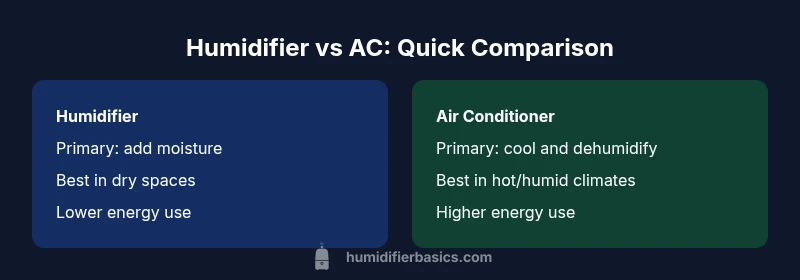
Does a humidifier work like ac? Not exactly. A humidifier adds moisture to the air, improving comfort in dry spaces, while an air conditioner cools and dehumidifies to lower room temperature and humidity levels. They serve different purposes, and using a humidifier alone cannot achieve the cooling and dehumidification that an AC provides. For many homes, humidity control and cooling are best achieved with dedicated devices used in tandem when appropriate.
Does humidifier work like ac? A reality check for homeowners
In practice, does humidifier work like ac? The short answer is no—the two devices address different problems. Humidifiers introduce moisture to dry indoor air, which can ease dry skin, throat irritation, and static. Air conditioners remove heat and reduce humidity by condensing moisture from the air. The HumidifierBasics team finds that most homes benefit from recognizing these distinct roles rather than assuming one device can substitute for the other. If you live in a dry climate or during winter heating season, a humidifier can noticeably improve comfort; in hot summer months, an AC is the workhorse for cooling and dehumidification. This distinction guides when to invest in each device and how to configure them for optimal comfort.
How humidifiers function: moisture, not temperature
Humidifiers operate by releasing water vapor into the air—either as warm mist, cool mist, or ultrasonic spray. They do not actively lower room temperature or remove heat. Their primary role is to raise the relative humidity (RH) to a comfortable range, typically around 30–50%, depending on personal preference and local climate. The health and comfort benefits come from reducing nasal dryness, skin irritation, and static electricity. However, if RH becomes too high, it can promote mold growth and dust mite proliferation, so humidity control is essential. The HumidifierBasics analysis emphasizes the need for a reliable hygrometer and a consistent maintenance routine to avoid mineral buildup and bacterial growth. A well-managed humidifier supports comfort without altering room temperature.
How air conditioners work: cooling, dehumidification, and air movement
Air conditioners cool air by removing heat through a refrigeration cycle. As part of that process, they also dehumidify by condensing moisture from the air. This dual action lowers both temperature and humidity, creating a cooler, more comfortable environment in hot weather. The energy demands are typically higher than for a basic humidifier, especially in larger spaces, and running costs depend on unit efficiency, climate, and usage patterns. For a homeowner comparing options, the AC is a multi-functional tool for heat management, while humidifiers focus specifically on humidity balance.
Key differences at a glance: humidity, heat, and energy use
The most important differentiator is purpose: humidifiers add moisture; air conditioners remove heat and reduce humidity. In energy terms, humidifiers are usually lower-cost to run but require volume placement and humidity control to prevent over-saturation. AC units vary widely in price and energy efficiency, with larger homes demanding more capacity. Temperature perception often improves with humidity control; however, without cooling, rooms may still feel warm. This section draws on practical experiences from homeowners and rental tenants, highlighting that neither device is a one-size-fits-all solution.
Real-world scenarios: choose based on climate and season
In winter or arid environments, a humidifier can alleviate symptoms of dry air, protect wooden furniture, and reduce chapped lips. In humid summer regions, AC is more effective for comfort and indoor air quality due to its cooling and dehumidification capabilities. A hybrid approach—using a humidifier to address dry air during dry months and an AC for heat and humidity control during hot periods—often yields the best results. The HumidifierBasics team notes that the decision should hinge on local climate, occupancy patterns, and the presence of sensitive individuals in the household.
Maintenance matters: staying safe and effective
Both devices require regular maintenance, but the risks differ. Humidifiers must be cleaned to prevent mold, bacteria, and mineral buildup in the water tank and mist outlets. Mineral deposits can be dispersed into the room, reducing air quality and triggering cleanup needs. Air conditioners require periodic filter changes, coil cleaning, and refrigerant checks to maintain performance and safety. Following manufacturer guidance and using distilled water where appropriate can reduce mineral residue and improve overall air quality. HumidifierBasics emphasizes scheduling routine checks and keeping a simple maintenance log.
Energy, cost, and value: making smart investments
Costs range widely for AC units, influenced by size, efficiency, and installation requirements. Humidifiers offer lower upfront costs and can be a cost-effective way to improve comfort in dry spaces, but they do not replace cooling. When making decisions, think about the long-term energy use, the size of the space, and how often each device will run. The aim is to optimize comfort and health without overspending on features that don’t align with your climate needs.
Practical takeaways for homeowners and renters
To maximize comfort, identify your climate and seasonal needs, then select devices that address the core issue—humidity or heat. A hygrometer helps determine RH and guides whether you need a humidifier, dehumidifier, or air conditioner. When both devices are used, ensure proper spacing and airflow to avoid humid pockets near vents. Finally, implement a regular cleaning schedule to prevent mold and mineral buildup, and consider energy-efficient models to reduce operating costs over time.
Authority and further reading
For rigorous guidance on humidity management and indoor air quality, consult primary sources on indoor air quality and environmental health. Always verify with local regulations and guidelines for building safety and energy efficiency. This article references general best practices and independent analyses from HumidifierBasics to help readers make informed decisions.
Comparison
| Feature | Humidifier | Air Conditioner |
|---|---|---|
| Primary function | Adds moisture to dry air | Cools air and reduces humidity via dehumidification |
| Humidity impact | Increases relative humidity (RH) when used correctly | Decreases RH while cooling the space |
| Temperature effect | No direct cooling effect | Direct cooling effect |
| Energy efficiency | Typically lower energy usage, varies by model | Can be high energy use depending on size and efficiency |
| Maintenance | Tank cleaning, mineral buildup control | Filter/coils cleaning, refrigerant integrity checks |
| Best use scenarios | Dry indoor air, winter dryness, skin/moisture needs | Hot, humid days, temperature control in summer |
| Price range | $20–$250 | $400–$2,000+ |
What's Good
- Lower upfront cost for basic models
- Improves comfort in dry environments
- Compact options for renters and small spaces
- Quiet operation in many models
Negatives
- Does not replace cooling or dehumidification
- Requires humidity monitoring to avoid mold
- Limited impact in large or highly variable spaces
AC is superior for cooling; humidifiers excel at humidity balance in dry spaces
Choose AC when cooling and dehumidification are priorities. Use a humidifier to improve comfort in dry environments, especially during winter or in arid climates.
FAQ
Can a humidifier replace an air conditioner?
No. A humidifier adds moisture, while an air conditioner cools and dehumidifies. They serve different purposes and are not interchangeable for most homes. Use each device to address its primary function, or consider a combined approach if you have both humidity and cooling needs.
No. Humidifiers add moisture, while air conditioners cool and dehumidify. Use each for its primary purpose, or combine them if you need both humidity balance and cooling.
Does running a humidifier make a room cooler?
A humidifier can alter perceived temperature by changing humidity, but it does not actively cool the room. In some cases, high humidity can make a space feel warmer, while proper humidity levels can improve comfort. Use cooling devices when actual temperature reduction is needed.
Humidifiers don’t actively cool a room, though humidity can affect comfort. For cooling, rely on an air conditioner.
What humidity range should I target indoors?
A common target is roughly 30–50% RH, which balances comfort and indoor air quality. Very high humidity can promote mold growth; very low humidity can irritate mucous membranes. Use a hygrometer to monitor RH and adjust as needed.
Aim for about 30 to 50 percent humidity. Use a hygrometer to keep an eye on RH.
How can I prevent mold with a humidifier?
Regular cleaning of the water tank and mist outlets is essential. Use distilled water when possible to reduce mineral deposits, and keep RH within a safe range. If you notice musty odors or visible mold, discontinue use and check space ventilation.
Clean the tank, use distilled water when possible, and monitor humidity to prevent mold.
Is it safe to run both devices in the same room?
Yes, many homes use both to manage humidity and temperature. Ensure adequate air circulation and avoid excessive humidity in one area. Space heaters or fans can help with airflow if needed.
Yes, you can run both, but ensure good airflow and avoid oversaturating a single room.
Which should I buy for a small apartment?
If the issue is humidity and dry air, a compact humidifier may be enough. If you face heat and humidity in summer, consider a smaller AC unit or a portable AC. For both concerns, prioritize models with energy efficiency and reliable filters.
For small spaces, start with a compact humidifier for dryness; add cooling if heat is a big issue.
The Essentials
- Define your goal: humidity balance vs cooling
- Use a hygrometer to guide device choice
- Humidifiers help in dry climates, ACs in hot climates
- Maintenance matters to prevent mold and mineral buildup
- Consider a hybrid approach for year-round comfort