Cool Mist vs Warm Mist Humidifiers: A Practical Comparison
Analytical comparison of cool mist and warm mist humidifiers for dry air. Learn how each type works, safety considerations, maintenance needs, energy use, and which is best for your home.


TL;DR: For dry air, cool mist humidifiers generally deliver faster humidity and lower ongoing costs, while warm mist models provide warmth and comfort but use more energy and carry a higher safety risk if mishandled. In most homes, cool mist is the safer, more versatile default; warm mist can suit colder rooms when warmth is a priority.
Understanding Dry Air and Humidification
Dry indoor air, especially in winter, can leave skin dry, irritate sinuses, and cause static shocks. To decide is cool mist or warm mist better for dry air, you first need to gauge your space and goals. The recommended relative humidity for living spaces generally sits around 30-50%, which reduces static, supports respiratory comfort, and protects furniture and electronics from cracking or warping. According to HumidifierBasics, start by measuring RH with a reliable hygrometer and ensure your humidifier is appropriately sized for the room. This foundational step helps you interpret device specs, avoid over-humidification, and set expectations for performance across different room sizes and climates.
How Cool Mist Humidifiers Work
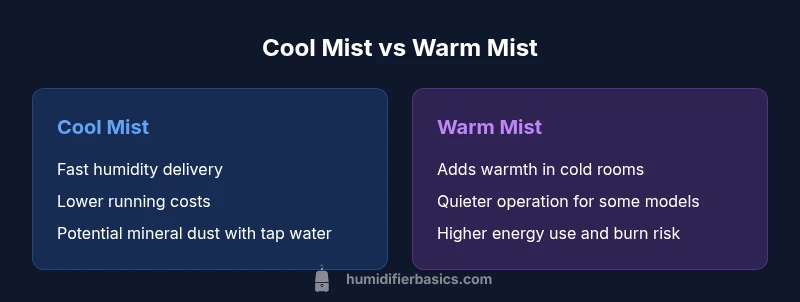
Cool mist humidifiers operate without heating water. They fall into two main subcategories: ultrasonic (using high-frequency vibrations to create a fine mist) and evaporative (airflow passes through a wick or mesh filter to evaporate water). The result is cool, breathable humidity that can spread quickly in a room. Benefits include generally lower energy consumption, a wider selection of models, and straightforward maintenance. Common drawbacks include mineral dust if you use tap water and, in some setups, higher noise from fans. Choosing distilled or demineralized water reduces mineral fallout and improves air quality over time.
How Warm Mist Humidifiers Work
Warm mist humidifiers boil water to produce steam, which adds humidity while releasing a warm breeze into the room. This can feel comforting in cold environments and may reduce some bacteria in the water, though it is not a substitute for regular cleaning and proper filtration. Advantages include quiet operation in many models and strong humidity output in a short period. Trade-offs are higher energy use due to heating, potential burn risks if the unit is reachable by children or pets, and more careful handling of water to prevent mineral buildup and scale.
Key Differences at a Glance
- Operating Principle: Cool mist uses ultrasonic vibration or evaporation; warm mist boils water into steam.
- Safety: Cool mist typically has no hot surface, reducing scald risk; warm mist carries a burn risk if tipped or accessed by curious kids.
- Energy Use: Cool mist generally consumes less energy; warm mist uses energy to heat water.
- Maintenance: Cool mist may require mineral management and filter changes; warm mist needs regular cleaning to prevent mineral buildup in the reservoir.
- Noise: Ultrasonic cool mist can be very quiet; evaporative and warm mist units have varying noise depending on fans and boiling mechanisms.
- Ideal Room: Cool mist is versatile for many room sizes; warm mist can be preferable in very cold rooms where added warmth is desired.
- Price and Availability: Both types are widely available; prices vary by features rather than type alone.
Understanding these differences helps you map a solution to your space, climate, and safety requirements.
Performance in Dry Air Scenarios
In homes with consistently dry air, cool mist humidifiers often replenish humidity faster because they disperse water as tiny droplets and can cover larger surfaces quickly. This is particularly helpful in living rooms or open-plan spaces where humidity needs to travel across multiple zones. Warm mist units can deliver substantial humidity in a shorter burst, which can feel advantageous in small, colder bedrooms, but their higher energy use means the effect may be less cost-effective over the course of a day. Humidity targets should always be monitored with a hygrometer to avoid overshooting and promoting mold growth.
Safety Considerations and Maintenance
Safety and cleanliness are central to humidifier effectiveness. For both types, using clean water and regular descaling/cleaning reduces mineral buildup and microbial growth. Warm mist devices can pose scald risks if children or pets access the tank, so placing the unit out of reach and using secure covers is wise. Cool mist devices require attention to filter cleanliness and mineral dust, so running distilled water or demineralized water helps minimize residue in the air. Regular replacement of filters (where applicable) and thorough routine cleaning are key to long-term performance.
Energy Use and Running Costs
Energy use varies by model and usage pattern rather than by type alone. Cool mist units tend to be more energy-efficient since they do not heat water, although some high-output or console models use more electricity. Warm mist machines incur energy costs through continuous heating, which can add up if the unit runs across many hours daily. The upfront cost of warm mist units can also be higher thanks to heating components and sometimes more robust systems. When budgeting, consider your typical daily running time, local electricity rates, and whether you value immediate humidity versus warmth and comfort.
Noise and Convenience
Noise levels are often model-dependent. Ultrasonic cool mist units can operate with little sound, making them suitable for bedrooms or quiet spaces. Evaporative cool mist and some warm mist units may produce modest fan or boiler noises. Convenience factors include how easy it is to fill, how often you must refill, and whether you need a built-in humidistat or remote monitoring. For busy households, a unit with a wide-fill opening, clear indicators, and simple maintenance routines will reduce friction and improve consistency of humidity.
Pet and Child Safety Considerations
Safety around children and pets is a practical concern when choosing between cool mist and warm mist humidifiers. Cool mist units generally present a lower risk of accidental burns, since there is no hot water surface. Warm mist units can be safe with proper placement and child-proofing, but the potential for burns in a curious home is higher. If you have infants or very young kids, a cool mist model with accessible water still warrants careful handling of water quality and regular cleaning. In all cases, keep units on stable surfaces away from edge risks and supervise when children are near them.
Cleaning and Maintenance Tips for Longevity
Regardless of type, consistent cleaning preserves performance and air quality. A weekly rinse with plain water and a monthly deep clean with a mild, non-abrasive cleaner helps prevent mold and bacteria. Use distilled or demineralized water to reduce mineral buildup and spraying of airborne minerals. Replace filters according to the manufacturer’s schedule, and keep the air paths clear of dust by cleaning surrounding surfaces. Proper maintenance reduces odor, improves humidity accuracy, and extends the unit’s life.
Selecting for Your Home: A Quick Decision Guide
- Measure RH in the target space and identify room usage patterns.
- Prioritize safety: if children or pets are present, lean toward cool mist or ensure warmth is contained and out of reach.
- Consider energy costs: if you want to run the humidifier for long periods, cool mist is typically more economical.
- Decide if warmth matters: in very cold climates, a warm mist may provide comfort alongside humidity.
- Ensure correct sizing: choose a model sized for the room to avoid over- or under-humidification.
- Plan for maintenance: pick a model with easy cleaning and straightforward filter cycles.
In practice, many households benefit from starting with a cool mist unit and testing adjusted settings before evaluating a secondary warm option if warmth is a priority for particular rooms. The HumidifierBasics team notes that this approach balances safety, cost, and effectiveness.
Real-World Scenarios and Recommendations
For a medium-sized living room in a dry climate, a cool mist unit with a hygrometer is often the best starting point. If you live in a cold region and want additional warmth during the winter, a warm mist model can complement heating rather than replace it, provided you manage safety and energy use. In child-rich homes, prioritize cool mist or use a warm mist unit with a top cover and guarded tank area to minimize contact risk. Always size the unit to the space and monitor humidity with a reliable gauge to maintain comfort without fostering mold or dust growth.
Comparison
| Feature | Cool Mist Humidifier | Warm Mist Humidifier |
|---|---|---|
| Operating Principle | Ultrasonic or evaporative | Boiling water to produce steam |
| Best For | Large rooms, cost-conscious households | Cold rooms, comfort-seekers in winter |
| Energy Use | Lower energy use (depends on model) | Higher energy use due to heating |
| Noise Level | Varies; often quiet (ultrasonic) | Quiet to moderate; boiling may add slight noise |
| Maintenance | Filter or mineral management; avoid mineral dust | Regular cleaning; mineral buildup management |
| Safety | Low burn risk; safe around kids when placed properly | Burn risk if tipped or accessible; use caution around children |
| Water Type | Distilled or demineralized preferred | Distilled or demineralized preferred |
| Price Range | Lower upfront costs on many models | Higher upfront costs due to heating element |
What's Good
- Clear, direct comparison helps you decide quickly
- Covers safety, energy, and maintenance factors in one place
- Useful for budgeting and room-by-room planning
Negatives
- Does not replace in-depth personal testing in your space
- May oversimplify brand- and model-specific differences
- Performance depends on correct sizing and water quality
Cool mist is the generally safer default; warm mist suits warmth-focused needs in cold spaces.
If you want versatile, economical humidity with lower burn risk, choose cool mist. If warmth and a quiet operation are top priorities and you can manage safety, warm mist can be a good complementary option in colder rooms.
FAQ
Is cool mist or warm mist more effective at humidifying a room?
Both can effectively increase room humidity when sized correctly. Cool mist often humidifies faster over larger areas, while warm mist can deliver a strong local humidity burst in smaller spaces. Proper humidity monitoring is essential for best results.
Both types can work well if sized properly. Cool mist tends to spread humidity faster in bigger spaces, while warm mist can deliver a strong localized humidification in smaller rooms.
Can warm mist kill bacteria in the water?
Heating water to steam in warm mist units can reduce some bacteria, but it does not guarantee a sterile room. Regular cleaning and using clean water remain important for air quality.
Warm mist heating can reduce some bacteria, but regular cleaning is still essential.
Are cool mist humidifiers safer around children and pets?
Generally safer because there is no hot water surface. Still, place devices out of reach, supervise usage, and maintain clean water to avoid mold and mineral dust in the air.
Yes, cool mist units are usually safer around kids, but you still need to keep them out of reach and clean regularly.
Do I need distilled water for either type?
Using distilled or demineralized water reduces mineral buildup and airborne dust for both types. If you use tap water, expect more mineral residue and more frequent cleaning.
Distilled water helps prevent mineral buildup for both cool and warm mist humidifiers.
Which is quieter, cool mist or warm mist?
Sound levels depend on model, but many cool mist ultrasonic units are very quiet. Warm mist devices are often quiet as well, though heating can add a soft hum or boil-like sound.
Most cool mist units are quiet, and many warm mist units are quiet too, though heating can add a minor hum.
What size humidifier should I buy for my room?
Choose a unit rated for the room size you plan to humidify. An undersized unit won't reach the target humidity, while an oversized unit can overshoot and create damp conditions that foster mold.
Match the unit to your room size and humidity goals to avoid under- or over-humidification.
The Essentials
- Measure RH before buying to set a target.
- Prioritize safety for homes with kids or pets.
- Prefer cool mist for energy efficiency and lower risk; reserve warm mist for specific warmth needs.
- Size the humidifier to the room and maintain water quality to maximize results.