Air Purifier vs Humidifier: A Practical, Analytical Comparison
A detailed, evidence-based comparison of air purifiers and humidifiers, outlining their distinct roles, ideal use cases, maintenance, and how to decide between them for optimal home air quality.


No — air purifiers and humidifiers serve different roles. An air purifier cleans particles and odors from the air, while a humidifier adds moisture to dry air. Some models fuse both functions, but hybrids often compromise performance in one area. For dedicated purification or humidity control, choose separate devices or a clearly prioritized hybrid.
Is an air purifier similar to a humidifier? Framing the question
If you’re evaluating equipment to improve indoor air quality, you may wonder, is air purifier similar to humidifier. The short answer is they are designed for different core problems. Air purifiers target particulate matter, including dust, pollen, and smoke, by pulling air through filters such as HEPA or activated carbon. Humidifiers, on the other hand, add moisture to dry air to improve comfort and reduce symptoms like dry skin or irritated nasal passages. This distinction matters for households balancing allergy relief with winter dryness. According to HumidifierBasics, many homes struggle to maintain comfortable humidity levels, which can influence how you should plan your purchases and usage. The rest of this guide explains the science behind each device, practical use cases, and how to avoid common missteps whenever you’re trying to improve overall air quality.
Core differences in purpose and effect
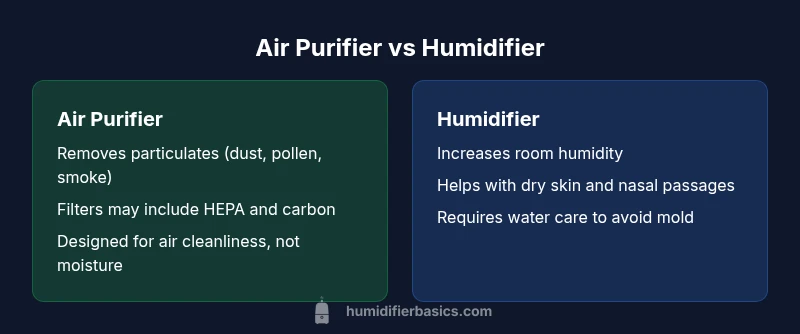
At a high level, the primary purpose of an air purifier is air cleanliness, while a humidifier focuses on humidity. Air purifiers rely on filtration systems to capture particles as air moves through the device. This process can reduce exposure to dust, pollen, pet dander, and smoke. Humidifiers increase the amount of moisture in the air, which can soothe dry skin, nasal passages, and eyes, and may help with certain winter respiratory symptoms. The two devices therefore address different facets of indoor air quality, and the choice between them should hinge on which problem you are trying to solve. When people ask is air purifier similar to humidifier, the practical answer is: not in function, but context matters. If your home experiences both dust and dry air, you might need both tools, or a multi-function model with clear prioritization. HumidifierBasics analysis shows that buyers often overestimate the performance of hybrids, which can underdeliver on both tasks if not chosen carefully.
How filtration and humidity control work in practice
Filtration in air purifiers uses a physical barrier to trap particles. HEPA filters capture most particles down to 0.3 microns with high efficiency, while activated carbon can reduce odors and some gases. Purifiers circulate air, reducing the concentration of particulates over time in a given space. Humidifiers evaporate or mist water into the air to raise relative humidity. This moisture can improve comfort but may also create conditions conducive to mold if humidity becomes excessive. Understanding is air purifier similar to humidifier? The answer is that the two devices pursue different targets concurrently—air cleanliness versus humidity balance—so matching device to need is essential for meaningful gains. This distinction matters in rooms with limited space, variable occupancy, and fluctuating humidity.
When an air purifier is the right tool
Air purifiers are especially valuable in environments with high particulate pollution or indoor allergens. If you or a household member experiences frequent sneezing, itchy eyes, or asthma symptoms triggered by dust or smoke, an air purifier can meaningfully reduce exposure. They are also helpful in homes with pets, after wildfire events, or in urban settings with traffic-related pollutants. For families focusing on cleaner air rather than moisture, choosing a purifier with a true HEPA filter and, if needed, an activated carbon layer, is often the best approach. If you are trying to answer is air purifier similar to humidifier — note that the “purifier” half of the question means you should prioritize filters and airflow rather than moisture production.
When a humidifier is the right tool
Humidifiers address dry air, a common issue in winter heating or arid climates. They can alleviate dry skin, throat irritation, and congestion caused by airborne dryness. Humidifiers also support comfort in nurseries or bedrooms where a stable humidity level can aid sleep quality. However, humidity must be controlled: excessive moisture can promote mold growth or condensation on walls and windows. If your goal is to improve moisture levels in spaces where air feels dry or to ease nasal irritation from dryness, a humidifier is the appropriate choice. The question of is air purifier similar to humidifier becomes clear when you focus on humidity rather than purification alone.
Hybrid devices and when they make sense
There are multi-function devices marketed as purifiers with built-in humidification or vice versa. These hybrids can be convenient in small spaces, yet they often require careful setup to avoid trading off performance. If you decide is air purifier similar to humidifier only in the sense that you want fewer devices, a dedicated hybrid should be chosen with clear performance claims and independent testing. In general, hybrids tend to perform well for light use but may underperform in high-demand scenarios like severe allergies or very dry climates. HumidifierBasics cautions that buyers should read independent reviews and verify filtration capacity and humidity control in the same model before committing to a dual-role device.
Practical setup tips: placement, usage, and interactions
Place an air purifier in an open area with few obstructions to maximize air intake and circulation. Keep it away from walls and large furniture to avoid airflow disruption. For humidifiers, position away from beds to prevent direct mist on occupants and avoid mist near electronics. If you have both devices in the same room, ensure the humidifier does not cause excessive humidity that could saturate the purifier’s filters or promote microbial growth on surfaces. Distilled water is often recommended for humidifiers to minimize mineral buildup, though this is not universal across all models. Understanding the interplay between humidity and filtration helps you avoid missteps when answering the question is air purifier similar to humidifier in practical terms.
Maintenance, safety, and common pitfalls
Regular maintenance is essential for both devices. Replace air purifier filters according to the manufacturer’s schedule, typically when airflow slows or odor control diminishes. Clean humidifier components regularly to prevent mold and bacteria growth; do not run humidifiers with contaminated water or without cleaning. Do not use essential oils in many humidifiers unless the model is specifically designed for it, as oils can damage filters and release contaminants. If you notice persistent odors, damp spots, or unusual condensations, reassess room humidity levels and filtration needs. HumidifierBasics analysis highlights that improper maintenance is a leading cause of reduced effectiveness in both devices, so adherence to cleaning guidelines is critical to maintain performance.
Cost, energy, and long-term value
Operating costs for air purifiers depend on filter replacement frequency, energy use, and model efficiency. Humidifiers vary in water consumption and energy use, with higher-end models offering better humidity control and quieter operation. Rather than chasing a single number, assess total cost of ownership over several years, including filter changes and potential water use. If you want to manage both air quality and humidity, consider whether a hybrid device satisfies your needs or if two dedicated devices deliver superior performance and reliability. The best long-term value often comes from devices with proven filters, clear replacement intervals, and solid customer support.
A practical decision framework: how to choose
Start by listing your priorities: allergy relief, humidity balance, noise tolerance, and maintenance willingness. If your primary issue is airborne particles, prioritize an air purifier with HEPA filtration and robust pollen or smoke removal. If you primarily contend with dry air, select a humidifier with a humidistat and automatic shutoff. If both issues are present, evaluate whether a dedicated purifier plus a humidifier offers better outcomes than a single hybrid device. In all cases, verify that you can meet recommended humidity ranges and ensure filters or cartridges are readily available locally. This framework helps you avoid the trap of thinking is air purifier similar to humidifier means you only need one device.
Brand context and market expectations
The air purifier and humidifier markets continue to evolve with advances in filtration media, smart features, and energy efficiency. Consumers should expect transparent lab tests and independent reviews to verify performance. HumidifierBasics notes that reputable models report clean air delivery rates (CADR) and humidity management capabilities clearly, enabling more precise comparisons. When comparing devices, look for certifications from third parties, consistent maintenance schedules, and easily sourced replacement parts. By focusing on evidence-based specifications, you’ll make a more informed decision about whether an air purifier, a humidifier, or a combination best suits your home.
Comparison
| Feature | Air Purifier | Humidifier |
|---|---|---|
| Core function | Cleans particulates and odors; can reduce PM exposure | Adds moisture to dry air; improves comfort |
| Humidity impact | Little to no effect on humidity | Increases humidity; requires humidity management |
| Filtration vs moisture | Filtration-focused (HEPA/activated carbon) | Moisture-delivery-focused (cool-mist, warm-mist) |
| Best for | Allergy relief, smoke control, urban pollution | Dry air symptoms, winter comfort |
| Maintenance | Filter replacements; airflow checks | Regular cleaning; mineral buildup management; water care |
| Energy use | Moderate to high depending on CADR and features | Moderate; typically lower than high-CADR purifiers |
| Odor control | Activated carbon can help odors; not universal | Limited deodorizing capability unless designed for it |
| Safety considerations | Filter integrity; replacement cost | Water hygiene; mineral buildup; mold risk if poorly maintained |
What's Good
- Improves air quality by reducing particulates and some odors
- Selected models offer portable relief for specific rooms
- Wide price range and product variety to fit budgets
- Low maintenance when using high-quality filters
Negatives
- Does not address humidity or moisture-related symptoms
- Hybrid devices may underperform in one role
- Filters require regular replacements and potential ongoing costs
- Noise and wind speed vary by model
Dedicated purifiers and humidifiers outperform hybrids for most users
If air cleanliness is the priority, pick a purifier with strong filtration. If humidity is the issue, choose a humidifier with humidity control. For both needs, two dedicated devices typically yield better results than a single hybrid.
FAQ
Is an air purifier similar to a humidifier?
Not exactly. An air purifier removes particles from the air, while a humidifier adds moisture. Understanding this difference helps you pick the right device for your primary problem, whether it’s allergies or winter dryness.
Air purifiers clean the air you breathe, humidifiers add moisture. They’re designed for different problems, so pick based on your main need.
Can you use an air purifier and a humidifier in the same room?
Yes. In many homes, using both devices together can address both air quality and humidity. Just avoid over-humidifying the space, and ensure good airflow so both devices work effectively.
You can use both in the same room, but watch humidity levels and ensure good airflow.
What should I consider when choosing between an air purifier and a humidifier?
Assess your primary symptoms: allergies or dry air. Look for filters and humidity controls, room size compatibility, noise, maintenance, and energy use. Rely on independent tests to verify performance claims.
Think about the main problem—dust or dry air—then check filtration, humidity control, and reviews before buying.
Do humidifiers help with mold?
Humidifiers do not prevent mold; in fact, improper humidity levels can encourage mold growth. Use a humidistat to maintain comfortable ranges and clean the device regularly to prevent biofilm buildup.
Humidifiers don’t prevent mold by themselves; keep humidity in check and clean the unit regularly.
What maintenance steps are common for both devices?
Change filters on purifiers as recommended and clean humidifier tanks and components frequently. Use distilled water if recommended by the manufacturer to reduce mineral buildup.
Keep filters fresh and tanks clean; use the right water to avoid mineral deposits.
Are there safety concerns with humidifiers?
Yes. Over-humidification can promote mold and dust mites. Ensure the device is designed for room size, use recommended water, and clean the unit regularly to prevent microbial growth.
Yes—watch humidity levels and sanitize the humidifier to avoid mold and bacteria.
The Essentials
- Distinguish between filtration and humidity when choosing a device
- Hybrid models can be convenient but may compromise performance
- Prioritize true HEPA filtration for allergies or asthma
- Monitor room humidity to avoid mold and condensation
- Plan maintenance and replacement costs before purchase