Evaporative Humidifier vs Cool Mist: A Practical Comparison
Compare evaporative humidifiers and cool-mist models to choose the right option for your home. This guide covers operation, maintenance, costs, safety, and tips from HumidifierBasics to help homeowners and renters optimize indoor humidity.


TL;DR: Evaporative humidifier vs cool mist: evaporative models use a wick and fan to emit a natural, self-regulating mist, while cool-mist units (often ultrasonic) deliver a quieter mist. For budget-friendly moisture control with less mineral dust and straightforward maintenance, evaporative humidifiers are strong; for quiet operation and compact design, cool-mist is popular. Consider room size, maintenance, and noise tolerance when choosing.
What evaporative humidifier vs cool mist means in home comfort
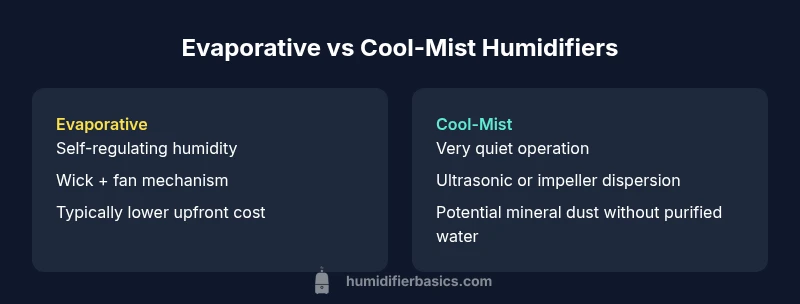
According to HumidifierBasics, the choice between an evaporative humidifier and a cool-mist model affects daily use, maintenance, and long-term costs more than most homeowners expect. The term evaporative humidifier vs cool mist describes two different approaches to delivering humidity: the evaporative relies on a wick and fan, while cool-mist designs disperse a mist using ultrasonic vibration or an impeller. In practice, your decision hinges on room size, noise tolerance, ease of care, and how you manage minerals in your water. In this guide, we break down the core differences, debunk myths, and give practical buying tips to help homeowners and renters.
How evaporative humidifiers work
Evaporative humidifiers rely on a wetted wick or filter that sits in contact with a water reservoir. A small fan pulls air through the damp filter, evaporating water into the airstream and releasing humidity into the room. The physics behind evaporative cooling means the more humidity in the air, the slower the evaporation rate becomes, giving a natural self-regulating behavior. This makes evaporative models particularly resilient against over-humidification in typical homes. Maintenance centers on changing or cleaning the wick or filter when mineral buildup appears and keeping the reservoir tidy to prevent mold growth.
How cool mist humidifiers work
Cool-mist humidifiers come in two main variants: ultrasonic and impeller. Ultrasonic units use a tiny vibrating diaphragm to create a fine mist that is dispersed into the room; impeller types scull water into a fan-driven disc to produce droplets. The result is often a very quiet operation with a visible mist plume. A common consideration with cool-mist models is mineral dust if the water isn’t purified; many users opt for distilled water or mineral cartridges to minimize residue on furniture, floors, and walls.
Core differences in design and operation
The most obvious difference is the mechanism: wick plus fan versus ultrasonic or impeller dispersion. Evaporative systems naturally limit humidity rise due to the air passing through an evaporation barrier, whereas cool-mist units have less intrinsic humidity control without a built-in humidistat. Wick-based evaporation tends to require more regular filter/wick maintenance, while ultrasonic systems demand cleaning to prevent mineral buildup. Size and shape considerations also matter: evaporative units often have bulkier housings, while cool-mist devices can be compact and sleek, fitting tighter spaces.
Humidity control and perceived comfort
In typical dry climates, evaporative humidifiers deliver steady, comfortable humidity without overshooting. If your home experiences sudden drops in humidity, an evaporative model might maintain a more balanced indoor environment. Cool-mist humidifiers can reach target humidity quickly and with very low noise, but users may need a humidistat or manual controls to avoid over-humidification, especially in closed rooms or small apartments. Both types benefit from monitoring humidity with a reliable hygrometer to keep conditions in the comfort zone.
Maintenance and cleaning considerations
Maintenance is a recurring theme with both technologies. Evaporative humidifiers require periodic wick or filter replacement, as these components trap minerals and contaminants. Regular cleaning of the reservoir and base reduces mold risk and improves efficiency. Cool-mist devices typically require regular cleaning to prevent mineral buildup on a vibrating diaphragm or impeller disc and to remove settled dust. If you choose a model with a demineralization cartridge, remember to replace cartridges according to manufacturer recommendations to maintain performance.
Health, safety, and mineral dust considerations
Mineral dust is a common concern with cool-mist humidifiers if you use tap water. Using distilled or demineralized water significantly reduces visible residue and particle emission. Evaporative models inherently trap minerals in the wick, which can minimize dust in the room. Both types should be cleaned regularly and kept away from mold-prone areas like damp basements or poorly ventilated rooms. For households with sensitive occupants, selecting a model with a built-in humidistat and automatic shutoff adds a safety margin.
Energy use, noise, and daily experience
Energy usage tends to be modest for both options, with evaporative models relying on a small fan and a passive evaporation process, and cool-mist units often designed for low-energy ultrasonic operation. Noise is a practical differentiator: evaporative units generate a soft hum from the fan, while ultrasonic cool-mist devices are typically among the quietest appliances in a room. If you work in a bedroom or home office, a quiet model or one with a sleep mode can be a decisive factor in comfort and productivity.
Suitability by room size and climate
For larger rooms, evaporative humidifiers with appropriately sized wick assemblies can deliver more uniform humidity without aggressive overshoot, making them well-suited for living areas and open-plan spaces. In smaller rooms or bedrooms, compact cool-mist units may offer the best balance of comfort and discreet operation. In humid climates, both types benefit from precise humidity control to avoid excess moisture and potential mold growth. When choosing, consider the ceiling height, room volume, and whether the space is well-ventilated.
Practical buying guide and feature checklist
When shopping, prioritize a model with an adjustable humidistat, clear humidity readings, and an easy-to-clean reservoir. Evaporative models benefit from easy wick replacement and accessible cleaning ports; cool-mist units shine when they include a true HEPA-type filter or a mineral cartridge and a display that shows current humidity. Look for auto-shutoff features, sturdy build quality, and availability of replacement parts. Finally, weigh the maintenance burden against your daily routine and preferred quietness level to pick the right fit for your home.
mainTopicQuery
humidifier types
Comparison
| Feature | Evaporative Humidifier | Cool-Mist Humidifier |
|---|---|---|
| Moisture control | Self-regulating humidity via evaporation (less overshoot) | Model-dependent; can overshoot without a humidistat |
| Noise level | Moderate due to built-in fan | Very low to low (ultrasonic/impeller) |
| Maintenance needs | Wick/filter replacement; regular cleaning | Frequent cleaning; possible filters or cartridges |
| Mineral dust | Lower mineral dust risk (wick traps minerals) | Possible white dust without distilled water |
| Energy usage | Moderate (fan-assisted) | Low (ultrasonic/impeller) |
| Best room size | Mid-to-large rooms (depending on model) | Small-to-medium rooms (compact models common) |
| Price range | $40-150 | $50-200 |
What's Good
- Lower risk of mineral dust and white residue
- Self-regulating humidity reduces over-humidification
- Typically lower upfront cost and easier wick maintenance
- Widely available replacement parts and simple repair options
Negatives
- Requires regular wick replacement and more frequent maintenance
- Produces audible fan noise in some models
- Can be bulkier and less stylish for small spaces
- May require distilled water to minimize mineral buildup (in some cases)
Evaporative humidifiers offer reliable, cost-effective humidity control for larger rooms, while cool-mist models excel in quiet operation and compact spaces.
If you prioritize budget-friendliness and self-regulating humidity, evaporative is typically the better baseline choice. If you need near-silent operation in a small space, cool-mist is often the better fit. Use room size, maintenance willingness, and noise tolerance to decide.
FAQ
What is the main difference between evaporative humidifiers and cool-mist humidifiers?
Evaporative humidifiers rely on a wetted wick and a fan to evaporate water, naturally regulating humidity. Cool-mist humidifiers disperse a mist using ultrasonic vibration or an impeller and can operate more quietly, with mineral dust risks if water isn’t purified.
Evaporative uses a wick and fan, cool-mist uses ultrasonic or impeller—quiet models exist in both categories.
Is evaporative humidifier better for allergy sufferers?
Allergy-friendly options depend on maintenance. Evaporative models tend to trap minerals in the wick, which can reduce dust. Regular cleaning and using clean water help minimize allergens in either type.
Maintenance matters for allergies—keep filters and wicks clean and use clean water.
Do evaporative humidifiers produce white dust?
Evaporative units typically produce less white dust than some cool-mist units because minerals stay trapped in the wick. If you do see residue, switch to distilled water or cheaper demineralization cartridges in compatible models.
White dust happens if minerals aren’t controlled; evaporative units tend to curb that risk.
Can I use distilled water in evaporative humidifiers to reduce mineral buildup?
Using distilled water is generally recommended to minimize mineral buildup in both types, but evaporative humidifiers are less prone to visible mineral dust due to the wick’s filtration role.
Yes—distilled water helps, especially with cool-mist models, but evaporative units rely on the wick to reduce minerals anyway.
Which is quieter: evaporative or cool mist?
Cool-mist humidifiers using ultrasonic technology are typically quieter than most evaporative models, which have a small fan producing a soft hum. If you need stealth operation, look for sleep modes and low-noise designs.
Ultrasonic cool-mist models are usually the quieter option.
Are evaporative humidifiers safe for children and pets?
Both types are generally safe when operated as directed. Prioritize models with automatic shutoff, easy cleaning, and non-slip bases to minimize accidental contact with water or moving parts.
Safety features and proper placement matter for homes with kids and pets.
The Essentials
- Assess room size before buying
- Prefer evaporative for self-regulating humidity
- Choose cool-mist for quiet operation in small spaces
- Plan for wick/cartridge maintenance and cleaning
- Use distilled water to minimize mineral residues