Diffuser vs Humidifier: A Practical Guide
Compare diffusers and humidifiers to decide which device fits your space, humidity goals, and lifestyle. This HumidifierBasics guide covers aroma vs humidity, safety, maintenance, costs, and setup to help homeowners choose wisely.


Diffusers and humidifiers serve different core purposes: scent versus humidity. A diffuser disperses essential oils into the air, delivering fragrance and potential relaxation benefits, while a humidifier adds moisture to improve comfort in dry environments. According to HumidifierBasics, your choice should prioritize the primary need—aroma or humidity—and consider room size, maintenance, and safety.
What is a diffuser?
A diffuser is a small device designed to release fragrance into the air by dispersing essential oils or scented blends. Most diffusers use ultrasonic vibration to create a fine mist, which carries aromatic molecules throughout the room. They are popular for creating mood, ambiance, and therapeutic sensations associated with certain oils. In practice, a diffuser focuses on scent delivery rather than boosting room humidity, making it ideal for living rooms, bedrooms, or home offices where fragrance and atmosphere matter more than climate control. When you think about diffuser vs humidifier, the key distinction is intention: aroma and ambiance versus measurable moisture. For people who crave scent-enhanced spaces, a diffuser can offer reliable, low-maintenance fragrance without the humidity changes that come with a humidifier.
What is a humidifier?
A humidifier is a device designed to add moisture to the air to alleviate dryness and improve perceived comfort. It converts water into vapor, steam, or a cool mist that disperses through a room to raise humidity levels. Humidifiers are measured by how much humidity they can deliver and how evenly they spread moisture across space. They are especially useful in dry climates, heated homes in winter, or rooms with low humidity that cause dry skin, irritated nasal passages, or static electricity. Unlike diffusers, humidifiers are primarily focused on humidity rather than fragrance, and their effectiveness depends on room size, airflow, and the relative humidity you are trying to reach.
Core differences at a glance
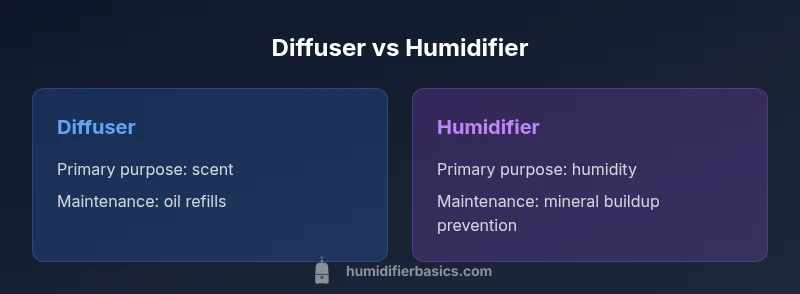
- Primary purpose: Diffuser for scent; humidifier for humidity.
- Moisture delivery: Diffuser uses a scented mist; humidifier adds un-scented moisture (unless paired with essential oil compatible units).
- Oil compatibility: Diffusers support essential oils; most humidifiers are oil-free or oil-incompatible unless specifically designed for oils.
- Room suitability: Diffusers fit small to medium spaces for aroma; humidifiers work across larger rooms for humidity control.
- Maintenance: Diffusers require oil refills and regular cleaning of the reservoir and nozzles; humidifiers require regular cleaning to prevent mineral buildup and mold.
- Noise and energy: Both models are generally quiet with similar energy use, depending on features.
Aroma delivery versus humidity delivery
A diffuser's primary value is scent, but it also creates a visually pleasant mist. The aroma can influence mood, focus, and relaxation, but the amount of humidity generated is typically modest. A humidifier prioritizes humidity; it can be tuned to reach a target relative humidity (RH) range and often includes humidistat controls. In real-world homes, you rarely need a single device to satisfy both goals; choosing the right device is about your main objective and space constraints. For example, a small apartment living room may benefit from a diffuser for fragrance and ambiance, while a bedroom or nursery may benefit more from a humidifier to ease nighttime dryness.
Scent safety and essential oil considerations
Essential oils are concentrated and potent. When used in diffusers, they can cause irritation for some people or pets if misused. Always dilute according to manufacturer guidelines, keep oils away from children and pets, and ensure good ventilation. Choose high-quality oils, and be aware that some oils are not recommended for households with pregnant people or pets. In contrast, humidifiers that are oil-compatible require caution: some units can distribute oil particles, which may leave residues or affect air quality. If in doubt, stick to plain water in a non oil-specific humidifier and reserve essential oils for a dedicated diffuser.
Room size, humidity targets, and coverage
For a diffuser, room size matters for scent diffusion. Smaller rooms easily absorb aroma, while scent may fade in open floor plans. For humidifiers, room size determines the required output; larger rooms need more powerful or multiple units to maintain a healthy RH. A typical target RH is comfortable around 40–60%, depending on climate and season. Use a humidistat or built-in sensors to monitor RH and avoid over-humidification, which can lead to condensation or mold. In spaces with poor insulation, even a humidifier with a strong output may struggle to reach the desired RH, making space planning a key factor.
Maintenance, cleaning, and lifespan
Regular maintenance prolongs device life and air quality. For diffusers, rinse the reservoir between uses, wipe down any residue where oils may accumulate, and replace pads or reeds as recommended. For humidifiers, clean weekly and sanitize periodically to prevent mineral build-up and microbial growth. Use distilled water where possible to minimize scaling. According to HumidifierBasics analysis, regular cleaning is essential to prevent microbial growth and ensure consistent performance. Always follow the manufacturer’s instructions for safe operation and oil compatibility to avoid damaging the unit.
Noise, energy use, and operating costs
Both diffusers and humidifiers are generally low-energy devices, but energy use scales with features like high-output modes, built-in fans, or warm-mist heating. In practice, diffusers may run continuously in aroma-mode without significant energy impact, while humidifiers in higher output settings will consume more electricity. Operational costs include replacement oils or fragrance cartridges for diffusers and mineral filters or cartridges for humidifiers. Budget-conscious buyers can look for auto-shutoff, timers, and energy-star rated components to maximize efficiency and minimize ongoing costs.
Water quality, minerals, and filtration
Humidifiers that rely on tap water can accumulate mineral deposits from hard water. Mineral buildup can reduce efficiency and distribute particles in the air. Filtered or distilled water helps extend maintenance intervals and improve air quality. Some humidifiers include demineralization cartridges or rinse cleaners to reduce scale. Diffusers do not typically interact with water quality beyond the bottle and its carrier oil; however, using poor-quality oils can affect scent and residue.
Using diffusers and humidifiers together vs separately
If you want both scent and humidity, you can use both devices in different rooms or consider a two-in-one hybrid device if available. Most households find separating functions reduces complexity and maintenance. If you live in a climate with persistent dryness or seasonal allergies, prioritizing humidity with a humidifier while keeping a diffuser for scent in the common areas can offer a balanced air experience.
Quick-start setup: Step-by-step guide
- Define your goal: humidity target vs scent. 2) Measure room size and pick the appropriate model. 3) Buy high-quality oils and, for humidifiers, distilled water. 4) Establish a regular cleaning schedule and safety checks to maintain air quality and device longevity.
Common mistakes to avoid
Avoid using essential oils in humidifiers that are not designed for oils, as this can damage the unit and alter performance. Do not overfill reservoirs or leave devices running unattended in unventilated spaces. Regularly clean mineral buildup and replace any worn seals or filters. Always verify compatibility with your room occupants, including pets and children, and maintain proper ventilation when using fragrance products.
Comparison
| Feature | Diffuser | Humidifier |
|---|---|---|
| Primary purpose | Aromatherapy and scent delivery | Humidity generation and air moisture |
| Mist type | Scented mist with essential oils | Un-scented or oil-compatible mist for humidity |
| Oil compatibility | Supports essential oils | Oil compatibility varies; many require water-only use |
| Room suitability | Small to medium spaces | Medium to large rooms or whole rooms |
| Maintenance | Oil refills and regular cleaning | Regular cleaning to prevent mineral buildup |
| Noise | Low to moderate, depends on model | Low to moderate, depends on model |
| Cost range | Low to mid-range | Mid to high depending on capacity and features |
What's Good
- Clear purpose-based choices for scent or humidity
- Wide price range to fit budget
- Low learning curve for basic operation
- Flexible placement across rooms
Negatives
- Diffusers offer limited humidity impact in large spaces
- Humidifiers require regular cleaning to prevent mold/mineral buildup
- Oil aromatics can irritate sensitive individuals or pets if misused
- No single device reliably delivers strong humidity and fragrance simultaneously
Choose the device that matches your primary air-quality goal: scent or humidity.
If your priority is fragrance and ambiance in smaller spaces, a diffuser is your best bet. If you mainly need to improve room humidity, a humidifier is the more effective choice. For mixed needs, consider using both devices in different spaces or a model designed for compatibility with oils if available.
FAQ
What is the main difference between a diffuser and a humidifier?
The diffuser primarily disperses essential oils to scent the air, while a humidifier adds moisture to increase relative humidity. They serve different core purposes and are not always interchangeable.
Diffusers scent the air with essential oils, while humidifiers add humidity. They serve different goals.
Can I use essential oils in a humidifier?
Most humidifiers are not designed for essential oils; using oils can damage the unit or alter humidity delivery. If you want oils, use a dedicated diffuser or an oil-compatible device.
Usually not recommended; use a diffuser for oils unless the humidifier specifically supports them.
Are diffusers safe for pets?
Pet safety varies by oil and species. Many essential oils can be harmful to cats and dogs in concentrated form. Use diffusers with caution and ventilate well, or consult a veterinarian.
Be careful with pets—some oils can be harmful. Check with a vet if you have animals.
Which device is cheaper to operate?
Upfront costs vary by model, but diffusers are commonly cheaper to start. Humidifiers may cost more upfront and use more electricity, depending on features and room size.
Diffusers are often cheaper to start, but overall cost depends on usage and model.
Can a diffuser humidify a large room?
Diffusers generally provide limited humidity and are not designed for large-scale humidification. For larger rooms or whole-home humidity, use a humidifier or multiple units.
Diffusers won’t humidify a large room effectively.
How should I clean each device?
Diffusers should be rinsed and wiped after use, with occasional pad or wick replacement. Humidifiers require weekly cleaning and periodic sanitizing to prevent mineral buildup and mold.
Clean diffusers with warm water and mild soap; clean humidifiers weekly according to the manual.
The Essentials
- Define your primary goal: scent or humidity.
- Match room size to device capacity for effective results.
- Plan maintenance: oils for diffusers, cleaning for humidifiers.
- Use distilled water to minimize mineral buildup in humidifiers.