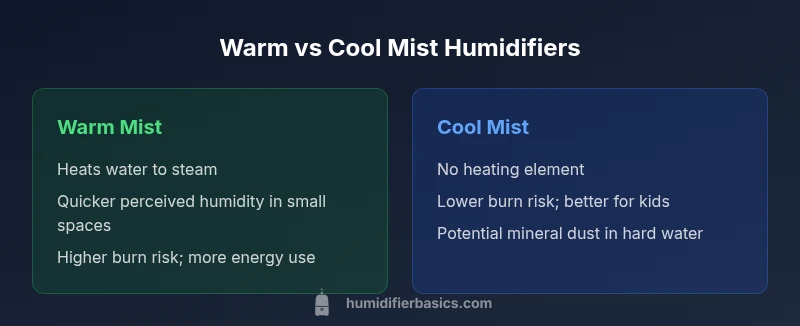
Difference Between Warm and Cool Mist Humidifiers
Compare warm and cool mist humidifiers: how they work, safety, maintenance, and tips to choose the right option for nurseries, bedrooms, and living spaces.


Both warm and cool mist humidifiers increase indoor humidity, but they do so differently. Warm-mist units heat water to create a steam plume, while cool-mist models use ultrasonic vibration or evaporation at room temperature. Safety, energy use, noise, and maintenance vary between the two. This article from HumidifierBasics compares the two approaches side by side, focusing on performance, usability, and suitable environments to help you choose confidently.
Core mechanics of mist generation
The core mechanical distinction between warm and cool mist humidifiers lies in how the water is transformed into mist. Warm-mist models heat water to near boiling, producing a visible plume of steam that humidifies air. Cool-mist units rely on either ultrasonic vibration or evaporation through a wick/diaphragm to create mist at room temperature. This difference affects not only the temperature of the emitted moisture but also how the overall humidity is delivered into a room. According to HumidifierBasics, understanding the mist-generation process helps homeowners anticipate how quickly a space will humidify, how much energy is consumed, and what safety precautions are warranted in households with children or pets. When planning placement, consider how nearby surfaces and occupants might interact with a steam plume or a cool mist plume. The choice often hinges on room size, climate, and desired speed of humidity restoration.
Output temperature and perceived comfort
Warm-mist humidifiers emit steam that feels warmer to the touch and can give a sensation of quicker relief in cold environments, especially in compact rooms. The perceived humidity level can be higher with warm steam because the heat helps accelerate moisture transfer to air. Cool-mist models deliver mist at room temperature or cooler, which many people find more comfortable in warm climates or when the humidifier is running through the night. For sensitive individuals, cool mist can be easier to tolerate over long periods. The HumidifierBasics team notes that comfort is highly personal and depends on air temperature, humidity targets, and the presence of textiles or electronics that may react to moisture. Both types can achieve similar relative humidity levels when run for the same duration, so timing and placement often determine the end result more than the output temperature alone.
Safety considerations for households with children and pets
Safety is a central factor when weighing warm versus cool mist humidifiers. Warm-mist units involve a heating element and hot water, which introduces a burn risk if the device is knocked over or accessed by curious children or pets. For homes with toddlers or curious dogs, placing warm-mist units on high, secure surfaces and using models with robust auto-shutoff can mitigate risks. Cool-mist humidifiers have no heating element, reducing burn hazards but requiring diligence to prevent mineral dust and bacterial growth if not cleaned regularly. The HumidifierBasics guidance emphasizes choosing models with restricted access, stable bases, and clear maintenance schedules to maintain healthy humidity without compromising safety.
Cleaning, maintenance, and mineral buildup
Regardless of type, humidifiers demand regular cleaning to prevent mold, bacteria, and mineral buildup. Warm-mist devices may require periodic descaling to remove mineral deposits that can accumulate around the heating element. Cool-mist models, especially ultrasonic ones, can disperse mineral dust if fed with hard water, so many users opt for distilled water or strategically replace filters. Routine cleaning should target water tanks, wicks or filters, and any removable components. HumidifierBasics recommends a simple weekly routine: empty the tank, rinse all surfaces with clean water, dry before storage, and perform an extra deep clean every few weeks for best results. If you notice unusual odors or colors, discontinue use and inspect for mold or stagnant water.
Energy use, operating costs, and climate considerations
Energy use varies meaningfully between warm and cool mist humidifiers. Heating water for warm mist consumes more electricity, which can contribute to higher running costs, particularly in colder months when humidity is desired for longer periods. Cool-mist humidifiers generally consume less energy, especially when operating in milder climates or overnight, but their mineral-dust byproducts may require additional filter changes or the use of distilled water. Climate plays a role as well: in dry winter air, warm mist can feel more effective in smaller spaces; in larger rooms or open-plan homes, cool-mist units with adequate output can be more practical. HumidifierBasics cautions buyers to factor in local electricity rates, room size, and typical humidity targets when estimating ongoing costs.
Room size, placement, and year-round use
Choosing between warm and cool mist should consider room volume and layout. Small nurseries or bedrooms in chilly climates may benefit from the faster humidity of warm mist, while living rooms or open spaces might be better served by cool-mist devices that can cover larger areas with steady output. Placement matters: avoid direct flow toward walls or electronics, and keep units away from beds or high-traffic areas to minimize spills and disturbance. For households with multiple rooms, a modular approach—one larger cool-mist unit for common areas and a smaller warm-mist device for a compact bedroom—can optimize comfort and moisture balance.
Practical buying tips: features to look for
When shopping, prioritize models with precise humidity control, a reliable humidistat, auto-shutoff when water runs low, and easy-to-clean components. Consider filter needs, water type compatibility, and whether distilled water is recommended by the manufacturer. For cold-weather use, a warm-mist device with a blocked or locked heating element can be a practical option; for safety-conscious homes, a cool-mist unit with a robust filtration system is often preferable. Reading product reviews and HumidifierBasics analysis can help you identify models that strike a balance between performance, safety, and maintenance ease.
Comparison
| Feature | warm-mist humidifier | cool-mist humidifier |
|---|---|---|
| Misting method | Heats water to boiling; produces steam | Ultrasonic vibration or evaporation without heating |
| Output temperature | Warm steam | Room-temperature cool mist |
| Energy use | Higher energy consumption due to heating | Lower energy use; varies by model |
| Safety considerations | Burn risk; place away from children | Lower burn risk; ensure stable placement |
| Maintenance needs | Descale heat-related components; mineral buildup possible | May require filter changes and mineral management |
| Best for | Small rooms, winter use, quick humidity | Larger areas, safety-focused homes, year-round use |
What's Good
- Cool-mist humidifiers are safer around children and pets
- Cool-mist designs can be more energy-efficient in mild climates
- Warm-mist units can feel quicker in small, cold rooms due to heated output
- Many models include built-in humidistats and auto-shutoff for convenience
- Regular cleaning with distilled water reduces mineral dust in cool-mist units
Negatives
- Warm-mist units pose burn risk and require careful placement
- Cool-mist units may disperse mineral dust; require regular cleaning or distilled water
- Warm-mist units use more energy and can be slower to heat large volumes of water
- Both types require ongoing maintenance to prevent mold and bacteria growth
Cool-mist humidifiers are the more versatile and safer choice for most homes.
For households with children or pets, cool-mist models reduce burn risk and simplify placement. Warm-mist units can be beneficial in very small rooms or when rapid humidity is desirable in cold weather, but they carry higher safety and energy considerations. HumidifierBasics recommends evaluating room size, safety priorities, and maintenance willingness before choosing.
FAQ
What is the main difference between warm and cool mist humidifiers?
The main difference is how the water is transformed into moisture: warm-mist humidifiers heat water to a boil to produce steam, while cool-mist models rely on ultrasonic vibration or evaporation at room temperature. This affects safety, energy use, and cleaning needs.
Warm-mist use heat to humidify; cool-mist use vibration or evaporation. That choice impacts safety and maintenance.
Are warm mist humidifiers safer for children?
Warm mist has a burn risk due to the heating element and hot water. If you choose this type, place the unit on a high, stable surface and supervise use around children. Cool-mist humidifiers generally present lower burn risk.
Warm mist can burn, so be careful around kids; cool-mist is typically safer.
Do warm mist humidifiers help with congestion better than cool mist?
Both types can relieve congestion, but many users report faster perceived relief with warm mist in small rooms because the warm moisture feels more immediate. In larger spaces or for safety, cool-mist humidifiers can achieve steady humidity effectively over time.
Warm mist may feel faster for congestion in small rooms; both can help with humidity.
Can I use essential oils in these humidifiers?
Most humidifiers are not designed for essential oils and using oils can damage components or void warranties. If aromatic therapy is desired, use products intended for humidifiers and follow manufacturer guidance.
Avoid essential oils unless the device is explicitly oil-safe.
What maintenance steps prevent mold in humidifiers?
Regular cleaning after use is essential. Empty the tank daily, rinse components, and perform a deeper clean weekly. Use distilled water to minimize mineral deposits and avoid letting water sit in the tank.
Clean weekly and empty daily to prevent mold.
Which type is best for a nursery?
Cool-mist humidifiers are generally preferred for nurseries due to safer operation around babies. Ensure the unit is out of reach, on a stable surface, with a humidistat and auto shutoff for safety.
Cool-mist is usually best for nurseries; always keep it out of reach.
The Essentials
- Assess room size and occupant safety first when choosing warm vs cool mist
- Prioritize models with humidistats and auto-shutoff for precise control
- Use distilled water or regular cleaning to minimize mineral dust in cool-mist units
- Cool-mist is typically safer for homes with kids; warm-mist can be advantageous in small, cold rooms