Cold vs Hot Humidifier: Practical Comparison Guide
A data-driven comparison of cold-mist and warm-mist humidifiers, covering safety, energy use, maintenance, and best-use scenarios to help homeowners choose the right unit for their space.


Cold vs hot humidifier: For most homes, cold-mist models are quieter, energy-efficient, and safer around children, while warm-mist units can warm a room slightly and may reduce some bacteria. The HumidifierBasics team finds that the right choice depends on room size, climate, and safety needs. Read our detailed comparison to see which option fits your home.
Core Differences in Practical Terms
When you hear the phrase cold vs hot humidifier, you’re really choosing between two approaches to adding moisture to indoor air. Cold-mist devices typically use evaporation or ultrasonic technology to create a fine mist without heating the water. Warm-mist units boil water to produce steam, delivering a slightly warmer mist. The practical difference for most households is not just temperature, but how the device handles minerals, noise, and maintenance. According to HumidifierBasics, your decision should hinge on safety for kids and pets, room size, and how much you value warmth during dry seasons. Understanding these core differences helps narrow the field before you compare models.
How They Work: Heating vs Non-Heating Mechanisms
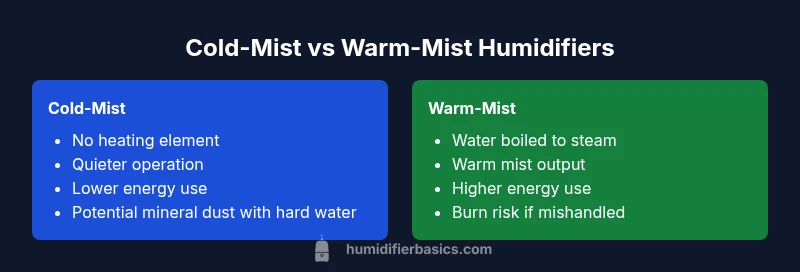
A cold-mist humidifier usually relies on a fan-driven evaporative process or ultrasonic vibrations to atomize water into a cool mist. No heating element is required, which generally reduces burn risk and energy usage. Warm-mist humidifiers boil water to create steam, releasing a humid vapor. The heating process can slightly improve perceived warmth in a room and may reduce certain bacteria, but it also uses more energy and has a higher burn risk if left unattended. This mechanical distinction underpins many of the safety, maintenance, and odor considerations you’ll encounter when comparing the two.
Safety and Maintenance Baselines
Safety-minded households often prioritize cold-mist units due to the absence of hot surfaces. From a maintenance standpoint, cold-mist devices may accumulate mineral dust if you use hard water and require regular filter or wick cleaning. Warm-mist units tend to scale the heating element with mineral deposits, needing occasional descaling and more attentive cleaning of the reservoir. Both types benefit from using distilled or demineralized water to minimize mineral buildup and white dust. The HumidifierBasics team notes that routine cleaning, safe storage, and proper placement away from furniture are essential for both varieties.
Room Suitability: Size, Noise, and Aesthetics
Room size and noise tolerance heavily influence the pick. Cold-mist humidifiers are commonly preferred for larger spaces or bedrooms where low noise is a priority, because many ultrasonics run quietly and without heated components. Warm-mist models can be more compact for the same humidity output but may emit more noticeable sound when the boiling process is active. Aesthetically, both types come in compact, sleek designs that blend with modern living spaces, though warm-mist units may have visible steam in some models. If you’re aiming for a near-silent night, cold-mist often edges ahead in practice, especially in shared sleeping spaces.
Health Considerations and Air Quality
Humidity levels that are too high or too low can irritate respiratory conditions. Cold-mist humidifiers typically offer precise control via humidistat, which helps maintain comfortable indoor humidity without overshooting. Warm-mist devices, while capable of killing some bacteria through boiling, don’t guarantee sterile air and still require cleaning to prevent mold growth on warm surfaces. For people with allergies or asthma, stable humidity with a clean water supply is key, regardless of the mist type. Humidifier pilots who track moisture levels report better comfort when using a device with automatic shutoff and a reliable filter.
Water Quality, Minerals, and Dust: What to Expect
Mineral deposits, or white dust, are a common topic when discussing cold vs hot humidifiers. Cold-mist units can aerosolize minerals more readily if the water is hard, unless filters or descaling routines are in place. Warm-mist units boil water, which can reduce the number of live microbes but still leaves mineral residues on heating elements and in the reservoir. Using distilled water minimizes mineral buildup and reduces the risk of white dust for both types. Regular cleaning is essential to prevent mold and bacteria from thriving in damp reservoirs, regardless of the chosen method.
Energy Use and Operating Costs
Energy consumption is a practical consideration for many households. Cold-mist humidifiers generally consume less electricity because there is no heating element. Ultrasonic cold-mist models can operate efficiently for many hours with modest energy use. Warm-mist units incur energy costs related to heating water, which can be noticeable during longer use or in cooler climates where you run the device more often. If you live in a climate where you run a humidifier most of the day, a cold-mist model may yield lower ongoing costs, while a warm-mist unit could justify its higher energy draw with warmth during winter or in small rooms.
Cleaning and Maintenance Routines: A Practical Schedule
Both types benefit from a routine maintenance routine. Weekly tasks include washing the reservoir with mild soap, scrubbing mold-prone corners, and checking for scale if you have hard water. Filter replacements should follow the manufacturer’s schedule, usually every 1–3 months depending on water quality and usage. For warm-mist units, descale mineral buildup periodically and clean heating components to prevent hot spots or odors. For cold-mist units, monitor filter life and replace as needed to maintain efficient mist output. Establishing a predictable routine saves time and protects air quality.
Common Misconceptions Debunked
Myth: Warm-mist humidifiers sterilize the air. Reality: Boiling water reduces some microbes, but it does not guarantee a sterile environment. Myth: Cold-mist humidifiers create dust is false when used with clean water and proper filtration. Reality: Mineral dust can occur with hard water, but appropriate filters and regular cleaning minimize the issue. Myth: Warm-mist units are always safer around kids. Truth: The heat source adds burn risk; placement and supervision matter. Distinguishing myths from evidence helps you choose with clarity.
How to Choose Based on Your Home
Selection hinges on several factors: room size, presence of children or pets, climate, noise sensitivity, and maintenance willingness. If you prioritize low noise and lower energy use, cold-mist is often best for bedrooms and larger living areas. If you want a bit of passive warmth during dry winter days and you have a small room, a warm-mist unit can be advantageous, keeping safety considerations in mind. A balanced approach is to list needs, compare features like humidistat, filter availability, and cleaning ease, then pick a model that aligns with your daily life.
Practical Setup Scenarios: Bedroom, Living Room, Nursery
For a quiet master bedroom, a cold-mist ultrasonic model with a rated moisture output and automatic shutoff is ideal. In a living room where guests congregate, consider a mid-size cold-mist unit that maintains humidity without visible heat or steam. In nurseries or child spaces, safety is paramount; choose a cold-mist model with a sealed reservoir, a reliable filter system, and a reminder system for maintenance. For winter cabins or homes with extremely low ambient temperatures, a compact warm-mist unit can offer a touch of warmth plus humidity, but keep it elevated and away from sleeping areas to avoid burns.
Maintenance Schedule and Troubleshooting Quick Guide
Create a simple calendar: weekly reservoir rinse, monthly filter checks, and quarterly descaling for hard-water areas. If you notice reduced output, inspect filters and mineral deposits, and replace filters as needed. If you observe unusual odors or foggy windows near the unit, clean the interior surfaces, empty the reservoir, and reassemble with fresh water. For persistent issues, consult the manufacturer’s troubleshooting guide, and never operate a unit with a damaged cord or housing. Regular upkeep preserves performance and indoor air quality.
Comparison
| Feature | cold-mist humidifier | warm-mist humidifier |
|---|---|---|
| Heating mechanism | No heating element (evaporation/ultrasonic) | Built-in heating element boils water |
| Noise level | Generally quiet to moderate; depends on model | Usually quiet but can be perceptibly louder due to boiling |
| Energy usage | Lower energy consumption | Higher energy use due to heating |
| Safety around children | Lower burn risk (no hot surfaces) | Burn risk exists from steam and hot surfaces |
| Water quality impact | Mineral dust possible; use filters/distilled water | Boiling reduces microbes; mineral scale can form on elements |
| Maintenance frequency | Moderate (filters, regular cleaning) | Higher (descaling heating element, more frequent cleaning) |
| Price range (typical) | Lower upfront cost | Higher upfront cost |
| Best room size | Medium to large rooms (with adequate output) | Small to medium rooms; can provide warmth |
What's Good
- Lower upfront cost and energy use (cold-mist)
- Quieter operation generally (cold-mist)
- Safer for households with kids and pets (no exposed hot surface)
- Flexible placement and maintenance schedules (both types)
- Less risk of burns when used properly (cold-mist)
Negatives
- Mineral dust can occur with hard water unless filtered or distilled water is used
- Warm-mist units pose burn risk due to boiling water and hot surfaces
- Heavier mineral buildup on heating elements can require more descaling (warm-mist)
- Cold-mist models may require filters and more frequent cleaning to prevent mold
Cold-mist humidifiers are the clear general-purpose choice for safety and cost efficiency, while warm-mist units serve niche scenarios where a bit of warmth and compact sizing matter.
Choose cold-mist for quiet operation, lower energy use, and safer environments around children. Opt for warm-mist if you need slight room warmth in a small space and can manage the higher maintenance and safety considerations.
FAQ
What is the main difference between cold-mist and warm-mist humidifiers?
The main difference is how they generate moisture: cold-mist units use evaporation or ultrasonic methods with no heating, while warm-mist units boil water to emit steam. This affects safety, energy use, and maintenance.
Cold-mist humidifiers use no heat, which makes them safer for homes with kids and pets. Warm-mist units boil water and can offer a bit of warmth but need careful handling.
Are cold-mist humidifiers safer for children and pets?
Generally yes, because there are no hot surfaces or boiling liquids. However, you must still place the unit away from reach and follow cleaning guidelines to prevent mold or mineral buildup.
Yes, cold-mist humidifiers are safer around kids since there’s no hot steam or surface to touch.
Do warm-mist humidifiers kill bacteria?
Boiling water in warm-mist units can reduce some microbes, but it does not guarantee a sterile environment. Regular cleaning remains essential.
Boiling helps, but you still need to clean the unit regularly to keep the air clean.
Can I use tap water in either type of humidifier?
Tap water is common, but high mineral content can lead to mineral dust and mineral buildup. Using distilled water or treating the water reduces these issues.
Tap water works, but distilled water is better for less mineral dust and cleaner operation.
Which humidifier is quieter for a bedroom setting?
Most cold-mist humidifiers—especially ultrasonic models—are quieter than warm-mist units; choose a model with a low-noise rating for best results in bedrooms.
Cold-mist humidifiers are usually quieter, which is great for bedrooms.
The Essentials
- Prioritize safety and noise for bedrooms
- Use distilled water to reduce mineral dust
- Cold-mist generally saves energy and cost over time
- Warm-mist offers warmth but requires careful supervision
- Regular cleaning is essential for both types