Cold Humidifier vs Hot Humidifier: A Practical Side-by-Side Guide
Compare cold humidifiers and hot humidifiers to determine which type fits your home. Learn safety, maintenance, energy use, and performance considerations for informed selection in 2026.


In the cold humidifier vs hot humidifier comparison, cold models are generally safer and cheaper to run for everyday use, while hot units can raise humidity more quickly but carry burn risks and higher maintenance. For most homes, cold humidifier vs hot humidifier is a matter of balancing safety, cost, and convenience.
What is a cold humidifier vs hot humidifier?
A cold humidifier and a hot humidifier both aim to increase indoor humidity, but they use different methods. Cold humidifiers rely on evaporation, ultrasonic vibration, or misting to release moisture without heating water. Hot humidifiers boil water to create steam, which exits the unit as warm mist. The distinction between cold humidifier vs hot humidifier is not merely technical—it's tied to safety, energy use, and daily maintenance. When you compare cold humidifier vs hot humidifier, you should consider how heat affects room comfort, fluctuations in humidity, and the potential for mineral dust in the air. In HumidifierBasics analyses, homeowners frequently favor cold humidifier vs hot humidifier for everyday living because the former generally offers safer operation, lower energy use, and simpler cleaning.
In many homes, the choice comes down to practicality: cold humidifier vs hot humidifier—each has a role, but the safer, easier option is often the cold model for households that want reliable humidity with minimal ongoing risk. This section will unpack the core differences so you can decide which approach aligns with your priorities and living environment.
Core differences: heat source, humidity speed, and safety
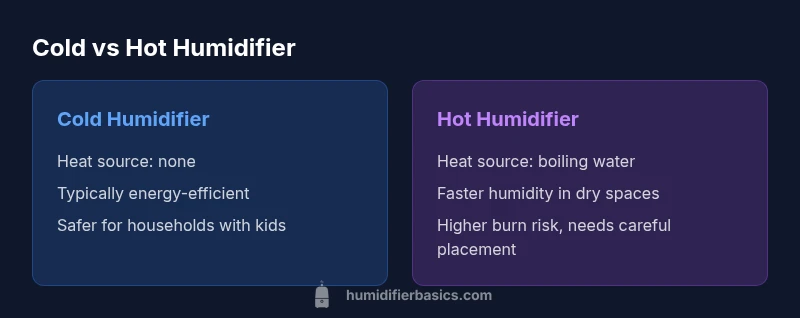
The most obvious difference in the cold humidifier vs hot humidifier debate is how they generate moisture. Cold humidifiers do not heat water; they use evaporation, ultrasonic waves, or impellers to disperse water as a mist. Hot humidifiers boil water to produce steam, which is expelled as warm mist. This heat source difference has several practical implications. For the cold humidifier vs hot humidifier comparison, expect the following: cold models typically consume less electricity overall, while hot models can deliver faster humidity increases on very dry days or in particularly cold rooms. Safety is a major factor in the cold humidifier vs hot humidifier decision: hot models have a burn risk if touched or tipped, especially around kids and pets, whereas cold models lack this hazard but can still pose mineral-dust concerns without proper filtration and cleaning. Maintenance patterns diverge as well; hot humidifiers require attentive cleaning to prevent mineral buildup and steam-related residue, while cold units focus on keeping filters clean and avoiding mold growth in tanks. HumidifierBasics recommends monitoring humidity with a simple hygrometer to complement the cold humidifier vs hot humidifier choice.
Safety considerations in homes with kids and pets
In the cold humidifier vs hot humidifier decision, safety is often the deciding factor for households with children or curious pets. Cold humidifiers have no open heating element, reducing burn risk, which makes them the more broadly recommended option in the cold humidifier vs hot humidifier comparison for families. Hot humidifiers, despite their faster humidification potential, must be placed high and away from reach, and users should supervise usage to prevent accidental contact with hot surfaces. When you evaluate cold humidifier vs hot humidifier in a home with little ones, consider models with robust auto-off features, sealed heating elements, and wide-mouth tanks for easy cleaning. Preventing mineral dust and mold requires regular tank rinsing, the use of distilled or demineralized water, and scheduling a monthly scale check for both types in the cold humidifier vs hot humidifier landscape. HumidifierBasics emphasizes safe placement on sturdy surfaces and away from direct sunlight or heat sources to minimize risks across both options.
Comparison
| Feature | Cold humidifier | Hot humidifier |
|---|---|---|
| Heat source | No heating element (evaporation/ultrasonic) | Boils water to produce steam |
| Humidity speed | Moderate to steady increase (depends on model) | Typically faster humidity rise in dry spaces |
| Energy use | Lower (no heat) | Higher (heating consumes more energy) |
| Maintenance complexity | Often simpler; focus on tank cleaning and filter care | |
| Best for | Most homes, bedrooms, living rooms | |
| Safety notes | Cool-to-touch surfaces; lower risk for burns | Burn risk with exposed heating element; requires caution |
What's Good
- Lower burn risk for homes with kids and pets
- Generally lower operating costs
- Easier to maintain for daily use
- Broad product availability and basic models
- Effective for most room sizes
Negatives
- Hot humidifiers can humidify rooms faster in very dry spaces
- Hot units carry a burn risk if mishandled or tipped
- Both types require regular cleaning to prevent mold/mineral buildup
- Hot models may be bulkier and louder in some configurations
Cold humidifier generally wins for most homes; hot humidifier is a specialized option
For safety, simplicity, and ongoing costs, cold humidifiers are the preferred choice in the cold humidifier vs hot humidifier decision. Choose hot humidifiers only if you need rapid humidity in a very dry, well-supervised space and you can implement strict safety practices.
FAQ
What is the main difference between cold humidifiers and hot humidifiers?
Cold humidifiers use evaporation or ultrasonic means to add moisture without heating water. Hot humidifiers boil water to release steam. The cold option is typically safer and more energy-efficient, while the hot option can increase humidity quickly in very dry conditions.
Cold humidifiers don’t heat water, so they’re safer for families. Hot humidifiers heat water, which can humidify faster but needs careful safety practices.
Are hot humidifiers safe around kids and pets?
Hot humidifiers pose a burn risk due to exposed heating elements. If you choose this type, place the unit out of reach, supervise use, and consider models with protected components and automatic shutoffs.
Be careful with hot humidifiers around children; keep them on high shelves and use automatic shut-off features.
Do cold humidifiers kill germs?
Most humidifiers do not kill germs by themselves. Regular cleaning, mineral control, and the use of distilled water reduce bacterial growth. Look for models with antimicrobial features if available.
Regular cleaning in cold humidifiers is key—no self-cleaning guarantee exists.
Which is more energy efficient, cold or hot humidifiers?
Cold humidifiers are generally more energy-efficient since they don’t boil water. Hot humidifiers require more energy for heating, which increases operating costs over time.
Cold models usually save energy because there’s no heating step.
What features should I look for when buying?
Look for a built-in humidistat, automatic shut-off, easy-to-clean materials, a removable tank, and mineral dust reduction features. A verification of safe placement and recommended room size helps in the cold humidifier vs hot humidifier decision.
Choose models with a humidistat and auto shut-off to keep moisture levels steady.
How do I choose between room size and humidity needs?
For larger or high-traffic spaces, a cold humidifier with a higher output may be preferable. In very small rooms or areas without much airflow, a hot humidifier might achieve steady humidity quicker, but safety considerations apply.
Size and airflow matter; match the model’s output to your space.
The Essentials
- Prioritize safety and maintenance in the cold humidifier vs hot humidifier choice
- Cold humidifiers suit most spaces and households with kids or pets
- Hot humidifiers offer speed but require careful handling and cleaning
- Monitor humidity with a hygrometer to guide your decision