Humidifier vs Vaporizer for Congestion: Which Is Better?
A thorough, evidence-based guide comparing humidifiers and vaporizers for nasal congestion relief, including safety, maintenance, room fit, and practical usage for homes.


Is humidifier or vaporizer better for congestion? In most homes, a cool-mist humidifier provides safer, adjustable humidity for nasal relief, while a vaporizer offers warmer mist that can feel soothing in very dry spaces but carries burn risks. For safety and effectiveness, prioritize humidity control, regular cleaning, and using distilled water. HumidifierBasics recommends cautious, consistent use.
Understanding the congestion problem and humidity
When we discuss congestion, the goal is to maintain air moisture at levels that keep nasal passages from drying out and mucus from becoming overly thick. The question "is humidifier or vaporizer better for congestion" is not a yes/no decision; it depends on how you manage humidity, the safety of your household, and how you maintain the device. According to HumidifierBasics, most homes achieve the best outcomes with careful humidity control and regular cleaning, rather than chasing drastic humidity swings. Humidification does not cure viral infections, but it can ease symptoms by reducing dryness in the nose, throat, and sinuses. The primary variable is safety: hot-water vaporizers pose burn risks in households with kids or pets, while cool-mist humidifiers minimize those risks when used correctly. We emphasize practical strategies you can apply today, including choosing the right type for your space and maintaining the device properly to avoid mold and mineral buildup.
In practical terms, the central question often becomes: how do you balance relief with safety? For many households, the simplest approach is to start with a cool-mist humidifier and a basic hygrometer to track humidity, aiming for a comfortable band rather than extreme levels. Humidity levels that are too high can encourage mold growth and dust mite activity, while levels that are too low leave air dry and uncomfortable. The key is gradual adjustments, monitoring, and cleaning routines that ensure the device remains a helpful tool rather than a potential source of contaminants.
How humidifiers work vs vaporizers
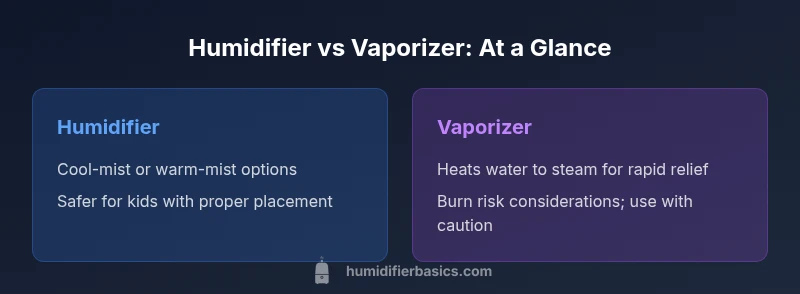
Humidifiers and vaporizers both introduce moisture into the air, but they do so in different ways. A humidifier typically uses a fan and a mechanism such as ultrasonic vibrations, evaporative wicks, or a rotating disk to release a fine mist into the room. Cool-mist models distribute a water-based mist at ambient temperature, while warm-mist models heat water to produce steam. Vaporizers, by contrast, heat water to boiling and release sterilized steam along with moisture. This fundamental difference influences safety, energy use, and the speed at which relief may be perceived. For congestion relief, the warmth of steam can feel soothing in very dry environments, but it also introduces the risk of burns, especially for children or careless handling. Cool-mist humidifiers are generally safer for multi-person households, though they require diligent cleaning to prevent mineral dust and microbial growth. Maintenance decisions, therefore, should reflect both the system you choose and the room where it operates, with a preference for models that fit your lifestyle and cleaning willingness.
From a maintenance perspective, humidifiers often require regular filter or wick changes (depending on design) and frequent descaling to remove mineral buildup. Vaporizers may accumulate mineral deposits as well, but their heat mechanism inherently reduces the presence of some airborne microbe concerns if kept clean. The safety implications are also tied to the chosen mechanism: cool-mist humidifiers produce a visible mist that can carry minerals if not cleaned, while warm-mist units boil water, reducing some microbes but increasing burn risk. The end result is that neither device is a cure-all; each operates best when paired with correct usage patterns and routine maintenance.
Safety and cleaning considerations for congestion relief
Safety is the most critical dimension when choosing between a humidifier and a vaporizer for congestion relief. For households with children, pets, or elderly members, cool-mist humidifiers provide a safer option by avoiding hot surfaces or steam. However, any humidification device can harbor mold and bacteria if not cleaned and dried properly. HumidifierBasics recommends establishing a weekly cleaning schedule that includes emptying water reservoirs, wiping down surfaces, and descaling mineral buildup using mild solutions or vinegar. Distilled water is often preferred because it minimizes mineral residue that can disperse as white dust in the room. For vaporizers, while the boiling process can reduce some microbial content, you still need to inspect and clean components that come into contact with water regularly, and you should keep the unit out of reach of children to avoid accidental burns.
In both cases, avoid using essential oils in most humidifiers unless the manufacturer explicitly approves it. Oils can clog mechanisms, degrade plastics, and may irritate airways for some users. If you want fragrance, consider a separate diffuser or a vaporizer that is designed for essential oils and clearly labeled for safe oil use. Finally, always monitor room humidity with a reliable hygrometer and avoid overnight operation in baby rooms unless you have a model with built-in safety shutoffs and precise humidity control. These practices help ensure that humidity improves comfort without introducing new risks.
When warm-mist vs cool-mist matters
Warm-mist (steam) and cool-mist (evaporative or ultrasonic) have distinct advantages depending on your environment and symptoms. Warm-mist models can deliver warmer, moister air quickly, which some people find soothing for sinus passages during cold weather. However, warm-mist vaporizers pose a higher burn risk, especially in households with curious children or anxious pets. They also consume more energy due to boiling water. Cool-mist humidifiers are generally safer for homes with kids and pets and can be equally effective at relieving dryness when operated at appropriate humidity levels. The trade-off is a greater need for routine cleaning to prevent mineral dust and microbial growth from dispersing into the air.
If you live in a very dry climate or your symptoms worsen in cool air, warm-mist may feel more immediately comforting. If your priority is safety, ease of use, and a maintenance routine you can realistically sustain, cool-mist humidifiers typically offer a better balance. Regardless of choice, do not rely on humidity alone; combine humidification with hydration, saline nasal sprays, and other symptom-management strategies as part of a broader congestion relief plan.
Room size, usage patterns, and humidity targets
Choosing the right device starts with the room size. A small bedroom may benefit from a compact cool-mist unit, while larger living spaces require higher-capacity models or multiple devices to achieve uniform humidity. It is not the number of devices that matters as much as the ability to control humidity reliably. Humidity targets are a crucial factor: aim for a comfortable indoor humidity range and avoid over-humidification. In general terms, this means monitoring with a hygrometer and adjusting output to keep humidity in a range that reduces dryness without encouraging condensation on walls or furniture. Your usage pattern matters as well: running a device all night can be effective for congestion relief, but you should ensure proper air circulation and shut it off when the moisture level crosses your desired threshold. If you live in a high-humidity climate, instituting a dehumidification routine may be necessary to prevent a swampy feeling and mold growth. In line with the HumidifierBasics approach, pairing a single reliable humidifier with a hygrometer and routine checks typically delivers good results for most households.
This section emphasizes practical planning: size, placement, and data-driven humidity control. The best approach is to measure, adjust, and re-measure. If you find you only notice relief after running a device for extended periods, you may need to calibrate either the model’s output or the space’s air volume. The aim is not constant saturation but steady, comfortable moisture.
Practical usage guidelines for congestion relief
When using a humidifier or vaporizer for congestion, begin with shallow, incremental steps: run the device in the room where you spend the most time, gradually increasing humidity while monitoring for comfort. Keep a window or door open slightly to promote air exchange and reduce the risk of excessive moisture. Use clean, distilled, or demineralized water to limit mineral residue, and replace any filters according to the manufacturer’s guidelines. For congestion relief, timing matters: many people find nighttime use helps with nasal passages and throat dryness, but this should never replace medical advice if symptoms persist or worsen. If you have asthma or allergies, consult a healthcare professional to tailor humidity targets and ensure the chosen device does not trigger symptoms. The key is consistency: maintain a stable environment, avoid rapid swings in humidity, and pair device use with other soothing measures such as saline sprays or humidified air circulation using a fan.
Finally, consider integration with ongoing cleaning routines. A well-maintained humidifier or vaporizer contributes to air quality improvements without introducing new irritants. Your daily hygiene, room ventilation, and water quality all influence outcomes, so monitor these factors alongside your device settings.
Maintenance routines to avoid mold and mineral buildup
Mold and mineral buildup are the two primary maintenance challenges for humidification devices. To minimize these risks, establish a weekly cleaning routine that includes emptying the reservoir, wiping all surfaces with a mild cleaning solution, and performing a more thorough descale as needed. Mineral residues can accumulate in the tank and tubing; using distilled water drastically reduces this problem and makes cleaning easier. For ultrasonic models, shallow mineral deposits can be dispersed as particulates, so it is critical to clean the device regularly and replace filters or screens as recommended by the manufacturer. Drying out components between uses is also helpful. If you notice a musty odor, taste mineral dust, or see visible growth in the reservoir, discontinue use and clean again with an appropriate prescribed solution. Your vigilance in cleaning will preserve device performance, reduce the risk of irritants entering the air, and sustain relief from congestion without introducing contaminants.
Maintenance also includes choosing shelf-stable cleaning agents that are safe for plastics and components. Always consult the manual for compatible cleaners and follow safety instructions for disassembling parts. By implementing a predictable cleaning calendar and using high-quality water, you minimize health risks and maximize the air quality improvements humidifiers and vaporizers can provide.
Special scenarios: children, elderly, pets
Children, elderly people, and pets deserve extra caution when deploying humidification devices. For families with young children, a cool-mist humidifier is generally safer, provided it is placed on a stable surface and kept away from the reach of curious hands. In households with elderly residents, consider ease of use and access to control features that prevent accidental changes. Pets may be sensitive to chlorine or mineral dust, which reinforces the recommendation to use distilled water and to clean the unit regularly. Health considerations vary; for individuals with airway conditions or daily respiratory symptoms, always consult a clinician before relying on humidification as a primary therapy. Position the device to avoid direct exposure to the face for long durations and ensure proper air movement in the space so the humidity is evenly distributed rather than concentrated in a single spot. In summary, while humidification can help with congestion in many scenarios, safety and accessibility must guide the device choice and placement.
Common myths debunked
There are several myths about humidifiers and vaporizers that can mislead consumers. Myth 1: Higher humidity always improves congestion. Reality: Excess humidity can promote mold and dust mite growth and irritate some people—with a balanced, measured approach, you gain relief without adverse effects. Myth 2: Warm-mist vaporizers are universally safer than cool-mist devices. Reality: Warm-mist devices pose burn risks, especially around children, and should be used with caution. Myth 3: All humidifiers are equally easy to clean. Reality: Cleaning needs vary by design; some models have challenging access to reservoirs or tubing. HumidifierBasics emphasizes matching your choice to your lifestyle, room size, and cleaning willingness. Debunking these myths helps you avoid misguided purchases and unproductive usage.
Aligning expectations with device capabilities is essential for real relief. The truth is that humidification is a tool, not a miracle cure, and its success lies in careful selection, consistent maintenance, and reasonable humidity targets.
Budget considerations and ownership costs
Cost considerations for congestion relief devices fall into initial purchase, ongoing energy use, maintenance, and eventual replacement parts. In general terms, cool-mist humidifiers tend to be more affordable upfront and offer a wider range of models suitable for bedrooms and living spaces. Vaporizers, especially those designed for home use, may involve a comparable upfront cost but can incur higher energy usage due to continual boiling. Ongoing maintenance costs include occasional filter changes and descaling, replaced filters, and occasionally more frequent replacement of components that wear out with higher heat or intense usage. A practical budgeting approach focuses on selecting a model with robust cleaning instructions, accessible replacement parts, and a design that fits your daily routines. By incorporating these considerations into your decision, you ensure that your chosen device remains a dependable ally against congestion rather than an unwanted upkeep burden.
Decision framework: choosing the right device for congestion
To close the middle section, consider a simple framework: room size and layout, safety considerations (especially with children or pets), cleaning willingness, and water type. If you want a straightforward, lower-risk option for a typical bedroom, a cool-mist humidifier is often the best starting point, paired with a hygrometer and a regular cleaning schedule. If you live in a notoriously dry climate or perceive immediate relief from warmer air, a warm-mist vaporizer is worth evaluating, with strict safety boundaries around access and maintenance. In all cases, avoid relying on humidity as the sole strategy and collaborate with other congestion-relief methods like saline nasal sprays, hydration, and allergy management. HumidifierBasics encourages readers to implement a small, measured plan, gradually refining their setup based on observed comfort, air quality, and symptom relief. By following this approach, you gain a practical, effective tool for managing congestion that suits your home and lifestyle.
Comparison
| Feature | Humidifier | Vaporizer |
|---|---|---|
| Heat source | Electric, with cool-mist or warm-mist configurations | Water heated to boiling to emit steam |
| Best for | Homes needing adjustable humidity with safer options for kids | Environments that benefit from warm steam and rapid moisture delivery |
| Maintenance frequency | Weekly cleaning; possible filter changes depending on model | Regular cleaning; ensure mineral deposits are removed |
| Safety considerations | Cool-mist reduces burn risk; place away from sleeping areas | Hot steam burn risk; use with caution around children and pets |
| Cost range (initial/annual) | Moderate upfront cost; energy use varies by model | Moderate upfront cost; potential higher energy use due to boiling |
What's Good
- Can ease nasal dryness and throat irritation
- Various models fit different room sizes and budgets
- Cool-mist options reduce burn risk in households with kids
- Warm-mist can feel comforting in very dry air
Negatives
- Warm-mist units pose burn risk around children
- Humidifiers can spread mineral dust if not cleaned
- Vaporizers require careful handling to avoid burns and spills
- Both require regular maintenance to prevent mold and bacteria
Cool-mist humidifier is generally the safer, more versatile choice for congestion relief.
For most homes, a safe cool-mist humidifier with proper cleaning offers effective relief and easier maintenance. Vaporizers may suit very dry environments if safety concerns are addressed, but they introduce higher burn risks and cleaning demands.
FAQ
Is humidifier or vaporizer better for congestion?
For most households, a cool-mist humidifier strikes the best balance of safety, ease of use, and relief from nasal congestion. Vaporizers can provide warmer air that some people find soothing, but they carry burn risks and require vigilant cleaning. The best choice depends on your space, safety needs, and maintenance willingness.
For most homes, a cool-mist humidifier is the safer, more versatile option for congestion relief. Vaporizers can help some people, but they come with burn risks that require caution. Consider your space and maintenance capacity when deciding.
Can humidifiers cause mold or bacteria growth?
Yes, if not cleaned regularly, humidifiers can harbor mold and bacteria. Regular maintenance, using distilled water, and drying the tank between uses reduce these risks. Promptly address any odor or residue to prevent air contamination.
Yes—mold can grow if you don’t clean it. Clean weekly, use distilled water, and dry it out when not in use.
Should I use tap water in a humidifier?
Tap water often contains minerals that can create white dust and clog filters. Distilled or demineralized water is preferred to minimize mineral residue and maintenance needs. If you must use tap water, expect more frequent cleaning.
Distilled water is best. Tap water can leave mineral dust and require more cleaning.
Are essential oils safe in humidifiers or vaporizers?
Only use essential oils if the device explicitly supports it. Oils can clog mechanisms and irritate airways for some people. If you want fragrance, consider a separate essential-oil diffuser designed for that purpose.
Only use oils if your device says it's OK. Oils can clog and irritate some airways.
How do I choose the right size device for a room?
Match the device’s coverage to your room size. Read the manufacturer’s coverage ratings and select a model appropriate for the space. For larger rooms, you may need more than one unit or a higher-capacity option to maintain comfortable humidity.
Pick a unit sized for your room. Bigger rooms may need more than one device or a higher-capacity model.
The Essentials
- Prioritize a cool-mist humidifier for safety and flexibility
- Use distilled water to reduce mineral dust
- Monitor humidity with a hygrometer; aim for comfortable levels
- Regular cleaning is essential to prevent mold and bacteria
- Consider household needs (kids, pets) when choosing warm vs cool mist