Is a Humidifier or Vaporizer Better for Cough? A Practical Comparison
Explore the effectiveness, safety, and maintenance of humidifiers and vaporizers for cough relief. This HumidifierBasics guide compares devices side-by-side and offers practical buying tips.


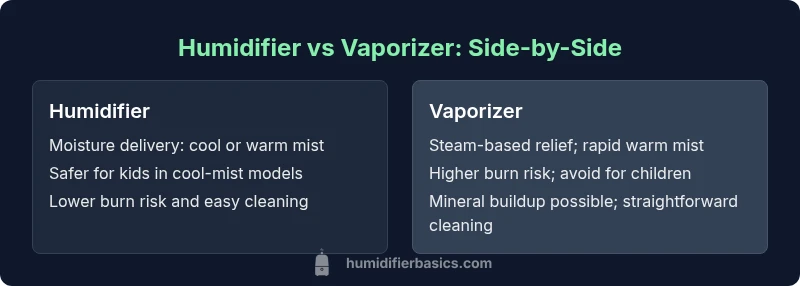
Is humidifier or vaporizer better for cough? In most homes, a humidifier is safer and more versatile for cough relief. Humidifiers add moisture to the air (cool-mist or warm-mist varieties), reducing throat irritation and congestion, while vaporizers produce steam that can help loosen mucus but pose burn risks and require careful cleaning. HumidifierBasics analysis favors a cautious, symptom-driven choice.
Why is cough-focused humidification important?
Is humidifier or vaporizer better for cough? Cough relief hinges on the surrounding air you breathe. Dry air can irritate the throat, thicken mucus, and worsen chest congestion, while properly humidified air can soothe irritated tissues and help thin mucus. The HumidifierBasics team emphasizes a practical, symptom-driven approach: select a device based on your cough pattern, room size, and household safety considerations. This means understanding how each device changes humidity, how it operates, and what maintenance it requires. In everyday settings, maintaining a comfortable indoor climate reduces coughing episodes and supports better sleep for both adults and children. By applying this framework, you can identify whether a humidifier, a vaporizer, or a combination best suits your home. The goal is sustainable relief that avoids mold growth and energy waste, not just a quick fix.
As seasons shift and respiratory health needs evolve, the HumidifierBasics guidance remains consistent: prioritize devices that are easy to clean, safe for multi-person households, and appropriate for your space. This section lays the groundwork for a clearer decision when you compare models, read user reviews, and assess long-term costs. Remember: the best choice is the one you can operate safely, maintain easily, and keep running day after day without creating new problems.
How a humidifier works: cool-mist vs warm-mist
Humidifiers come in several flavors, mainly categorized as cool-mist and warm-mist devices. Cool-mist humidifiers can use ultrasonic technology, evaporative mechanisms, or rippling mist generated by a fan. They are generally quieter and involve lower burn risk because the water isn’t heated to steam. Warm-mist humidifiers boil water to produce a breathable steam, which can feel more immediately soothing for nasal passage irritation. From a cough perspective, both deliver moisture, but the comfort, safety, and room dynamics differ. In small bedrooms, a cool-mist model with a built-in humidistat helps maintain a stable environment without overheating the space. For those who prefer a gentle warmth, a warm-mist unit can be comforting, but it requires more careful placement away from children and pets and a secure refill routine. Regardless of type, regular cleaning prevents mineral buildup and bacterial growth that would otherwise worsen respiratory symptoms.
Key practical points:
- Cool-mist models are typically safer around kids and pets when used with distilled water.
- Warm-mist units may deliver perceived relief faster, but carry burn risks and higher energy use.
- Humidistats help prevent over-humidification, a common cause of mold or dampness.
- Choose a model that’s easy to disassemble and clean, with accessible filter replacements if needed.
How a vaporizer works and when it helps
Vaporizers generate steam by boiling water. This steam can locally moisten the nasal passages and throat, which some users report as quick symptom relief. However, the steam is hot and poses a real burn hazard, particularly for children and curious pets. Vaporizers may offer relief in small, controlled spaces or use-case scenarios where immediate moisture delivery is desired. Not all vaporizers are compatible with essential oils, and adding oils can clog the mechanism or irritate lungs, especially in households with infants or people with asthma or allergies. Because of these considerations, many families reserve vaporizers for occasional use and focus on a safe, controlled humidification strategy most days. If you do choose a vaporizer, ensure it is placed out of reach of children, never leave it running unattended, and clean it regularly to prevent mineral buildup and microbial growth.
A practical takeaway: vaporizers can be effective for brief relief when used properly, but they require stricter safety habits and cleaning routines than typical cool-mist humidifiers. In day-to-day life, this often means using a vaporizer only in rooms where adults supervise and avoiding essential oil additions unless explicitly approved by the manufacturer.
Safety considerations for households with humidifiers and vaporizers
Safety is a central concern when addressing cough relief with humidification devices. Cool-mist humidifiers tend to be safer for households with children and pets because they do not operate at boiling temperatures. Still, any humidifier can become a source of mold or bacteria if not cleaned regularly. Water quality matters: mineral dust and bioaerosols can accumulate if you rely on tap water. To minimize risk, use distilled or demineralized water, empty and dry the tank daily, and perform a weekly cleaning routine with a mild solution recommended by the manufacturer. Keep units away from heating sources or direct sunlight, and ensure proper placement so there is no risk of tipping. Vaporizers introduce steam, which can burn skin or eyes. Place them well away from beds and high-traffic areas, and never leave them running while unsupervised. If you have young children or a history of reactive airways, prioritize devices with automatic shut-off, low-temperature operation, and simple, thorough cleaning procedures.
In sum, safety means choosing the lowest-risk option for your household and then enforcing meticulous maintenance practices. This approach reduces the chance of mold growth, mineral deposits, and accidental injuries while still delivering the cough-relief benefits of humidification.
Maintenance, cleaning, and air quality implications
Maintenance directly influences effectiveness and safety. Humidifiers, especially those with filters, require routine filter changes and mineral scale removal. If you use distilled water, you minimize mineral buildup, but you still need to wipe down reservoirs and bases to prevent microbial growth. A weekly cleaning schedule with a non-abrasive solution helps keep all surfaces free from mold and bacteria. Vaporizers, while simpler to clean in some cases, demand careful disassembly and mineral deposit removal from boiling chambers. In either case, never substitute harsh chemicals for manufacturer-approved cleaners. Keep the device out of direct sunlight when not in use, and never leave a humidifier running in an unventilated space for long periods. Good air quality starts with clean devices and a routine that fits your household habits.
Water quality matters for the long term: mineral dust can irritate lungs and trigger coughing episodes if inhaled repeatedly. Therefore, many HumidifierBasics readers prefer distilled water and frequent cleaning to maintain clean moisture delivery. This not only improves comfort but also prolongs device life and reduces the risk of allergies triggered by contaminants.
Practical buying tips and model features to prioritize
Choosing a device should begin with a clear understanding of room size and usage patterns. For larger spaces, a heavy-duty humidifier with a larger tank and higher output is essential; for a single bedroom or nursery, compact units are usually sufficient. Prioritize models with:
- An integrated humidistat to maintain stable humidity and avoid over-humidification
- A visible water level indicator and automatic shut-off when empty
- Removable, easy-to-clean components and dishwasher-safe parts where possible
- Clear instructions for water type, cleaning, and maintenance intervals
- Filters that are easy to replace and readily available
- Compatibility with your daily routines, including carless refill options and quiet operation at night
Water quality choices matter too: distilled water reduces mineral residues and helps protect your device and lungs. For households with allergies or sensitive airways, look for models that minimize dust and contaminants and that are tested for low noise levels during operation. If you are unsure which model suits your space, start with a mid-range unit that offers a humidistat, auto-shutoff, and easy cleaning, then adjust based on your nightly comfort and cough patterns.
Real-world scenarios and tailored recommendations
- Scenario 1: A dry cough worsened at night in a small apartment. Recommendation: a cool-mist humidifier with a built-in humidistat placed near the bed but away from the pillow, used with distilled water.
- Scenario 2: Household with a toddler and frequent nasal congestion during dry seasons. Recommendation: a compact cool-mist humidifier with easy-to-clean parts, scheduled maintenance, and a guard around the unit to prevent tipping. Avoid warm-mist models in this setting unless there is strict supervision.
- Scenario 3: Severe throat irritation for a short period; warm, comforting steam could help briefly, but only in a controlled space and away from children. If used, keep the unit in a separate room and limit exposure time to avoid burns.
- Scenario 4: A household with seasonal allergies. Recommendation: humidifier that supports easy filter replacement and dust control, plus an occasional deep cleaning schedule. Always pair with high-quality air filters and regular vacuuming.
In every scenario, the decision should balance relief with safety and maintenance ease. HumidifierBasics' practical approach is to try a safe, controllable humidifier first and evaluate symptom relief after a few days, adjusting as needed based on cough response and air quality readings.
Common myths and safety reminders
Myth: If humidity helps cough, you should run a humidifier all day, every day. Truth: Excess humidity can create mold and damp surfaces. Use a humidistat and keep humidity in a comfortable range. Myth: Vaporizers are always safer because they generate steam. Truth: Steam poses burn risks and can be hazardous to children and pets; safe supervision is essential. Myth: Essential oils are safe to add to every humidification device. Truth: Many devices are not designed for oils; oils can damage components and irritate airways. Check manufacturer guidance before use. Myth: Cleaning is optional if the device looks clean. Truth: Biofilm can be invisible; a routine, thorough cleaning schedule is necessary to maintain air quality and device efficacy.
If you adhere to evidence-based cleaning routines, maintain appropriate humidity levels, and select an appropriate device for your home, you’ll reduce cough risks and improve comfort without compromising safety. The HumidifierBasics team emphasizes that ongoing maintenance is as important as initial selection when you aim to improve indoor air quality for cough relief.
Comparison
| Feature | Humidifier | Vaporizer |
|---|---|---|
| Operation principle | Adds moisture to air via ultrasonic/evaporation (cool-mist or warm-mist) | Boils water to emit steam |
| Best for cough relief | Moisturizes dry air, reduces throat irritation and congestion | Provides steam for mucus loosening; perceived quick relief |
| Safety considerations | Lower burn risk with cool-mist; placement and cleaning matter | Burn risk due to exposed steam; careful placement required |
| Maintenance effort | Moderate: regular cleaning; filters common | Potentially higher cleaning if mineral buildup occurs |
| Noise level | Varies by model; typically quiet (especially ultrasonic) | Usually low to moderate; boils water creates sound |
| Price range | $30-$150 (varies by capacity/model) | $40-$180 (varies by features) |
| Best for | General cough relief and climate control | Short-term steam relief in controlled settings |
What's Good
- Safer for households with children when using cool-mist devices
- Versatile across climates and seasons
- Typically lower running costs and wide model availability
- Simple to operate and replace parts in many models
Negatives
- Vaporizers can provide rapid steam relief but carry burn risks
- Steam devices require careful placement and supervision around kids
- Mineral buildup and cleaning can be burdensome with some models
- Oil-based additives can damage devices or irritate airways when not manufacturer-approved
Humidifier generally wins for daily cough relief and everyday safety; vaporizers can be useful for targeted steam relief under strict supervision
Choose a humidifier for consistent, safer cough relief and easier maintenance in most homes. Reserve a vaporizer for short-term steam benefits only when supervision and safety practices are in place.
FAQ
What is the main difference between a humidifier and a vaporizer?
Humidifiers add moisture to the air with cool or warm mist without boiling water, while vaporizers boil water to produce steam. Humidifiers are generally safer for households with children, whereas vaporizers can offer quick relief but require strict safety practices.
Humidifiers moisten the air safely; vaporizers produce steam but carry burn risks. Choose based on safety and cough type.
Which is safer for households with children?
Cool-mist humidifiers are typically safer for households with children, provided you use distilled water, clean regularly, and place the unit away from sleeping areas. Vaporizers pose higher burn risks and should be kept out of reach or used with strict supervision.
Cool-mist humidifiers are usually safer for kids; vaporizers need extra safety steps.
Can both devices help with cough symptoms?
Yes. Both devices add moisture that can ease throat irritation and nasal congestion. Your choice should consider cough type, room size, safety, and maintenance practicality.
Both can help with coughs by adding humidity, but safety and maintenance matter.
Are there health risks associated with humidifiers?
If you don’t clean your humidifier or use impure water, biofilms and mineral dust can circulate in the air. Regular cleaning, distilled water, and following manufacturer guidance reduce risk.
Clean regularly and use clean water; otherwise there’s a risk of mold and bacteria.
Should I use distilled water in a humidifier or vaporizer?
Yes. Distilled water minimizes mineral buildup and reduces white dust, improving device performance and air quality. Tap water can lead to mineral deposits over time.
Distilled water helps keep devices clean and reduces mineral dust.
The Essentials
- Start with a humidifier for everyday cough relief
- Avoid high-heat steam around children
- Match device to room size and use-case
- Prioritize easy cleaning and built-in humidistat
- Use distilled water to reduce mineral buildup and improve air quality