Is a Humidifier and Steamer the Same? A Practical Comparison
A rigorous, data-informed look at whether humidifiers and steamers are interchangeable. Learn key differences, safety, maintenance, and which device fits your home needs for healthy humidity.


No. Humidifiers and steamers are not the same device, nor should they be used interchangeably for room humidity. A humidifier adds moisture to the air at ambient temperature (cool-mist or warm-mist options), while a steamer boils water to produce high-temperature steam for targeted use. Understanding the differences in output, safety, and typical use cases is essential.
The Core Question: is humidifier and steamer same? In practical terms, the answer is no. The HumidifierBasics team examined common consumer questions and found that most people confuse these devices because both involve adding moisture to the air in some form. The core distinction rests on how moisture is generated, where the moisture goes, and what safety precautions are necessary. When you ask whether is humidifier and steamer same, think about intended space (a room vs a small area), temperature of the output, and potential risks. According to HumidifierBasics, clarifying this difference upfront prevents unsafe uses and helps you pick the right tool for the job.
Defining the Two Devices and Their Cousins
Humidifier: a device designed to add moisture to indoor air at ambient or mildly warmed temperatures, typically used to support general comfort and air quality. Steamer: a device that boiling water to emit high-temperature steam, often used for localized humidification, sanitizing tasks, or culinary/cleaning purposes. A steam-based humidifier exists as a specific category that blends both concepts, but it still serves a different purpose than a standard room humidifier. The HumidifierBasics team emphasizes that the key to the question “is humidifier and steamer same” is recognizing output type, target area, and safety constraints, not merely the presence of humidity in the air.
Output Temperature and Distribution: how moisture leaves the device
Humidifiers release water vapor at ambient or warm temperatures depending on design. Cool-mist models distribute mist without heating the water, making them generally safer for living spaces but potentially requiring larger units for significant room humidity. Warm-mist units boil water to produce steam, delivering higher-energy output in a localized way and often with a visible plume. Steam-based devices can feel more intense and are not ideal for continuous room humidification due to temperature and safety considerations. This is a primary reason the question is not simply about labeling; it’s about function and use-case fit.
Safety First: the burn and electrical risk
Steamers boil water and expel hot steam, introducing higher burn risks to children, pets, and caregivers. Humidifiers, especially cool-mist types, carry fewer immediate burn hazards but demand diligent cleaning and water-quality management to prevent mold and mineral buildup. From a safety perspective, the question of is humidifier and steamer same deserves careful framing: steamers are not designed to humidify an entire room safely for extended periods; humidifiers are built for continuous, safer room humidity control.
Maintenance and Water Quality: keeping devices healthy
Regular cleaning is essential for both device types, but the maintenance patterns differ. Humidifiers often require periodic filter changes and mineral-agnostic cleaning (depending on water type). Steamers may need more thorough descaling and attention to steam-nozzle cleanliness to prevent mineral deposits from blocking output. HumidifierBasics analysis shows that choosing water type—distilled vs tap—can dramatically influence scale, efficiency, and lifespan for both devices, yet the daily care routine remains different.
Cost, Energy, and Longevity: what you should expect
Energy use varies: many humidifiers run continuously at low power to maintain air moisture, while steamers consume more energy per use and are used for shorter sessions. Over time, maintenance costs (filters, descalers, rubber seals) add up differently for each device. HumidifierBasics research suggests that upfront cost is only part of the story; ongoing maintenance and replacement parts often determine true cost of ownership.
Real-World Scenarios: apartments, nurseries, and larger homes
In small apartments, a compact cool-mist humidifier may suffice for comfort and humidity control without overheating the room. For nurseries, safety and gentle humidity are paramount; many parents favor cool-mist units with sealed water reservoirs and easy cleaning. Steamers, while effective for short-term humidity or inhalation routines, are usually less practical for continuous room humidity and may be restricted around children or in bedrooms.
Myths vs. Realities: common misconceptions debunked
One common myth is that all steam is the same and can replace a humidifier. In reality, the quality, safety, and distribution of moisture differ; the phrase is humidifier and steamer same does not hold in most homes. Another misconception is that more humidity is always better; in fact, over-humidification can promote mold growth and dust mite proliferation. Understanding these dynamics helps homeowners make safer, smarter choices.
Decision Framework: a quick guide to choose wisely
Ask yourself: Is the goal to improve room humidity for the entire living space or to generate moisture for a specific task? If the goal is room-wide humidity, a dedicated humidifier is typically the safer, more efficient option. If you need brief, localized steam for inhalation or cleaning, a steamer may be suitable, but never substitute for a room humidifier when steady humidity is needed.
Practical tips for safe operation and setup
Place devices away from walls and furniture to maintain airflow; use distilled water when possible to reduce mineral buildup; regularly clean reservoirs and nozzles; never place a steamer in a child’s bedroom; monitor humidity with a thermometer/h hygrometer to avoid over-humidification.
Comparison
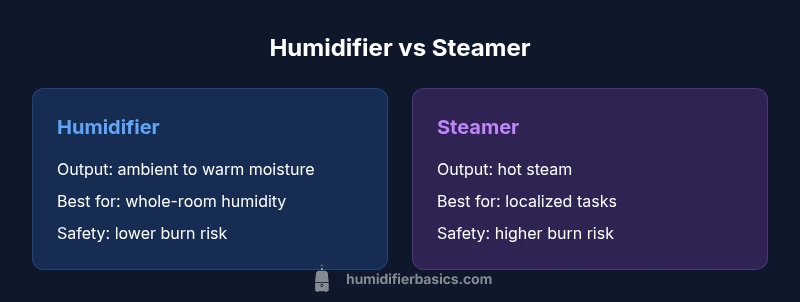
| Feature | Humidifier | Steamer |
|---|---|---|
| Output method | Vapor emitted at ambient or warm temperatures (cool-mist or warm-mist variants) | Boiled water produces high-temperature steam for short bursts |
| Ideal use | Whole-room humidity, year-round comfort | Localized moisture tasks; inhalation or cleaning in small areas |
| Temperature of output | Ambient to warm (not boiling) | Hot steam at boiling temperature |
| Safety considerations | Lower burn risk; ensure proper cleaning | Higher burn risk; keep away from children and sensitive surfaces |
| Maintenance | Regular cleaning; filters may be needed | Descaling and nozzle cleaning; monitor mineral buildup |
| Best for | Homes needing consistent humidity | Small-area humidity or targeted tasks |
What's Good
- Clarifies device distinctions for safer use
- Helps select space-appropriate equipment
- Supports safer humidity management with clear maintenance paths
- Encourages use of proper water quality and cleaning routines
Negatives
- Steamer is not suitable for continuous room humidification
- Higher burn risk with steamers in living spaces
- Steamers can be more challenging to clean and maintain
- Humidity overshoot is possible with any device without monitoring
Humidifier is generally the safer choice for whole-room humidity; steamers serve narrow, task-specific needs.
For routine humidity, choose a humidifier. Use a steamer only for short, localized moisture tasks where safety measures are in place. The HumidifierBasics team recommends prioritizing devices designed for indoor air quality and continuous operation over temporary steam generation.
FAQ
Is a humidifier the same as a steamer?
No. Humidifiers add moisture to the air for whole-room humidity, while steamers produce hot steam for localized tasks. They serve different purposes and have distinct safety considerations.
No—humidifiers and steamers aren’t the same. Humidifiers humidify a room; steamers create hot steam for limited uses. Safety differs for each.
Can you safely use a steamer to humidify a room?
Steaming a whole room is generally not recommended due to burn risk and uneven humidity distribution. If you need room humidity, choose a dedicated humidifier instead.
Steamer in a room is not recommended for safety and effectiveness; use a humidifier for room humidity.
What is the difference between cool-mist and warm-mist humidifiers?
Cool-mist humidifiers emit cooler water vapor and are typically safer for households with kids, while warm-mist units boil water to emit steam and can provide quicker humidity in small areas.
Cool-mist is safer for homes; warm-mist steams briefly but can burn if not used carefully.
Should I use essential oils in a humidifier or steamer?
Many devices are not designed for essential oils. Oils can clog components and void warranties. Use only recommended products and follow manufacturer guidance.
Avoid adding essential oils unless your device specifically supports them.
Are humidifiers good for allergies or dry skin?
Humidifiers can help with nasal dryness and throat irritation when humidity is properly managed, but poor maintenance can worsen allergens. Distilled water and regular cleaning reduce irritants.
Humidifiers can help dryness if kept clean and used with proper water.
What should I check before buying a humidifier or steamer?
Check room size compatibility, output type (cool vs warm), safety features, ease of cleaning, and whether the unit uses filters. This ensures you get the right tool for your space.
Look at room size, safety features, and how easy it is to clean before you buy.
The Essentials
- Know the difference between room humidifiers and steamers
- Choose humidifiers for continuous, whole-space humidity
- Use steamers only for short, targeted tasks with safety in mind
- Regular cleaning and distilled water improve longevity
- Monitor humidity to avoid mold and dust mites