Humidifier or Dehumidifier: Practical Home Guidance
Learn when to use a humidifier or dehumidifier, how indoor humidity affects health and comfort, and how to choose the right device for your space with a clear, data-informed comparison.


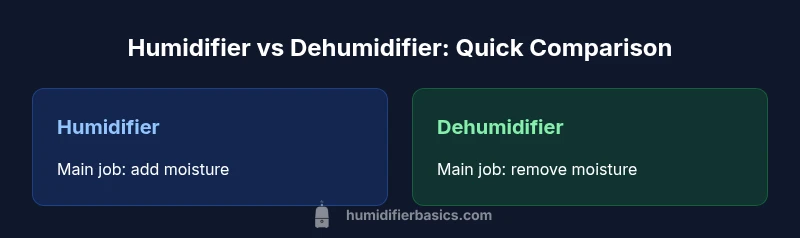
Humidifier or dehumidifier: the right choice hinges on your room’s moisture level. A humidifier adds moisture to dry air, while a dehumidifier removes excess moisture in damp spaces. Track humidity with a hygrometer and aim for roughly 30-50% RH; use the humidifier if RH stays below 30-40%, and switch to a dehumidifier if it stays above 60%.
Understanding the humidifier or dehumidifier decision
Choosing between a humidifier or dehumidifier hinges on the current moisture in your space and your comfort goals. According to HumidifierBasics, the question 'humidifier or dehumidifier' is about measuring relative humidity (RH) and aligning with recommended ranges. In dry climates or during the heating season, a humidifier raises moisture to relieve dry skin, throat irritation, and static electricity. In damp environments, a dehumidifier removes excess moisture to prevent mold, musty odors, and condensation. This article presents a structured comparison to help homeowners decide which device to deploy and when. The HumidifierBasics team emphasizes practical measurement and room-specific needs over brand slogans, ensuring readers can make informed, evidence-based choices.
How humidity levels impact health and comfort
Humidity influences comfort, respiratory health, and even furniture longevity. Low humidity can dry mucous membranes, irritate the throat, and worsen static shocks; high humidity fosters musty odors and mold growth. A practical rule is to maintain indoor relative humidity in a middle range—roughly 30% to 50% RH—where bacteria and dust mites are less active and comfort improves. HumidifierBasics analysis shows that many homes drift outside this range seasonally, underscoring the need to tailor humidity-control tools to the space. Readers should consider the local climate, indoor activities, and the presence of sensitized individuals when setting RH targets.
Humidifier: how it works and when to use it
A humidifier adds water vapor to the air through one of several technologies. Ultrasonic units generate a fine mist, evaporative models use a wick and fan, and warm-mist designs boil water for visible steam. Use a humidifier in rooms that feel dry, during winter heating cycles, or in spaces with dry skin symptoms. Pay attention to water quality and filter maintenance, and avoid over-humidifying the room, which can create condensation on windows or lead to mold growth. The humidifier or dehumidifier decision becomes a matter of RH tracking rather than merely turning a device on or off.
Dehumidifier: how it works and when to use it
Dehumidifiers remove moisture from the air by drawing air over cooled coils that condense water, which is then drained or collected in a reservoir. They excel in basements, laundry rooms, and spaces prone to dampness or musty odors. Use a dehumidifier when RH readings stay consistently above the mid-range target (commonly around 50-60%), or after water damage, or in climates with high humidity. Like humidifiers, dehumidifiers require regular cleaning and filter changes to prevent secondary issues such as odors or microbial growth. The humidifier or dehumidifier choice should be guided by RH data rather than anecdote alone.
Room-by-room guidance: when to pick which device
Living rooms in humid climates often benefit from dehumidification, especially in warmer months when moisture increases. Bedrooms in dry climates may require a humidifier to improve comfort and sleep quality. Basements typically benefit more from dehumidification due to persistent dampness. In mixed conditions, consider a humidity-monitoring plan and, if necessary, a staged approach using both devices at different times of the year. The choice between humidifier or dehumidifier is a function of measured RH, room use, and occupant sensitivity.
Energy use, maintenance, and running costs
Running costs hinge on tank size, flow rate, and energy efficiency. Generally, larger units with higher moisture outputs consume more electricity, but efficiency varies by model and technology. Maintenance includes regular cleaning, descaling for mineral buildup, and timely filter changes. Consider energy-efficient models and those with automatic humidity controls to avoid overshooting the target RH. In the long term, a well-chosen device reduces health-related costs associated with dry air or damp environments.
Space planning: placement and airflow
Placement matters for both humidifiers and dehumidifiers. Keep units away from walls and furniture to maintain airflow, and position near the center of the room for even humidity distribution. Use fans to aid air movement, especially in larger rooms. In small spaces, a compact, low-noise model may be sufficient. Regularly monitor RH in multiple zones if your space is open-plan or split-level to ensure consistent humidity control.
Safety, sanitation, and water quality
Water quality is a key safety consideration. Use distilled or demineralized water when possible to reduce mineral buildup and white dust. Empty tanks promptly to prevent mold growth and sanitize devices according to the manufacturer’s guidelines. Never run a humidifier or dehumidifier with contaminated water or in rooms with poor ventilation. Humidifier or dehumidifier performance improves when combined with proper cleaning routines and humidity monitoring.
Reading product specs: features that matter
Look beyond price to features: humidity sensors, built-in humidistat, automatic shutoff, bottle or reservoir capacity, filtration, and filter replacement frequency. Energy Star ratings can indicate efficiency, while noise levels matter for bedrooms and nurseries. Compare models by their ability to maintain a stable RH, not just peak moisture output. The goal is a device that reliably maintains the target RH in your primary living spaces without creating discomfort.
Authoritative sources and best practices
Maintaining indoor humidity is a multifaceted task guided by public health guidance and building science. See authoritative sources such as the Environmental Protection Agency’s guidance on humidity and indoor air quality, established industry standards, and health organizations for best practices. Practical humidity-control strategies should be tailored to your climate, space, and sensitivity to humidity fluctuations. This section cites essential references to help readers verify recommendations and apply them in real homes.
Practical decision framework and quick-start checklist
Start by measuring RH in the space you want to control. If RH is consistently below 30%, consider a humidifier and a plan to maintain ~40% in winter. If RH remains above 60%, a dehumidifier is the better choice. For seasonal transitions, reuse the same framework and adjust as needed. Maintain a clean unit, use appropriate water, and track RH changes with a hygrometer for ongoing optimization.
Comparison
| Feature | humidifier | dehumidifier |
|---|---|---|
| Main purpose | Adds moisture to dry air | Removes moisture from damp air |
| Ideal humidity range | Typically targets 30-50% RH | Typically targets 30-50% RH |
| Energy usage | Moderate (varies by model) | Moderate to high (varies by model) |
| Maintenance | Tank refills, filter care (depends on model) | Tank emptying, filter care (depends on model) |
| Noise level | Varies by model; often acceptable | Varies by model; often acceptable |
| Best for | Dry rooms, winter dryness, comfort: dry air relief | Damp rooms, mold prevention, mildew control |
| Price range | $30-$250 (consumer units) | $40-$300 (consumer units) |
What's Good
- Balances comfort in dry climates and reduces mucosal irritation
- Supports sleep quality and skin hydration when RH is low
- Can protect wood and textiles from cracking due to dry air
- Improves overall air quality when used with humidity monitoring
Negatives
- Over-humidification can promote mold, condensation, or dust mites
- Requires regular cleaning to prevent microbial growth and odors
- Infrequent maintenance can lead to mineral buildup and reduced efficiency
- Energy use adds to operating costs in larger spaces
Choose based on measured RH: humidifier if RH is consistently low (below ~30-40%), dehumidifier if RH is consistently high (above ~60%), and target a comfortable range of about 30-50% RH.
RH data should drive device choice. Humidifiers are best for dry air; dehumidifiers are best for damp air. In variable climates, plan for seasonal adjustments and monitor RH to stay in the comfortable mid-range.
FAQ
What is the main difference between a humidifier and a dehumidifier?
A humidifier adds moisture to dry air, while a dehumidifier removes moisture from damp air. The choice depends on current RH and the space’s needs. Monitoring RH helps you decide which device to use and when to run it.
A humidifier adds moisture to dry air, while a dehumidifier removes moisture from damp air. Use RH readings to decide which device to run.
Can I use both devices in the same room?
It’s possible but usually unnecessary in typical home spaces. If you have mixed humidity pockets, you may run one device in certain areas and another in others after measuring RH in each zone.
In most homes you won’t need both at the same time; use RH readings to guide where each device should run if needed.
How do I know when to use a humidifier or a dehumidifier?
Use a hygrometer to monitor RH. If RH consistently falls below 30%, turn on a humidifier. If RH stays above 60%, use a dehumidifier. The goal is to keep most rooms in a comfortable 30-50% range.
Check your humidity with a hygrometer; humidify dry spaces and dehumidify damp ones to stay around 30-50% RH.
Are humidifiers safe around children and pets?
Most modern units include safety features like auto shutoff and timers. Always place devices away from reach, follow cleaning guidelines, and use distilled water to reduce mineral dust.
Yes, with proper placement, maintenance, and using clean water, humidifiers can be safe around kids and pets.
What maintenance tasks are essential for both devices?
Regular cleaning to remove mineral deposits or mold, timely filter changes, and proper water quality are essential. Follow the manufacturer’s recommendations for cleaning schedules and product care.
Keep it clean and change filters as recommended, and use clean water to keep things running smoothly.
Do humidifiers help with allergy symptoms?
Humidity control can reduce some allergy symptoms by limiting mold and dust mites, but overly humid spaces can worsen allergies. Monitor RH and keep airflow steady.
Humidity helps, but don’t overdo it. Keep RH in the 30-50% range to minimize mold and mites.
The Essentials
- Measure RH before buying any device
- Use humidifier for dry air, dehumidifier for damp air
- Target 30-50% RH for health and comfort
- Regular maintenance prevents mold and odors
- Choose energy-efficient models with humidity control