Why Are Evaporative Humidifiers Better? A Practical Guide
Explore why evaporative humidifiers are often the better choice for home humidity. This analytical guide covers how they work, practical advantages, common concerns, and how to choose and maintain them for safe, efficient use.


If you’re weighing humidifier options, the quick answer is that evaporative models are often the better choice for many homes due to safety, simplicity, and cost effectiveness. They use a wick and fan to add moisture through natural evaporation, reducing burn risk and energy use compared with heated units. This guide explains why are evaporative humidifiers better and when they shine.
Why evaporative humidifiers are a strong choice for many homes
If you’re wondering why are evaporative humidifiers better, the short answer is that they offer reliable, safe, and cost-effective humidity for everyday living. These devices rely on a simple wick filter and a fan to draw water up and release moisture through natural evaporation, which fosters a comfortable, breathable indoor climate without heating water. According to HumidifierBasics, this straightforward mechanism tends to reduce burn risk, uses less energy than most heated models, and is more forgiving of typical home water quality. For many homeowners and renters, this combination translates into a practical, low-maintenance path to better air quality and comfort. As you read, you’ll see how the evaporative approach compares to other common options and why it often wins on balance.
How evaporative humidifiers work and why the mechanism matters
Evaporative humidifiers operate on a simple physical principle: water evaporates from a wetted surface (usually a wick) into the surrounding air as a fan helps move dry room air through the moistened medium. This natural evaporation self-regulates humidity levels because the rate of evaporation slows as humidity rises, reducing the risk of oversaturation in a typical living space. The mechanism matters for long-term performance, energy efficiency, and user safety. By avoiding a heating element, evaporative models generally consume less electricity and present a cooler mist, which many households prioritize for bedrooms and nurseries. HumidifierBasics notes that this combination often translates into steady humidity without dramatic spikes.
Practical advantages over other humidifier types
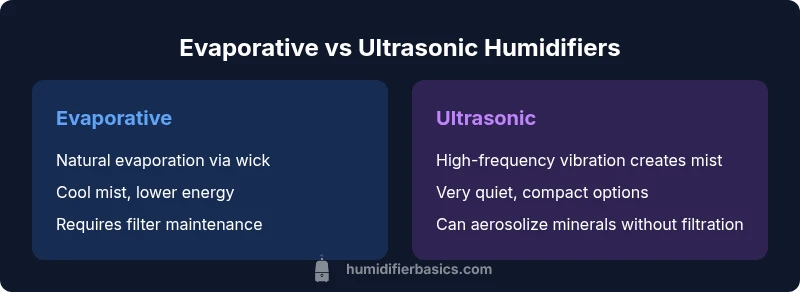
Compared with ultrasonic or warm-mist models, evaporative humidifiers offer several tangible benefits. First, their simple design has fewer high-heat components, lowering burn risk for children and pets. Second, the self-regulating evaporation tends to stabilize humidity, reducing the likelihood of over-humidification in rooms that stay at varying levels of dryness. Third, maintenance can be straightforward (filters may need periodic replacement), but the absence of a scorching heat source means safer operation in households where safety is a priority. Finally, energy consumption tends to be lower than that of heated humidifiers, especially in moderate humidity needs. These factors collectively explain why are evaporative humidifiers better for many homes seeking a balanced, safe solution.
Common concerns and misconceptions about evaporative humidifiers
A common concern is mineral dust from evaporative wick filters. If you use tap water in areas with hard minerals, you may notice fine dust on surfaces; this is typically harmless and can be reduced by using distilled or demineralized water, or by ensuring the unit’s filter is clean and replaced as recommended. Some buyers worry about noise from the fan—most evaporative units operate at moderate sound levels, which is usually acceptable for living spaces and bedrooms. Another misconception is that evaporative units cannot achieve rapid humidity increases; in reality, they raise humidity gradually, which many users prefer for its predictability. HumidifierBasics emphasizes that choosing the right size and setting humidity targets helps mitigate most concerns.
How to choose and optimize your evaporative humidifier
Start by measuring the room size and selecting a unit designed for that square footage. Check the airflow path to avoid blocking vents or placing it behind furniture. Water quality matters: mineral-rich water will create more dust unless filtered; consider distilled water if dust is a concern. Look for a wick filter with clear replacement schedules and a design that makes filter changes easy. Aim for a humidity target around 30–50% for most homes, adjusting based on comfort and seasonal needs. HumidifierBasics recommends pairing evaporation with a hygrometer to track real-time humidity and prevent over-humidification.
Maintenance routines to maximize safety and efficiency
A regular maintenance routine keeps evaporative humidifiers performing well. Clean the water tray and the wick area weekly to prevent mold and mineral buildup. Replace wick filters according to the manufacturer’s schedule or sooner under heavy use or in hard-water regions. Empty and dry the tank between uses to reduce microbial growth. Store the unit dry if you won’t use it for extended periods. Keeping the device away from walls and ensuring proper clearance helps maintain efficient airflow and better humidity distribution. These practices support a safer, longer-lasting appliance and align with the question of why are evaporative humidifiers better over time.
Real-world scenarios: when evaporative humidifiers shine
In mid-sized living rooms and nurseries where safety and quiet operation matter, evaporative humidifiers often outperform heated models. They deliver consistent, moderate humidity without escalating energy costs, which is ideal for households with children or pets. In homes with variable humidity, the self-regulating evaporation helps prevent excessive moisture that could foster mold growth. For renters and homeowners who want a practical, low-maintenance solution, evaporative humidifiers can be an excellent fit when paired with regular filter changes and water quality considerations. The HumidifierBasics team’s experience shows these devices typically strike a favorable balance among safety, cost, and user-friendliness.
Comparison
| Feature | Evaporative Humidifier | Ultrasonic Humidifier |
|---|---|---|
| Water interaction | Natural evaporation via wick filter and fan | Ultrasound creates fine mist by vibrating water |
| Maintenance frequency | Moderate (filter changes) | Low to moderate (depends on model) |
| Noise level | Moderate to low | Very low to low, often quieter |
| Energy efficiency | High (no heater) | Moderate to high depending on features |
| Best for | Medium to large rooms, mineral dust control favors proper water quality | Quiet operation in bedrooms, small rooms, or nurseries |
What's Good
- Cool-mist operation reduces burn risk for kids and pets
- No heating element lowers energy use and simplifies design
- Self-regulating evaporation helps prevent over-humidification
- Usually lower upfront cost than heated models
Negatives
- Requires regular wick filter changes
- Mineral dust can occur with tap water without filtration
- Slower humidity rise in very dry spaces compared to some other types
- Bulkier units may be less portable
Evaporative humidifiers are a balanced, practical choice for many homes.
They offer safety with cool mist, energy efficiency, and predictable humidity through natural evaporation. If your priorities are cost, reliability, and ease of use, evaporative humidifiers are typically strong performers. The HumidifierBasics team recommends evaluating room size, water quality, and maintenance capacity to confirm suitability.
FAQ
What is an evaporative humidifier?
An evaporative humidifier uses a wick filter and a fan to draw water and release moisture into the air through natural evaporation. It does not heat the water, which keeps operation cooler and usually more energy-efficient.
It’s a simple, cool-mist humidifier that uses a wick and a fan to add moisture to the air without heating the water.
Are evaporative humidifiers better for allergy sufferers?
They can be suitable for allergies when kept clean and used with filtered water, as the wick can trap minerals and some particles. Regular maintenance is essential to prevent mold or mineral dust.
If you keep the wick clean and water quality good, they can be fine for allergies.
How often should I replace the wick filter?
Filter replacement frequency depends on usage and water quality, but many users replace the wick every 3–6 months under typical conditions. Always follow the manufacturer’s guidance.
Check the schedule on your unit and replace when it looks worn or after several months of use.
Do evaporative humidifiers help with mold prevention?
Maintaining a comfortable indoor humidity level (generally 30–50%) helps prevent mold. Evaporative humidifiers aren’t a solution for existing mold but can help avoid excessive moisture when used correctly with humidity monitoring.
Keep humidity in check and clean regularly to avoid mold problems.
Do evaporative humidifiers use more energy than ultrasonic ones?
In general, evaporative units use less energy than heated models and can be comparable to some ultrasonic units, depending on design and fan speed. The key factor is no heating element.
They usually use less energy because there’s no heater.
The Essentials
- Evaluate room size before choosing a model
- Regularly replace wick filters for optimal performance
- Use distilled water to minimize mineral dust
- Aim for humidity targets around 30–50% in occupied spaces
- Prioritize safety and energy efficiency in the decision