Why Ultrasonic Humidifiers Are Better: A Practical Comparison
Explore why ultrasonic humidifiers are often superior for home comfort, maintenance, and air quality. This analytical guide compares technologies, offers buying tips, and shares maintenance best practices.


If you’re asking why are ultrasonic humidifiers better, the short answer is that they’re typically quieter, more energy-efficient, and deliver a fine, cool mist quickly. They also tend to be compact and affordable to run, though they require clean water and regular mineral-management to minimize white dust. In practical terms, the combination of low noise, steady moisture delivery, and simple design makes ultrasonic models a strong default for many homes.
Why Ultrasonic Humidifiers Are Often Better for Home Use
For households evaluating comfort and air quality, the question why are ultrasonic humidifiers better often centers on three core benefits: quiet operation, efficient moisture delivery, and straightforward maintenance. Ultrasonic humidifiers use high-frequency vibrations to turn water into a fine mist, which means you can humidify a room without the loud hum of a motor or air draw. According to HumidifierBasics, this leads to noticeably lower energy consumption in typical use, especially in bedrooms, nurseries, or home offices where silence matters as much as performance. The mist produced by ultrasonic devices is usually cool, reducing burn risk around children and pets while still delivering immediate relief in dry environments. In practice, this combination translates to a comfortable humidity level without disrupting daily routines. The HumidifierBasics team found that many users appreciate how compact, lightweight designs fit on nightstands or desks, enabling quick setup and portability. When deciding between humidifier technologies, readers should assess room size, water quality, and cleaning tasks, because the best option balances moisture delivery with ease of care. This context helps explain why ultrasonic models frequently stand out in real-world homes.
Key Differences From Evaporative and Steam Models
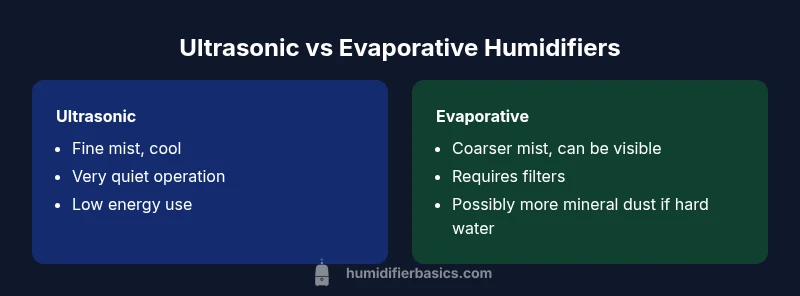
Ultrasonic humidifiers differ from evaporative and steam (warm-mist) models in several core ways. Evaporative humidifiers rely on a wick or filter and a fan to release moisture; they can add minerals to the air as dust if the water is hard, but they are resilient and naturally self-regulating as humidity rises. Ultrasonic units produce a fine mist without a visible fan noise, and they draw less electrical power than steam devices. However, the lack of a built-in mineral trap means minerals from tap water may become visible as a white dust in certain conditions. The HumidifierBasics analysis notes that this dust is not harmful but can land on surfaces, requiring cleaning and the use of distilled or demineralized water. When choosing between technologies, consider room size, target humidity, and tolerance for occasional maintenance tasks. For households prioritizing quiet operation, ultrasonic often wins; for those with hard water and limited cleaning capacity, evaporative may be preferable.
Practical Considerations for Everyday Use
Real-world use highlights practical constraints and steps to optimize performance. Water quality matters; minerals in hard water can leave residue. Use distilled water when possible; if not, use demineralization cartridges if the unit supports them. Regular cleaning is essential to prevent mold and bacterial growth; a weekly rinse, with a monthly deep clean, helps. Place humidifiers away from walls and electronics to avoid moisture damage. Keep humidity levels between 30-50% to reduce mold risk and ensure comfort. For alignment with our guidelines, HumidifierBasics recommends testing humidity with a simple hygrometer and adjusting output as needed. In multi-room spaces, consider a unit with adjustable mist and a wider coverage area. Ultrasonic mist in a small room can reach the target humidity quickly, but in larger spaces you may need a larger unit or a secondary unit.
Real-World Scenarios: Where Ultrasonic Shines
In bedrooms, nurseries, and home offices, quiet operation matters as much as raw humidity. Ultrasonic humidifiers excel in small-to-medium spaces where fast moisture and minimal noise improve sleep quality and concentration. For households with kids or pets, cool-mist devices reduce burn risk and deliver relief during dry seasons. In environments with moderate humidity, ultrasonic units can maintain comfortable levels with fewer fluctuations. Many models offer simple controls and timers, which helps when balancing humidity with daily routines. If you live in a dry climate, a higher-capacity ultrasonic model or a dual-unit setup can provide consistent comfort without relying on large, energy-hungry machines.
Common Myths About Ultrasonic Humidifiers
Myth 1: Ultrasonic humidifiers spread bacteria. Reality: Bacteria can grow in any standing water, but proper cleaning reduces risk. Myth 2: They always produce white dust. Reality: Mineral dust is more likely with hard water; using distilled water mitigates this issue. Myth 3: They can’t handle large rooms. Reality: Large-capacity ultrasonic units exist, and you can pair units for bigger spaces. Myth 4: They are energy-inefficient. Reality: Most are energy-efficient because they rely on vibration rather than a heavy fan. Debunking these myths helps homeowners make informed decisions.
Comparison
| Feature | Ultrasonic Humidifier | Evaporative Humidifier |
|---|---|---|
| Mist Quality | Fine, cool mist | Coarser mist with vapor and mineral carryover |
| Noise Level | Very quiet | Moderate to noticeable fan noise |
| Energy Efficiency | High (low power draw) | Moderate (fan-assisted) |
| Maintenance | Regular cleaning; mineral dust possible | Filter replacement; less mineral dust |
| Price Range | Typically mid-range | Typically lower upfront cost |
| Best For | Quiet spaces and quick humidification | Larger rooms and cost-conscious use |
What's Good
- Quieter operation supports better sleep and focus
- Faster humidification for many spaces
- Compact designs fit on desks or nightstands
- Lower energy use compared to some alternatives
- Simple controls and intuitive upkeep
Negatives
- Mineral dust if using hard water without distillation
- Regular cleaning required to prevent mold and bacteria
- Water quality directly affects performance and upkeep
Ultrasonic humidifiers strike a strong balance for most homes
They offer quiet operation, efficient moisture delivery, and straightforward maintenance. If you have hard water or limited time for cleaning, plan for mineral management and regular sanitization to maintain peak performance.
FAQ
Are ultrasonic humidifiers better than evaporative humidifiers?
In many cases, ultrasonic units are quieter and more energy-efficient, making them better for bedrooms and offices. Evaporative models can handle larger spaces and may require less attention to mineral dust.
Ultrasonic units are often quieter and energy-smart, but evaporative models can work well in big spaces.
Do ultrasonic humidifiers produce mineral dust?
Mineral dust can occur if you use hard tap water; using distilled water reduces this issue. Regular cleaning also helps.
Yes, minerals can show up as dust with hard water, but distilled water helps.
Can I use tap water in ultrasonic humidifiers?
Tap water is acceptable in many cases, but it increases mineral buildup and dust. If possible, use distilled or demineralized water.
Tap water works for many models, but distilled water reduces mineral deposits.
How often should I clean an ultrasonic humidifier?
Clean every 3-7 days for regular use; perform a deep clean monthly. Always follow the manufacturer’s instructions for disinfection.
Clean it regularly—weekly to monthly depending on use.
Do ultrasonic humidifiers work in large rooms?
Yes, high-capacity ultrasonic models can cover larger spaces; for very large areas, you may need multiple units or a higher-output model.
Yes, but you may need a larger unit or more than one.
Are ultrasonic humidifiers safer for children?
Cool-mist ultrasonic humidifiers reduce burn risk compared with hot-water devices. Still, maintain proper humidity and clean the unit regularly to avoid mold.
They’re generally safer for kids because the mist is cool, but keep up with cleaning.
The Essentials
- Identify room size before choosing a unit
- Expect low noise and fast humidity in typical spaces
- Use distilled water to minimize mineral dust
- Schedule regular cleaning to prevent microbial growth
- Match features to climate, space, and lifestyle