Warm vs Cool Mist Humidifier: A Practical Comparison
A data-driven comparison of warm mist and cool mist humidifiers. Learn how each type works, safety considerations, maintenance, running costs, and real-world use to decide which fits your home.


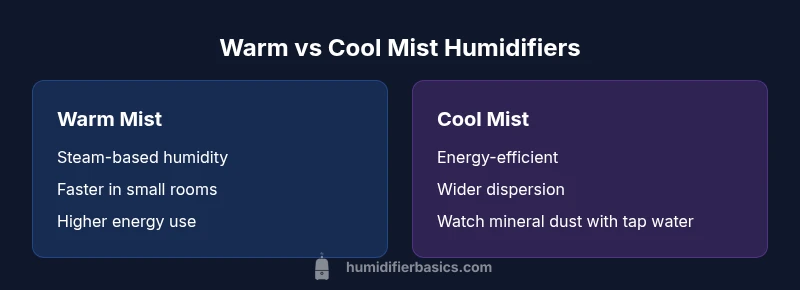
Warm vs Cool Mist Humidifier: a practical comparison for 2026 shows that both types improve comfort and air quality, but they differ in safety, energy use, and maintenance. Warm mist can raise humidity quickly in small spaces and may reduce bacteria due to boiling, while cool mist models offer energy efficiency and broader room coverage with lower surface temperatures. The best choice depends on room size, safety needs, and how much cleaning you’re willing to perform.
Introduction to warm and cool mist humidifiers
Humidifiers come in two popular flavors: warm mist and cool mist. In this guide, we compare warm mist and cool mist humidifiers to help homeowners and renters decide which type best fits their needs. The warmth of a warm mist can increase perceived comfort in cold rooms, while cool mist models often excel in energy efficiency and safety in homes with children and pets. Throughout this article we refer to the keyword warm and cool mist humidifier to ensure you understand the practical differences and real-world implications. This framing aligns with HumidifierBasics guidance, which emphasizes practical maintenance, safety, and cost awareness. By the end, you should have a clear sense of which type aligns with your room size, climate, and daily routines, plus actionable tips for selection and care.
How warm mist and cool mist humidifiers work
Warm mist humidifiers heat water to produce steam that evaporates into the air. This boiling action can reduce some bacteria and minerals before they escape as vapor, though mineral buildup remains a maintenance factor. Cool mist humidifiers use ultrasonic vibration or evaporation to disperse a fine mist, which can distribute humidity more broadly without heat. Each mechanism has implications: warm mist tends to deliver faster humidity in small spaces, but carries a burn risk; cool mist can be noisier on some models and requires safe distances from infants. In practical terms, both types rely on similar humidity setpoints (generally around 40-60% RH for comfort), but actual results depend on room airflow, occupant activity, and water quality. For readers investigating the best soundness of their home environment, the HumidifierBasics team recommends considering how each method interacts with your heater, air drafts, and existing filtration.
Safety considerations and best practices
Safety is a central concern for households with children, pets, or elderly residents. Warm mist units create steam and surfaces near the unit can be hot, so placement away from high-traffic zones is advised. Cool mist units have cooler surfaces but can disperse minerals if you use tap water; distillation or using distilled water can minimize mineral dust. Regardless of type, proper cleaning prevents mold and bacteria growth and reduces the risk of white dust or film on nearby surfaces. Always follow the manufacturer’s instructions for cleaning frequency, filter replacement (if applicable), and water type recommendations. For bedrooms and nurseries, consider models with automatic shutoff and adjustable humidity controls to avoid over-humidification.
Performance and humidity control in real homes
In real rooms, the performance of warm and cool mist humidifiers depends on room size, air movement, and the presence of heaters and fans. In small bedrooms, a warm mist can deliver noticeable humidity quickly, while cool mist units may take longer but keep temperatures comfortable without adding heat. In larger living spaces, a quiet cool mist evaporative model commonly provides steadier humidity over longer periods, provided you maintain water quality and routine cleaning. The key metric is maintaining the recommended RH range without oversaturating walls, furniture, or electronics. For renters, the choice often hinges on portability, ease of replacement parts, and the absence of permanent fixtures. Humidity targets should be checked with a hygrometer, ideally in the main living area and in the most used room.
Maintenance routines that protect performance
Maintenance is the silent driver of long-term humidifier performance. With warm mist models, mineral buildup can occur in the boiler chamber if water quality is high in mineral content; cleaning weekly and descaling every two weeks is prudent in many homes. Cool mist units, especially ultrasonic types, are prone to mineral dust if you use tap water; using distilled or demineralized water and regular cleaning of the mist vents is crucial. Replacement filters (when included) should be inspected every 1-3 months depending on usage and water quality. Regular cleaning reduces bacterial growth and odors, and helps your humidifier operate at the designed humidity output. If you’re unsure about proper technique, consult the HumidifierBasics maintenance checklist for step-by-step guidance.
When to choose warm mist vs cool mist by room and climate
In colder climates and in rooms with compact layouts, warm mist humidifiers can quickly elevate humidity with a visible steam and a sense of warmth. This can improve throat comfort in dry winters. In warmer or poorly insulated spaces, cool mist humidifiers are often preferred due to their cooler surface temperatures and lower perceived heat load. Open floor plans or rooms with high ceilings may benefit from the broader dispersion of cool mist models. For allergy-prone occupants, the choice often comes down to how much dust control and maintenance you’re willing to commit to; cool mist often requires more diligent cleaning to prevent mineral dust from dispersing. The decision ultimately hinges on your space and your tolerance for heat, noise, and maintenance tasks.
Cost of ownership: upfront, operating, and replacement parts
Upfront costs for warm mist humidifiers tend to be modest, while cool mist models vary widely based on included features and brand reputation. Running costs depend on energy use, water consumption, and the frequency of filter or wick replacements. In general, warm mist units consume more electricity due to the boiling process, while cool mist units are often more power-efficient but may require periodic filter changes. Over the device lifetime, mineral management, regular cleaning, and occasional component replacements represent ongoing costs. Consumers should compare total cost of ownership across typical 1-3 year usage windows to avoid surprises. HumidifierBasics Analysis, 2026 provides baseline guidance on balancing upfront price with ongoing maintenance when evaluating options.
Water quality: distilled water, mineral dust, and health considerations
Water quality has a meaningful impact on both warm and cool mist humidifiers. Using distilled or demineralized water minimizes mineral dust that can settle on furniture and irritate the lungs, which is particularly relevant for sensitive individuals. In warm mist units, minerals can accumulate inside the boiler and eventually reduce efficiency if water quality is high in mineral content; a simple descaling routine helps maintain performance. For cool mist humidifiers, mineral dust is a common concern with tap water; running units in a room with good air exchange reduces dust deposition, and cleaning the unit regularly reduces buildup. If you’re unsure about the local water quality, start with distilled water for the first few weeks and compare the perceived indoor air quality and maintenance burden.
Design features that matter in 2026
Look for water tank capacity that matches your typical nightly usage, a reliable built-in hygrometer for automatic humidity control, and quiet operation. Safety features—such as auto shutoff when water runs dry and cool-touch surfaces—are essential when kids or pets are around. For those balancing energy use and comfort, models with variable fan speeds and adjustable humidity targets offer the best control. Some hybrids blend both methods or include dual tanks to switch modes, giving greater flexibility for varying seasons. Bluetooth or app connectivity can help monitor humidity remotely, though this adds cost and potential privacy considerations.
Practical buying checklist and decision framework
To compare warm and cool mist humidifiers, start with a clear use-case, room size, and risk assessment. Ask: Is there a child or pet in the home? Do you prefer a quieter model, or a faster humidity boost? What is your budget, and are you willing to manage more frequent cleaning or filters? Create a short list of must-have features (auto shutoff, ease of cleaning, filter availability) and a nice-to-have list (digital display, app control). Then evaluate models against a simple scoring rubric that weighs safety, maintenance, and running costs. Finally, read independent reviews and, if possible, request trials from reputable retailers to ensure compatibility with your home's airflow and existing appliances.
Common myths and misconceptions debunked
Myth: Warm mist humidifiers are always safer around children. Reality: Hot water can still pose a burn risk if devices are misused or placed within reach. Myth: Cool mist humidifiers cause more mineral dust. Reality: Mineral dust can occur with any humidifier if you use tap water without proper cleaning. Myth: You must always use distilled water. Reality: Distilled water reduces mineral deposits but is not strictly required; using treated water and cleaning can also work. Myth: Humidifiers fix all indoor air quality issues. Reality: Humidifiers are only one part of a broader solution that includes ventilation, filtration, and humidity control.
Integrating a humidifier with broader air-quality strategies
A well-run humidifier should be part of an integrated air-quality plan that includes proper ventilation, regular cleaning, air filtration, and humidity monitoring. Place humidifiers away from direct airflow from vents to avoid over-humidifying certain zones. Use a hygrometer to maintain RH within the recommended range, and pair humidification with clean, covered air sources to minimize contaminants. For those unsure about how to calibrate a room, HumidifierBasics provides step-by-step guidance on creating a balanced, safe, and cost-effective humidity strategy for homes and rentals.
Comparison
| Feature | Warm Mist Humidifier | Cool Mist Humidifier |
|---|---|---|
| Output method | Boiled water steam | Ultrasonic or evaporative mist |
| Best for | Small, warm spaces needing rapid humidity | Larger rooms and heat-sensitive environments |
| Noise level | Low hum with possible steam hiss | Typically very quiet at low to mid settings |
| Energy use | Higher due to boiling water | Lower; no heating element in most models |
| Maintenance needs | Boiling chamber cleaning; potential mineral buildup | Regular cleaning; mineral dust risk if using tap water |
| Water type impact | Mineral buildup inside boiler; distilled water recommended | Mineral dust risk without distilled water; keep water clean |
| Price range | $40-120 | $30-90 |
| Safety considerations | Hot surfaces; place away from kids | Cool surfaces; ensure proper cleaning and water quality |
What's Good
- Offers clear, approach-oriented humidity control for different rooms
- Each type has distinct advantages in comfort and energy use
- Wide model availability and price range
- Using distilled water reduces mineral dust and scaling
Negatives
- Requires regular cleaning to prevent mold and mineral buildup
- Warm mist uses more energy and carries a burn risk if mishandled
- Cool mist may disperse minerals if water quality is poor
- Choosing the wrong type can lead to inefficient humidity or discomfort
Cool mist humidifiers are generally the better all-around choice for households with kids or pets and larger spaces
For most homes balancing safety, noise, and maintenance, cool mist offers versatile performance. Warm mist can be preferred in small rooms or when rapid humidity is needed, provided safety considerations are followed.
FAQ
What is the main difference between warm mist and cool mist humidifiers?
The main difference is how humidity is generated. Warm mist boils water to create steam, while cool mist uses ultrasonic vibration or evaporation to release a cool aerosol. Each method affects safety, energy use, and maintenance needs differently.
Warm mist boils water to make steam, cool mist uses vibration or evaporation. Choose based on safety and room size.
Are warm mist humidifiers safer around children?
Warm mist devices present a burn risk due to hot surfaces and steam. Place them out of reach and supervise use around children. Safety features like auto shutoff can help, but caution is still essential.
They can burn if touched, so placement and supervision are key.
Do I need distilled water for these humidifiers?
Distilled water minimizes mineral dust and reduces scaling, but it’s not mandatory. If you use tap water, expect more frequent cleaning to manage mineral buildup and dust.
Distilled water helps, but you can still manage with tap water if you clean regularly.
Which one is better for large rooms?
Cool mist humidifiers generally disperse humidity more evenly in larger spaces, though a powerful warm mist unit can still work in smaller, enclosed rooms.
Cool mist usually covers large rooms better.
Can I use both types in the same home?
Yes, you can use either type in different rooms based on needs. Portable units make this feasible, but manage water quality, cleaning schedules, and safety for each room.
Sure—use one type in one room and the other in another, with good maintenance.
How loud are these devices overall?
Most cool mist models are quiet on low to medium settings, while warm mist units can be slightly noisier due to the boiling process. Noise varies by model and design.
Cool mist is usually quieter; some warm mist models can be louder because of boiling.
The Essentials
- Define room size and safety needs before selecting type
- Consider water quality to minimize mineral dust
- Expect higher energy use with warm mist
- Cool mist often handles larger spaces more evenly
- Regular cleaning extends device life and maintains output