Humidifier Sizing for 800 Sq Ft Rooms: Practical Guide
Learn how to size, place, and maintain a humidifier for an 800 sq ft space. Practical steps, humidity targets, and maintenance tips from HumidifierBasics.


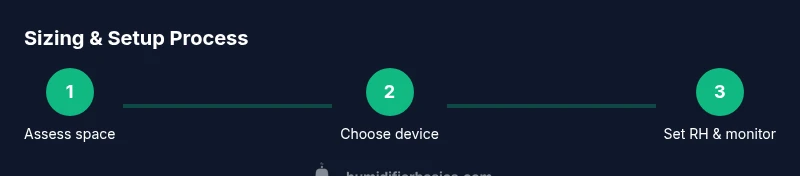
Step 1: Confirm the space and humidity targets. Step 2: Choose a humidifier rated for 800 sq ft or larger, with adjustable output. Step 3: Add a humidistat, set a comfortable RH (40-60%), and monitor weekly to stabilize humidity in an 800 sq ft area.
Understanding space and humidity needs for 800 sq ft
Managing humidity efficiently for an 800 sq ft area involves more than selecting a big-capacity unit. The goal is to achieve a stable relative humidity in the comfortable range (roughly 40-60%) without creating damp spots or mold risk. The HumidifierBasics team notes that an 800 sq ft space typically corresponds to a mid-size living area or an open-plan layout when ceilings are standard height. Your heating, ventilation, and insulation levels will influence how quickly humidity levels rise and fall. For renters or homeowners, starting with a target RH around 45-55% during heating seasons helps prevent dry skin, static electricity, and damaged woodwork. Always consider climate: dry winter climates require more aggressive humidification, while humid climates may require less. In this guide we’ll walk through sizing, placement, and maintenance strategies tailored to this footprint, with practical steps you can apply today. According to HumidifierBasics, accuracy in room sizing and humidity targets is the foundation of success.
Sizing a humidifier for 800 sq ft: watts, gallons per day, and CFM
Selecting the right humidifier for an 800 sq ft space means matching the unit’s rated coverage to the actual room size, not just its price or bells-and-whistles. Look for models labeled for at least 800–1000 sq ft, and prefer those with adjustable output tied to a built-in humidistat. If your ceilings are higher than eight feet or your space is open to other rooms, choose a unit that can scale to larger volumes or consider using two smaller units for even distribution. Avoid oversized devices that push humidity too quickly, as rapid swings can lead to condensation on windows or walls. For best results, pair the humidifier with a reliable humidity monitor and maintain RH in the 40–60% range to support comfort and health. HumidifierBasics emphasizes starting with conservative settings and adjusting based on real-room measurements rather than theoretical capacity alone.
Humidifier types that work for large rooms
Large-room humidification benefits from understanding the main types: ultrasonics, evaporative, warm-mist, and steam. Ultrasonic models are quiet and energy-efficient, often preferred for open living spaces; they produce a fine mist that disperses quickly. Evaporative units use a wick or filter to add moisture naturally and can mitigate mineral dust issues since the air flow helps filter. Warm-mist humidifiers boil water to release heated vapor, which can feel more effective in cold climates but uses more energy and requires careful cleaning to avoid mineral buildup. Steam humidifiers provide the strongest output but are less common for casual home use due to energy use and safety considerations. For 800 sq ft areas, a pair of compact evaporative or ultrasonic units placed in opposite corners often yields more uniform humidity than a single large device. Always verify that the device’s stated coverage aligns with your room layout and ceiling height to avoid dry pockets or over-humidified zones.
Portable vs whole-house: pros and cons for 800 sq ft homes
Portable humidifiers offer flexibility and are ideal when you rent or have a mixed-use space where humidity needs shift. For an 800 sq ft zone, one or two portable units positioned in the living area and bedroom can maintain comfortable RH without modifying the HVAC system. Whole-house humidification, usually installed near the furnace or on the main duct, delivers steady moisture throughout connected spaces but requires professional installation and a higher upfront cost. In smaller or single-occupant homes, portable units are often sufficient and simpler to manage. In larger, open layouts around 800 sq ft, a hybrid approach—one reliable portable unit plus selective HVAC-assisted humidity control—can achieve balanced moisture while keeping maintenance reasonable. HumidifierBasics recommends evaluating the layout, occupancy patterns, and budget before choosing a preset approach.
How to position and install for even coverage
Position humidifiers away from walls, furniture, and electronics to minimize condensation and ensure airflow. For an 800 sq ft space, place units on a stable surface, ideally near a central area but not directly in line with doorways where air currents might blow mist away. Elevating units a few inches off the floor helps with even distribution. If you use more than one device, stagger their placement to promote cross-ventilation and reduce hot spots. Always follow manufacturer guidance for power, water type, and cleaning. Use distilled or demineralized water to minimize mineral deposits, and keep surfaces dry after running to prevent mold growth. A clean, unobtrusive setup often yields the most consistent humidity across a large room.
Humidity targets, RH ranges, and monitoring in large spaces
Maintaining a steady RH in an 800 sq ft space requires reliable monitoring. Use a high-quality humidistat or smart hygrometer in the central living area to reflect room conditions accurately. Maintain RH in the 40–60% range, with a preference for the lower end in spaces experiencing frequent heat or sunlight to avoid condensation on windows. If you notice obvious humidity gradients (warmer, drier pockets in corners), re-position units and consider adding another source of moisture or adjusting door openings to improve air flow. Regularly check water quality, especially in areas with hard water, and clean the unit according to the manufacturer’s schedule to prevent mineral buildup that can impede performance. HumidifierBasics highlights that consistent monitoring is the fastest path to stable comfort in larger spaces.
Maintenance routines to prevent mineral deposits and mold
Effective maintenance for an 800 sq ft humidification setup starts with routine cleaning and water quality management. Empty and rinse tanks daily or every other day if you use the unit heavily; perform a deep clean weekly with a mild vinegar solution to dissolve mineral deposits. Replace filters or wick cartridges as recommended by the manufacturer, typically every 1–3 months, depending on usage and water hardness. If you notice white dust, damp windows, or a musty odor, increase cleaning frequency and consider switching to distilled water. After drying, store units in a dry area to prevent mold colonization. Regular maintenance not only extends the life of the humidifier but also protects indoor air quality for you and your family.
Troubleshooting common issues in 800 sq ft spaces
Common issues in large spaces include uneven humidity, condensation on windows, and mineral dust from ultrasonic units. If RH swings wildly, add another humidifier or reposition existing units to improve air distribution. For condensation, reduce output or increase room ventilation; ensure the unit isn’t aimed directly at walls or windows. Mineral dust can be mitigated by using distilled water and upgrading to a model with better filtration. If the unit makes unusual noises, check for blockages, clean the wick or filter, and verify electrical connections. Inconsistent performance often points to water quality or placement rather than device capability. A systematic approach—recheck placement, water type, and cleaning routines—usually resolves most issues in 800 sq ft spaces.
How to choose a model and maintain it: decision checklist
When selecting a humidifier for 800 sq ft, use a checklist: verify the unit’s coverage rating matches your space; prefer units with a built-in humidistat and automatic shutoff; check filter availability and replacement costs; assess water type compatibility and mineral emission. Budget for ongoing maintenance like filters and cleaning supplies. Create a maintenance calendar and keep spare filters on hand. Finally, set a baseline RH and adjust as you observe room conditions over the first two weeks. The HumidifierBasics team recommends keeping a simple log of RH readings and maintenance dates to identify trends and optimize comfort.
AUTHORITY SOURCES
- https://www.cdc.gov
- https://www.epa.gov
- https://www.ashrae.org
Tools & Materials
- Humidifier with 800+ sq ft coverage rating(Look for models labeled for 800–1000 sq ft or larger.)
- Humidistat or smart humidity monitor(Place in central living area for accurate readings.)
- Distilled or demineralized water(Reduces mineral deposits and white dust.)
- Measuring cup or pitcher(For refilling accuracy and water checks.)
- Soft microfiber cloth(For quick wipe-down of surfaces.)
- Replacement filters or wick cartridges(Check manufacturer schedule; factor water hardness.)
- Anti-microbial cleaning solution(Follow safety guidelines for cleaning.)
Steps
Estimated time: 45-75 minutes
- 1
Assess room and humidity goals
Measure the space you intend to humidify (approximately 800 sq ft) and set a target RH in the comfortable range (40-60%). Choose a humidifier rated for this footprint and ensure you have a reliable humidity monitor.
Tip: Document your initial RH reading to compare progress after installation. - 2
Select appropriate humidifier
Pick a model suited for 800–1000 sq ft with adjustable output and a built-in humidistat if possible. Decide between a portable setup or a whole-house approach based on your space layout and budget.
Tip: Avoid oversized units that can overshoot humidity targets. - 3
Set up device and water source
Fill with distilled water, place away from walls, and connect to power. Position to maximize airflow and minimize direct mist on furniture.
Tip: Use distilled water to reduce mineral buildup. - 4
Install humidistat and enable auto mode
Connect the humidistat to the humidifier and set the target RH. enable auto mode if available so the unit adjusts output automatically.
Tip: Auto mode helps maintain stable humidity with variable room conditions. - 5
Monitor performance over first week
Track RH readings at several locations in the 800 sq ft area. If readings vary widely, reposition units or add a second unit.
Tip: Aim for a steady RH within the 40–60% range. - 6
Maintain routine maintenance
Follow cleaning and filter replacement schedules. Use distilled water and inspect for mineral deposits or mold.
Tip: Schedule weekly quick cleanings and monthly deep cleans. - 7
Adjust as seasons change
Winter heating often dries air; summer humidity may require less humidification. Reassess RH targets and device settings seasonally.
Tip: Keep a simple chart to track seasonal adjustments. - 8
Troubleshoot common issues
If humidity is uneven, try repositioning units or using two devices. If you notice condensation, reduce output or increase ventilation.
Tip: Check for airflow obstructions before assuming device fault. - 9
Document conclusions and next steps
Record final RH, maintenance dates, and any changes made. Use this log to inform future humidifier purchases or adjustments.
Tip: A short summary helps sustain long-term comfort.
FAQ
What size humidifier do I need for 800 square feet?
Look for a humidifier rated for 800–1000 sq ft or larger, and verify it has adjustable output and a built-in humidistat. If your space is open or has tall ceilings, consider more than one unit or a larger-capacity model.
Choose a unit rated for roughly 800 to 1000 square feet, and use a humidistat to keep humidity steady.
What humidity level should I maintain in an 800 sq ft space?
Aim for a relative humidity between 40% and 60%. In winter, stay closer to 40-50% to avoid condensation, while in dry climates you may reach toward 50-60% if comfortable.
Keep humidity in the 40 to 60 percent range, adjusting based on comfort and condensation signs.
Is a portable humidifier enough for 800 sq ft?
A single portable humidifier can work if it’s rated for 800–1000 sq ft and the space isn’t open to many adjoining rooms. In open layouts, two units placed strategically may provide better coverage.
One portable unit can work in a large room, but you may need two for even coverage in bigger open spaces.
How often should I clean a humidifier in a large space?
Clean weekly with a mild cleaning solution and replace filters per manufacturer guidance. Hard water areas may require more frequent cleaning to prevent mineral buildup.
Clean weekly and replace filters as recommended to keep performance steady.
Can mineral dust from ultrasonic humidifiers harm health?
Yes, minerals can become airborne as white dust. Use distilled or demineralized water, or choose an evaporative unit with a wick that traps minerals.
Yes, mineral dust can be an issue; use distilled water or choose a unit designed to minimize minerals.
What maintenance tips help an 800 sq ft humidifier last longer?
Regular cleaning, using distilled water, and timely filter replacement extend the unit’s life and maintain air quality in larger spaces.
Clean regularly, use distilled water, and replace filters on schedule for best results.
Watch Video
The Essentials
- Size your humidifier to the 800 sq ft footprint with room-to-airflow in mind
- Maintain 40-60% RH for comfort and health
- Prefer devices with humidistat control for automatic adjustments
- Use distilled water to minimize mineral deposits and dust
- Monitor RH at multiple locations and adjust if needed