What Size Humidifier for 1000 Sq Ft: A Practical Guide
Learn how to size a humidifier for a 1000 sq ft home. This guide explains room factors, coverage ratings, and a practical method to balance humidity safely and efficiently.


To size a humidifier for 1000 sq ft, start with room metrics and your humidity goals. Choose a device whose coverage rating matches or slightly exceeds the space, and decide between a single larger unit or multiple smaller units. Consider warm-mist vs cool-mist and plan to test and adjust with a hygrometer.
Understanding room size and humidity needs
For the question "what size humidifier for 1000 sq ft", the answer begins with how space translates to humidity needs. A 1000 sq ft open area with standard ceiling height will require a device that can influence humidity evenly across the entire footprint. The HumidifierBasics team emphasizes sizing based on room metrics rather than relying on generic room-by-room claims. In practice, start by measuring the actual space you want to cover, then assess ceiling height, insulation quality, and air leakage that can sap or concentrate humidity. If you have an open floor plan, the humidity will distribute more slowly to far corners, making a single large unit less effective than a couple of well-placed units. This block sets up the core idea: sizing is space-driven, not guesswork, and it should align with your target RH (relative humidity) range.
How humidifier sizing is measured
Humidifier sizing relies on several factors that manufacturers publish as coverage ratings, usually expressed in square feet. These ratings assume a standard ceiling height and typical room conditions. Type matters: evaporative and ultrasonic units distribute moisture differently, which influences perceived coverage. Look beyond label numbers: consider how the unit performs in your climate, how fast it can raise humidity, and how evenly it distributes mist. An important distinction is that a larger room with drafts or multiple closed-off areas may require strategic placement or multiple devices to avoid hot spots or damp corners. In short, sizing is a blend of device capability and real-world room dynamics.
A practical sizing method for 1000 sq ft
A reliable method starts with volume and target humidity. Calculate rough volume as floor area times ceiling height to estimate the air volume you want to affect. Decide on a safe winter humidity target, typically around moderate RH, and avoid overshooting to prevent condensation and mold. Then compare devices by their stated coverage, choosing a unit that covers more than your calculated area, or plan for two appropriately placed units if the space is very open. If you have high ceilings or large windows that increase heat exchange, opt for units with higher output or consider phased humidification. This approach provides a reasonable starting point for the keyword "what size humidifier for 1000 sq ft" without forcing exact numbers.
Choosing between single large unit vs multiple smaller units
For 1000 sq ft, a single large humidifier can simplify maintenance and operation, but it may struggle to reach every corner in an open layout. Multiple smaller units give you control over humidity in distinct zones and can respond to localized dryness near vents or windows. The decision depends on room shape, furniture layout, and whether you have pets or small children that create variable humidity needs. In practice, many homeowners opt for one central unit plus a smaller supplementary device in a high-use area (like a living room or nursery). When evaluating options, ensure both units have compatible filters, water-type compatibility, and straightforward cleaning routines to maintain peak performance.
How to account for ceiling height and air leakage
Ceiling height changes air volume dramatically. If your home features ceilings taller than the standard 8 feet, you’ll be effectively humidifying a larger air mass, which can require higher output or additional distribution points. Drafty windows, doors, or attic access can cause humidity to escape or enter unevenly, creating cold spots and damp corners. A practical tactic is to place units away from direct drafts while still within reach of the primary living spaces. If possible, use a portable hygrometer in several zones to map humidity spread. This helps verify that the chosen size actually achieves the target RH across the 1000 sq ft footprint.
Maintenance considerations that affect effective sizing
Sizing a humidifier is not a one-time decision. Mineral buildup, filter life, and water quality all affect output efficiency. Regular cleaning prevents mineral dust and biofilm that can trap moisture and alter distribution. If your tap water is hard, you may choose distilled or demineralized water to avoid scaling that reduces performance. Replacing filters on schedule maintains airflow and prevents mold growth inside the unit. Finally, seasonal re-evaluation is wise: what worked in fall might underperform in winter or summer humidity shifts. Humidifier sizing should be treated as an ongoing process, with periodic checks tied to weather and occupancy.
Authority sources and practical references
When sizing a humidifier for a space as large as 1000 sq ft, consult authoritative sources to confirm safe ranges and best practices. Reputable guidance from agencies and medical publications emphasize humidity control as a key factor in indoor air quality. The EPA’s IAQ guidance discusses maintaining comfortable RH, while Mayo Clinic and Harvard Health articles offer practical tips on safe humidifier use and upkeep. While individual room conditions vary, these references provide a solid baseline for sizing decisions and ongoing maintenance. For quick verification, see the links below and apply the principles to your space.
Tools & Materials
- Measuring tape(At least 20 feet long for long rooms; use to measure length, width, and doorways)
- Notebook and pencil(Record room measurements, ceiling height, and placement notes)
- Hygrometer(s)(Digital preferred for quick readings; place in multiple zones)
- Calculator or smartphone app(Helpful for rough volume calculations (area x height))
- Distilled water(Use in units with mineral buildup concerns)
Steps
Estimated time: 30-60 minutes
- 1
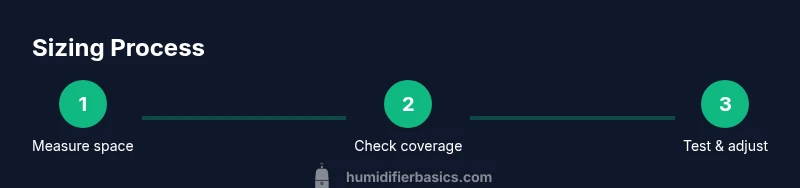
Measure the space
Use a measuring tape to record the length and width of the area you want to humidify and note ceiling height. Document any partitions or open doorways that affect air movement. This step establishes the baseline for sizing and helps you estimate the total air volume.
Tip: Take measurements at multiple points to capture irregular floor plans. - 2
Estimate room volume
Multiply floor area by ceiling height to approximate the air volume you need to influence. If you have unusually tall ceilings, slightly increase the volume estimate to reflect added air mass that must be humidified.
Tip: When in doubt, use the higher end of your volume estimate to avoid under-sizing. - 3
Check product coverage
Review the humidifier’s stated coverage rating in square feet at a standard ceiling height. Compare this to your measured space, aiming for a device that matches or exceeds your space. If your layout is open, consider two units to ensure even coverage.
Tip: Prefer units that offer adjustable output to fine-tune distribution. - 4
Factor climate and moisture needs
Consider your climate and seasonal humidity targets. In drier environments, you may need higher output or longer run times. In milder climates, smaller adjustments can achieve the same RH goals.
Tip: Keep target RH in the safe range (generally around moderate humidity) to avoid mold risk. - 5
Plan placement and pairing
Decide whether to use a single larger unit or multiple smaller units. Place units away from direct drafts while ensuring access for cleaning. If open spaces cause uneven distribution, a secondary unit can stabilize humidity more effectively.
Tip: Avoid placing units behind furniture blocking airflow. - 6
Test and adjust with a hygrometer
Run the humidifier and monitor RH in several zones after an initial run period. If readings are too high or too low in any area, adjust output or reposition units. This step verifies that sizing decisions meet real conditions.
Tip: Allow at least 30 minutes between adjustments to observe impact.
FAQ
How many square feet does a humidifier cover?
Most humidifiers list a coverage rating in square feet. To size for 1000 sq ft, choose a unit whose rating meets or exceeds that area, and plan for a margin if your space has open zones or high ceilings.
Choose a humidifier with a coverage rating that matches or exceeds your space, adding a margin for open areas.
Is one large humidifier better than multiple smaller units for 1000 sq ft?
Both approaches can work. A single unit simplifies maintenance but may struggle to evenly humidify a large or irregular space. Multiple units can balance humidity zone-by-zone but require more management.
One unit is simpler, but several smaller units can give you better zone control.
What humidity level should I target indoors?
A general guideline is to maintain indoor humidity in the moderate range to minimize mold risk while reducing irritation. Use a hygrometer to monitor and adjust toward around a comfortable level for your family.
Aim for a comfortable, moderate indoor humidity level and adjust with a hygrometer.
Can an oversized humidifier cause mold or condensation?
Yes. Running a unit with too much output can push humidity above safe levels, leading to condensation and mold. Always monitor RH and use the device output control to stay within a safe range.
Yes—too much humidity can cause mold; monitor RH and adjust output.
How often should I clean or replace humidifier components?
Regular cleaning and component replacement depend on usage and water quality. Follow the manufacturer’s schedule and inspect for mineral buildup. Cleanings reduce microbial growth and maintain performance.
Clean and replace parts as recommended to keep the unit safe and effective.
Do I need a humidifier for every room in a 1000 sq ft home?
Not necessarily. In many homes, a few well-placed units or a central device can maintain balance if rooms are connected and air flows are good. For partitioned layouts, targeted humidification in key living areas is often sufficient.
Often not—focus on key zones rather than every room.
Watch Video
The Essentials
- Measure space and ceiling height before choosing a device.
- Match or exceed the space coverage rating for reliable humidity.
- Consider open layouts and potential airflow with multiple units.
- Regular maintenance preserves effective sizing and performance.