How Much Space Does a Humidifier Cover? A Practical Guide
Find out how to estimate humidifier coverage for your space. Learn unit types, room-size considerations, placement tips, and maintenance for reliable humidity control. HumidifierBasics explains coverage ranges, sizing guidance, and common mistakes to avoid.


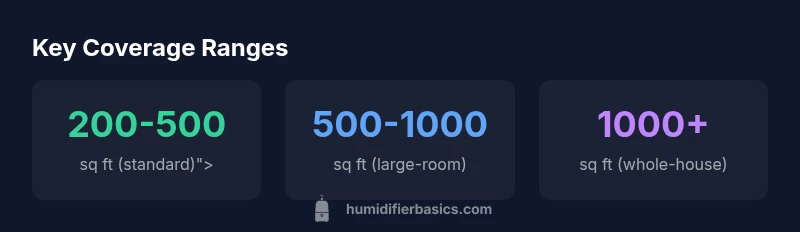
Most standard humidifiers are rated to cover roughly 200-500 square feet. Larger models can handle 500-1500 square feet, and some whole-house units exceed that. Coverage depends on airflow, ceiling height, ventilation, and whether the space is shared with other humidity sources. Always verify the unit's stated range and choose placement accordingly.
Understanding coverage as a practical metric
When you hear that a humidifier can cover a certain square footage, that figure is a practical guideline rather than a hard rule. Coverage is influenced by how the space is used, how well air moves, and how humid the room already is. According to HumidifierBasics, the most reliable way to interpret coverage is to view it as a starting point and then adjust for real-world factors such as ceiling height, furniture layout, and whether other sources of moisture (like kitchens or showers) are nearby. In practice, you want enough capacity to raise humidity evenly without creating damp spots. For many homes, this means selecting a unit with a stated range that matches or slightly exceeds the room size you intend to humidify—and then testing with a hygrometer to verify target humidity levels.
In addition to raw square footage, consider the room’s volume (length × width × height) because higher ceilings change the amount of air that needs humidification. A space with tall ceilings may need a unit that leaks humidity more slowly into the air, or more evenly via multi-directional mist dispersion. This is where real-world testing matters more than the label alone. HumidifierBasics recommends starting with the lower end of the stated coverage and adjusting as you monitor humidity performance over several hours or days.
The goal is comfortable, stable humidity—typically between 30% and 50% relative humidity for living spaces. If you notice condensation on windows or walls, you’re over-humidifying; if the air feels dry, you may need more coverage or a different placement strategy. Use a humidity monitor to keep track and prevent issues like mold or dust mite proliferation that can accompany improper moisture levels.
Factors that influence coverage
Coverage is not a fixed number; it shifts with several variables. First, ventilation: a well-ventilated room can dilute humidity faster, requiring higher-capacity units or longer operation times. Second, room layout: open-plan spaces may benefit from higher or multiple units placed to promote cross-room airflow. Third, ceiling height: taller rooms require more air volume to humidify evenly, which means either a unit with a higher output or multiple devices. Fourth, current humidity and external climate: in dry winter air, a unit might need to run longer to reach the target range; in humid summers, you may require less. Fifth, water quality and mist type: distilled water and fine-mist output reduce mineral buildup and improve perceived coverage. Finally, the presence of air drafts (near doors, windows, or fans) can push mist away from the center of the room, reducing effective coverage unless corrected by placement or ventilation adjustments.
Coverage by unit type and typical usage
| Unit Type | Avg Coverage | Notes |
|---|---|---|
| Compact humidifier | 200-350 sq ft | Best for small bedrooms or desks |
| Standard humidifier | 350-500 sq ft | Balanced option for most rooms |
| Large-room model | 500-1000 sq ft | Ideal for open layouts |
| Whole-house (multi-room) | 1000-1500+ sq ft | Requires proper airflow and ducting |
FAQ
What does 'coverage' mean for a humidifier?
Coverage refers to the area the device can humidify effectively, usually expressed as square feet. It’s a guideline that assumes typical room conditions and airflow. If your space differs significantly, the actual effective area may be smaller or larger.
Coverage means the area a humidifier can effectively humidify, usually shown in square feet.
Can one humidifier cover an entire open floor plan?
It’s possible with a high-capacity unit or multiple devices placed to optimize airflow. Always add the square footage of open spaces and verify the total coverage in the product specs.
It can cover an open area with a high-capacity unit or multiple devices.
Is humidity evenly distributed in a large room?
Even humidity depends on air movement. Use placement strategies and, if needed, a small fan to circulate air without creating drafts.
Distribution depends on airflow; place units to promote even circulation.
Should I use a humidifier in a nursery?
Yes, with caution: place the unit away from direct contact with the child, use distilled water, and clean regularly to prevent mold and bacteria growth.
Yes, but keep it clean and away from the child.
How often should I clean or replace filters?
Follow the manufacturer’s guidelines, typically involving weekly cleaning and periodic filter replacement depending on usage and water quality.
Clean regularly and replace filters as recommended by the manufacturer.
“Effective humidification starts with accurate coverage. Always size the unit to the space and adjust for airflow and occupancy.”
The Essentials
- Match unit to room size for reliable humidity
- Always verify the unit’s stated coverage range
- Account for ceiling height and airflow when placing the humidifier
- Consider multiple units for larger spaces or multi-room homes
- Use distilled water to maintain performance and reduce mineral buildup