Humidifier 3000 Sq Ft: A Practical Guide to Whole-Home Humidification
Practical guidance for humidifying a 3000 sq ft home, including sizing, efficiency, maintenance, and safety tips from HumidifierBasics to improve air quality.


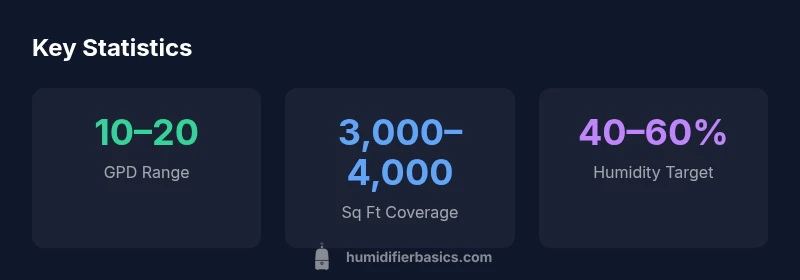
For a 3000 sq ft home, target a whole-house humidifier rated for roughly 10–20 gallons per day (GPD) or a unit advertised to cover 3,000–4,000 sq ft. This space-driven sizing helps maintain comfortable humidity without over-humidifying. Verify performance with a house-wide humidity sensor and ensure installation in the HVAC plenum for even distribution.
Why sizing matters for a humidifier 3000 sq ft
According to HumidifierBasics, sizing is the single most important factor for effective humidification in large spaces. A unit that is too small will fail to reach the target humidity, while an oversized model can lead to oversaturation and increased mineral deposits. For a 3000 sq ft home, a properly sized humidifier helps maintain a comfortable 40–60% relative humidity range, reducing dry skin, static electricity, and seasonal allergies. Beyond capacity, consider the distribution method—whole-house systems connected to your HVAC ducts usually provide the most even humidity. Use a reliable hygrometer in several rooms to verify performance and adjust settings as needed. The HumidifierBasics team found that pairing a properly sized unit with a humidity sensor yields the most stable results over time. When possible, choose a unit with automatic humidity control and a user-friendly interface to simplify daily use.
How to size a humidifier for large spaces
Sizing a humidifier for a home around 3000 sq ft starts with understanding space, insulation, and air exchange. A home with good insulation and sealed ducts may reach target humidity with a smaller unit (toward the 10 GPD end), while drafty or high-heat-loss areas push you toward the higher end (closer to 20 GPD). In practice, look for units labeled for large rooms or whole-home coverage and verify they advertise 3,000–4,000 sq ft coverage. Always pair the humidifier with a calibrated humidistat placed in several rooms to monitor actual humidity and avoid over-humidification. HumidifierBasics analysis suggests starting at the mid-point (15 GPD) and adjusting based on measured RH and seasonal changes.
Execution choices: evaporative, ultrasonic, and steam
There are three main humidifier technologies suitable for large spaces: evaporative, ultrasonic, and steam. Evaporative units naturally cap humidity and require mineral deposits cleaning, but can be economical and robust for 3000 sq ft. Ultrasonic models are quieter and energy-efficient but may release fine mist that interacts with minerals in water, emphasizing the need for filtered water. Steam humidifiers deliver the cleanest humidity quickly but consume more energy. For most large homes, a well-sized evaporative or ultrasonic model integrated into the HVAC system provides a balance of performance, maintenance, and cost. HumidifierBasics notes that a properly sized, well-maintained unit will outperform a larger-but-mismatched alternative.
Practical sizing examples and caveats
Example scenarios help translate numbers into real decisions. A well-insulated, single-zone 3000 sq ft home might perform well with a 12–16 GPD unit, especially if you install a bypass or powered option in the ductwork. In an open-plan 3000 sq ft layout with multiple zones, consider a dual-channel system or a single high-capacity unit with zoning control to avoid hotspots between rooms. Seasonal humidity swings will change needs; you’ll likely run closer to the mid-to-upper end of the range in dry winters and reduce output in humid summers. Always corroborate with live RH readings and adjust as seasons shift.
Installation considerations for whole-house humidifiers
Placement matters for even distribution. Install the humidifier on the return side of the HVAC system or directly within the furnace plenum for best dispersal, with appropriate drainage and overflow protection. Decide between bypass and power-assisted models based on your furnace type and DIY comfort. Ensure that your water supply is clean and that mineral deposits are mitigated with a proper water treatment or filtered water. Finally, verify that the system is balanced with your thermostat and airflow to avoid adding humidity where you don’t need it.
Sizing and installation notes for 3000 sq ft homes
| Category | Recommendation | Notes |
|---|---|---|
| Unit type | Whole-house humidifier (large-room) | Best for 3000 sq ft homes |
| GPD range | 10–20 GPD | Space-driven sizing |
| Installation | HVAC duct mounting | Bypass vs. powered connection |
FAQ
What size humidifier do I need for a 3000 sq ft home?
For a 3000 sq ft home, a whole-house humidifier rated around 10–20 GPD is typically suitable, or one that claims coverage for 3,000–4,000 sq ft. Always verify with RH measurements and adjust to seasonal conditions.
For a 3000 square foot home, aim for about 10–20 gallons per day and check humidity with a sensor to fine-tune.
Can I use a smaller unit or multiple units for even distribution?
Smaller units can work in clusters or in zoned setups, but ensure the total capacity matches the space. Multiple smaller units require careful balance to avoid over-humidification in some zones.
Multiple smaller units can work, but you must balance them carefully to avoid hotspots.
What installation options exist for a whole-house humidifier?
Most large-space humidifiers install in or near the furnace plenum or within the return ductwork. Choose bypass or powered options based on your HVAC type, and ensure proper drainage and water treatment.
Install in the furnace plenum or return duct, with proper drainage.
How often should I replace filters and clean the unit?
Check filters every 2–6 months depending on water quality and usage. Clean mineral buildup and sanitize the system at least twice a year to maintain performance.
Check filters every few months and clean mineral buildup twice a year.
Is it safe to run a humidifier in a bedroom?
Yes, with proper humidity control. Keep RH around 40–60% to prevent condensation on walls and mold growth. Use a quiet unit and place it away from direct wind paths.
Yes, just keep humidity in a safe range and use a quiet model.
“Sizing a humidifier for large spaces is the single most important step. The HumidifierBasics Team recommends units rated for 3,000–4,000 sq ft with reliable humidity control and routine maintenance.”
The Essentials
- Size by space and humidity targets, not guesses
- Use a humidistat in multiple rooms for accuracy
- Choose a unit rated for 3,000–4,000 sq ft coverage
- Prefer automatic humidity control for ease
- Maintenance matters: clean and monitor mineral deposits