Humidifier vs Dehumidifier: A Practical Side-by-Side Guide
Compare humidifier and dehumidifier performance, costs, and use cases to decide which device best fits your climate and air quality goals. Practical guidance, maintenance tips, and setup strategies for healthier indoor air.


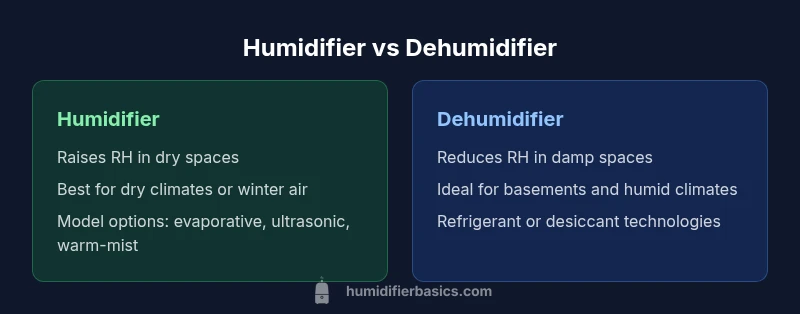
Humidifier vs dehumidifier are two sides of humidity control. A humidifier adds moisture to dry air, while a dehumidifier extracts excess moisture. Start by measuring room RH, then pick the device that moves RH toward a comfortable target (typically ~40-60% in living spaces). According to HumidifierBasics, use measurements to guide placement, capacity, and seasonality.
Why humidity control matters in homes
Maintaining appropriate humidity levels is essential for comfort, health, and the longevity of your home. When humidity is too low, people experience dry skin, irritated airways, and static electricity; when humidity runs high, dust mites, mold, and musty odors flourish. In many homes, central heating in winter drives RH downward, while humid summer climates push RH upward indoors. Understanding the difference between humidifier versus dehumidifier helps you diagnose the problem and pick the right tool. According to HumidifierBasics, the first step is to measure the room's relative humidity with a reliable hygrometer and note seasonal swings across living spaces. Real-world climates vary, so what works in a dry desert room may not suit a humid coastal basement. In practice, you’ll use RH targets to guide device choice, placement, and operation. This section lays the groundwork for a pragmatic comparison by clarifying what “too dry” and “too humid” actually mean for typical households. A measured approach reduces energy waste and health risks while protecting furniture and electronics.
Comparison
| Feature | humidifier | dehumidifier |
|---|---|---|
| Ideal humidity range | 40-60% RH typical | 30-50% RH typical |
| Energy efficiency | Model-dependent; efficiency varies by type and size | Model-dependent; efficiency varies by type and size |
| Maintenance effort | Regular cleaning, water quality, and possible filter changes | Regular cleaning, filter checks, and drainage management |
| Best for | Dry indoor air, winter dryness, comfort and skin health | Excess moisture, mold risk, damp basements, and condensation |
| Typical price range | $50-$300 | $60-$350 |
What's Good
- Helps maintain comfortable, healthy humidity levels
- Reduces musty odors and condensation with proper use
- Protects furniture and electronics from humidity extremes
- Wide model availability and feature options
Negatives
- Requires ongoing monitoring to avoid over-humidification or over-drying
- Can be energy-intensive in poorly insulated spaces
- Needs regular cleaning to prevent mold and mineral buildup
- Wrong timing or sizing can worsen air quality in a room
Choose humidifier for dry environments and dehumidifier for damp spaces; use RH measurements to guide the choice.
Begin with a room RH reading to decide which device to deploy. Humidifiers are best when air is dry; dehumidifiers excel where moisture gathers. In some homes, a staged approach or a hybrid system offers the most balanced solution.
FAQ
What is the main difference between a humidifier and a dehumidifier?
A humidifier adds moisture to the air, while a dehumidifier removes moisture. The choice depends on your room’s current RH and the climate. Measure RH first to determine which device will move humidity toward the target level.
Humidifiers add moisture, dehumidifiers remove it. Start by checking RH to decide which device will bring the humidity to a comfortable level.
How do I know which device to buy for my home?
Start with a hygrometer and observe seasonal RH swings in the main living areas. If RH is consistently low, a humidifier is warranted; if consistently high, a dehumidifier is needed. Size the unit for the room and consider energy features.
Use a humidity meter to guide your choice: dry spaces need a humidifier, damp spaces need a dehumidifier.
Can I use both devices in the same room?
Yes, in rooms with extreme variability or specialized needs, using both at different times can help maintain a stable RH. Use separate controls for each device and monitor RH closely.
You can run both, but time and control them so you don’t overshoot your humidity target.
What maintenance do humidifiers require?
Regular cleaning to prevent mold, mineral buildup, and odors is essential. Change or clean filters as recommended and use distilled water when possible to minimize mineral dust.
Keep the tank clean, use clean water, and check filters regularly.
Are there health risks with humidifiers?
Over-humidification can promote mold and dust mites. Maintain RH within a safe range and clean devices to prevent mold spores from entering the air you breathe.
If you keep humidity within a comfortable range and clean devices, health risks are minimized.
What about energy costs?
Energy impact varies by model, size, and climate. Choose ENERGY STAR models where possible and avoid running devices longer than needed by using humidity sensing and auto-off features.
Energy use depends on the unit and how you use it; aim for automatic controls to save power.
The Essentials
- Measure RH with a reliable hygrometer before buying
- Target a comfortable RH range (roughly 40-60% for living spaces)
- Choose humidifier for dry air, dehumidifier for damp spaces
- Monitor RH and adjust settings to avoid overcorrection
- Consider energy efficiency features and maintenance needs