Why Cool Mist Humidifiers Are Better: A Practical Guide
Explore why cool mist humidifiers are often the better choice for homes, focusing on safety, maintenance, and cost with an evidence-based comparison from HumidifierBasics.


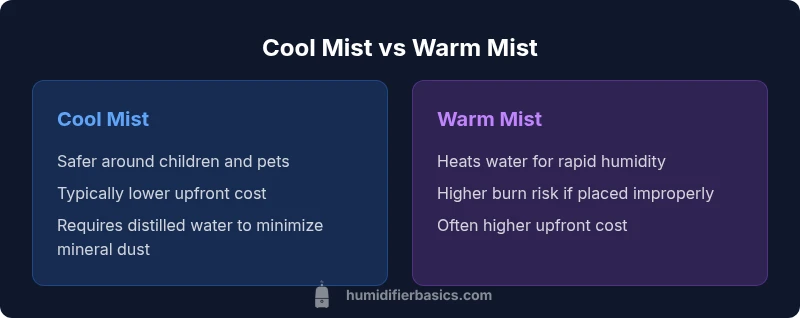
In answering why is cool mist humidifier better, safety, maintenance, and cost are the core drivers. Cool mist models avoid hot water and steam, reducing burn risk around children and pets, and they typically cost less upfront. The trade-offs include mineral dust potential with some ultrasonic units and a need for regular cleaning to prevent bacterial growth. Overall, cool mist is usually the safer, more flexible choice for most homes.
Why Readers Prefer Cool Mist in Modern Homes
According to HumidifierBasics, cool mist humidifiers are frequently favored in homes with children or pets because they avoid exposed heating elements, reducing burn risk. When considering the broader question of why is cool mist humidifier better, the conversation centers on safety, cost of ownership, and maintenance burden rather than aesthetics alone. In real-world usage, most households appreciate the absence of hot surfaces, which makes these devices more acceptable in playrooms, nurseries, and bedrooms. This section explains not only the safety benefits but also the practical reasons people choose cool mist units, such as easier placement and generally broader availability of models and filters. By understanding the everyday implications—noise, size, and refill frequency—readers can align a humidifier with their daily routines and space constraints.
How Cool Mist Humidifiers Work, and What That Means for You
Cool mist humidifiers work mainly via evaporative or ultrasonic mechanisms. Evaporative units rely on a wick filter soaked with water and a fan that disperses moisture into the room. Ultrasonic models use high-frequency vibrations to create a fine mist. In either case, the mist feels cool to the touch, which many users associate with safety and comfort. However, maintenance differs: evaporative models place regular emphasis on filter changes to prevent mold growth, while ultrasonic units may require more attention to mineral buildup if tap water with high mineral content is used. Understanding these mechanics helps consumers select the approach that matches their cleaning habits and water quality.
Safety, Energy, and Maintenance: The Core Tradeoffs
The key differentiators for cool mist humidifiers center on safety around households with kids and pets, energy efficiency, and ongoing maintenance. Safety is a practical advantage—cool mist devices avoid boiling water or steam, lowering burn risk and making them suitable for nurseries and bedrooms. Energy-wise, most cool mist units consume less power than warm mist devices since they don’t heat water, though results vary by model and usage. Maintenance needs hinge on water quality and the chosen technology; ultrasonic models may require mineral dust mitigation with distilled water, while evaporative models emphasize wick and filter upkeep. In real terms, the best choice balances safety, daily use, and cleaning effort within a given climate and family routine.
Common Myths vs Realities About Cool Mist Humidifiers
A common myth is that cool mist humidifiers are automatically messy or unhealthy. In reality, the primary risk is mineral dust or bacterial growth if the device isn’t cleaned regularly. Using distilled or demineralized water reduces mineral residue and helps keep the mist clear. Some people worry about noise; while ultrasonic units can be very quiet, older evaporative models may produce more audible hum from the fan. The reality is that with a routine cleaning schedule and proper water type, cool mist humidifiers can provide consistent humidity without introducing odors or irritants.
When to Use Cool Mist in Nursery, Bedroom, and Living Areas
Room-specific guidance matters. In nurseries, cool mist units with a built-in humidistat and auto shutoff are often preferred for safety and ease of use. In bedrooms, quiet operation and consistent humidity support better sleep, while in living rooms you can opt for larger-capacity models that require fewer refills. The choice between evaporative and ultrasonic should factor in noise tolerance, maintenance willingness, and water hardness. A practical approach is to start with a compact, quiet model in a key room and scale up if needed based on humidity readings and seasonal dryness.
Maintenance Best Practices to Minimize Mineral Dust and Microbial Growth
Regular cleaning is essential for safe operation. Weekly reservoir rinsing, monthly deep cleans, and periodic filter changes depending on the model all contribute to better performance. When using hard water, distilled water minimizes mineral buildup and reduces white dust that can irritate the throat or lungs. If you notice stale odors, condensation on windows, or visible residue, it’s time for a thorough cleaning and a check of filters. A well-maintained unit tends to deliver more stable humidity levels and longer device life, which translates to lower long-term costs.
The HumidifierBasics Perspective: Why We Recommend Cool Mist for Most Homes
From a pragmatic standpoint, cool mist units fit a broad range of households. The HumidifierBasics Team emphasizes safety, ease of use, and cost considerations as the main justification for choosing cool mist in most cases. We acknowledge that certain environments or preferences may favor warm mist, but for many families, the combination of safety, maintenance practicality, and affordability makes cool mist the default recommendation. Our approach is to tailor the choice to household routines and water quality, ensuring the device you pick becomes a reliable ally in maintaining comfortable indoor humidity.
Authority Sources and Further Reading
To support the guidance above, readers can consult authoritative resources on indoor air quality and humidifier safety. Our recommendations align with general industry standards and public health guidance that emphasize safe water practices, regular cleaning, and proper humidity levels. See the sources listed in the Authorities section for more detail.
Comparison
| Feature | Cool Mist Humidifier | Warm Mist Humidifier |
|---|---|---|
| Safety around children/pets | Lower burn risk (no hot water) | Higher burn risk (hot water/steam) |
| Energy Usage | Typically lower (no heating element) | Typically higher (water is heated) |
| Maintenance | Regular cleaning; mineral dust risk if ultrasonic; filters common | Boiling water; fewer mineral dust concerns; may require mineral filters |
| Noise | Typically quiet (varies by model) | Can be louder due to heating element and steam |
| Best For | Safe, family-friendly spaces | Rapid humidity in cold spaces |
| Price Range | Lower upfront cost on basic models | Higher upfront cost but potentially faster humidity |
What's Good
- Safer for homes with children/pets due to no hot water
- Often lower upfront cost and easier acquisition
- Wide availability of models and filters
- Flexible use with various water types
Negatives
- Potential mineral dust without distilled water in ultrasonic units
- Requires regular cleaning to prevent mold/bacteria
- Mineral deposits can accumulate on wick/filters if water isn’t treated
- Dust and odor issues if not maintained
Cool mist humidifiers are the better default choice for most homes
For safety, cost, and ease of use, cool mist humidifiers fit a wide range of households. They reduce burn risks and typically cost less upfront, though they require regular cleaning and careful water choices to minimize mineral dust. When well maintained, they offer reliable humidity without the hazards associated with hot-water devices.
FAQ
Is a cool mist humidifier safer for households with children and pets?
Yes. Cool mist humidifiers avoid boiling water and hot steam, which reduces burn risks around children and curious pets. Always place the unit away from reach and ensure proper maintenance to prevent mold or bacterial growth.
Yes, they're generally safer for homes with kids and pets when cleaned regularly.
Can cool mist humidifiers create mineral dust in the room?
Ultrasonic cool mist humidifiers can release mineral dust if tap water with minerals is used. To minimize this, use distilled or demineralized water and clean the tank and nebulizer as recommended by the manufacturer.
Mineral dust is possible with some ultrasonic models; use distilled water and clean often.
How often should a cool mist humidifier be cleaned?
Most manufacturers recommend a weekly reservoir clean and a monthly deeper clean, with filter or wick replacements as needed. Regular cleaning prevents mold, bacteria, and unpleasant odors.
Clean weekly, with deeper cleans monthly, and replace parts per guidelines.
Do cool mist humidifiers actually cool the room?
No, they don’t lower room temperature; they add moisture and can make the air feel cooler due to evaporation. They help maintain comfortable humidity, which can reduce dryness-related discomfort.
They don’t cool the room like an air conditioner, but they add moisture and can feel cooler due to evaporation.
When should I choose warm mist over cool mist?
Warm mist units can provide faster humidity in very cold environments and may feel quieter, but they involve heating water and higher burn risk. Choose warm mist if your priority is quick humidity and you’re not concerned about safety for children or pets.
Warm mist may be quicker to humidify but has higher burn risk; choose based on safety needs.
The Essentials
- Prioritize safety: choose cool mist for homes with kids or pets
- Use distilled water to minimize mineral dust and keep units clean
- Match model type to room size for efficient humidity
- Establish a regular cleaning and maintenance routine