What Size Humidifier for Bedroom: A Practical Guide
Learn how to choose the right humidifier size for your bedroom. We break down room-size ranges, output needs, and practical steps to achieve comfortable humidity levels without overdoing it.


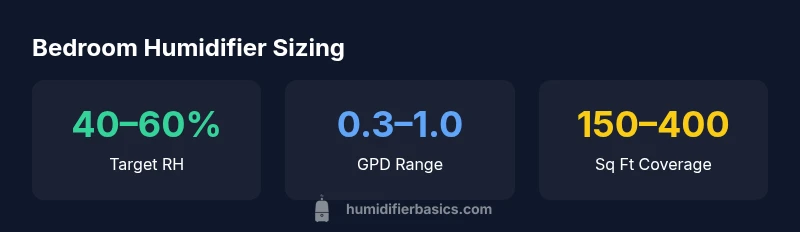
The right humidifier size for a bedroom depends on the room’s square footage and your target humidity. For most bedrooms under 250 square feet, aim for a unit that delivers roughly 0.3–1.0 gallons per day and covers about 150–400 square feet. For larger bedrooms, look for higher output and greater coverage. In general, choose adjustable-output models to dial in 40–60% relative humidity.
Why bedroom size matters
If you're asking what size humidifier for bedroom is right, the answer begins with the room’s square footage and your target humidity. According to HumidifierBasics, correctly sizing a humidifier reduces the risk of under- or over-humidification, helps control dryness, and supports better sleep. Start by measuring the room, including the ceiling height and whether the space is well-sealed or leaky. In most homes, a compact bedroom (roughly 100–250 square feet) benefits from a small-to-mid sized unit, while larger bedrooms require more capable models. The goal is to achieve a comfortable humidity range (often 40–60% RH) without making the air feel damp or stuffy. The sizing decision should also consider how often the space is occupied, how well the room vents, and whether you use supplemental heat. A thoughtful assessment now reduces the need for constant fiddling later.
Beyond room area, think about occupancy and climate control. If a heater is in the room, humidity can swing quickly; if the room is very drafty, you may need a bit more capacity to counteract loss. A conservative approach—starting with a unit that slightly exceeds the room’s needs—allows you to dial in humidity more precisely after a few days of monitoring with a hygrometer. By focusing on size first, you set up a stable baseline for comfort and air quality.
How to calculate the right humidifier size
Sizing a bedroom humidifier is a practical exercise that blends room measurements with humidity goals. Here are the steps you can follow:
- Measure the room’s square footage and note the ceiling height. A typical bedroom falls in the 100–250 sq ft range, but larger spaces exist. 2) Decide on your target humidity, usually 40–60% RH for comfort and health. 3) Look for a humidifier with coverage that matches your space. Many manufacturers label units by the square footage they can effectively humidify; choose one that equals or slightly exceeds your room size. 4) Check the output rating, often expressed in gallons per day (GPD) or liters per day. For smaller bedrooms, models in the 0.3–0.6 GPD range are common; mid-sized rooms often do well with 0.6–1.0 GPD; larger spaces may require 1.0–1.5 GPD. 5) After installation, use a hygrometer to verify humidity levels and adjust settings as needed. A few days of observation help confirm you’ve hit the target range. This method balances simplicity with accuracy and helps you avoid oversizing or undersizing the unit.
Size-to-output guidance for bedroom humidifiers
| Room Size (sq ft) | Recommended Output (gal/day) | Coverage (sq ft) |
|---|---|---|
| 100-150 | 0.2–0.5 | 150–200 |
| 151-250 | 0.4–1.0 | 200–400 |
| 251-350 | 0.8–1.5 | 400–600 |
FAQ
What size humidifier do I need for a 100 sq ft bedroom?
For a small bedroom around 100 sq ft, choose a compact unit with adjustable output, typically in the 0.3–0.6 gallons per day range, and look for coverage around 150–200 sq ft. Monitor humidity with a hygrometer to confirm it stays within 40–60% RH.
For a 100 sq ft bedroom, pick a compact humidifier with adjustable output and monitor humidity to stay in the 40–60% range.
Can I use a large humidifier in a small room?
A large humidifier in a small room can oversaturate the air, causing dampness and mold risk. If you only have a large unit, run it at the lowest setting and verify humidity with a hygrometer, or use a smaller-capacity model when possible.
A big humidifier in a small room can overshoot humidity; use the lowest setting and check with a hygrometer.
What is the ideal humidity level for bedrooms?
Aim for a humidity range of about 40–60% RH in bedrooms. This range helps relieve dry skin and throat while reducing condensation and mold risk.
Keep bedroom humidity around 40–60% for comfort and health.
How often should I clean my humidifier?
Clean your humidifier every 1–2 weeks during regular use and after extended downtime. Rinse the reservoir, wipe the base, and replace any filters as recommended by the manufacturer.
Clean every 1–2 weeks when in regular use to prevent mineral buildup and mold.
Is evaporative or ultrasonic better for bedrooms?
Ultrasonic humidifiers are quiet and efficient, making them popular for bedrooms. Evaporative units tend to be less prone to over-humidification but can be noisier and bulkier. Choose based on noise tolerance and ease of cleaning.
Ultrasonic units are quiet and common for bedrooms; evaporative units are another option if you need robust output.
“Accurate sizing ensures comfortable, healthy air without the frustration of over-humidification. An adjustable-output humidifier makes it easy to dial in the ideal range.”
The Essentials
- Size bedrooms by square footage before choosing a unit
- Aim for 40–60% relative humidity in bedrooms
- Prefer adjustable-output humidifiers for flexibility
- Match the unit’s labeled coverage to your room size
- Monitor humidity with a hygrometer to fine-tune settings