Ultrasonic humidifier vs evaporative: A Practical, Data-Driven Comparison
A data-driven look at ultrasonic humidifier vs evaporative models: noise, humidity delivery, maintenance, and cost to help homeowners choose the right humidifier for bedrooms, nurseries, and living spaces.


Ultrasonic humidifier vs evaporative: ultrasonic units are quieter and produce mist quickly, while evaporative models offer steady humidity with fewer mineral issues. This quick comparison helps you weigh noise, humidity distribution, maintenance, and cost to decide which type fits a bedroom, nursery, or living area best.
What ultrasonic humidifier vs evaporative means
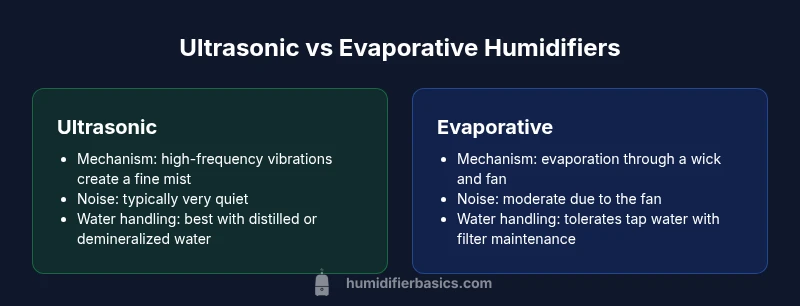
In the ultrasonic humidifier vs evaporative comparison, two distinct technologies drive how moisture enters your space. Ultrasonic humidifiers use high-frequency vibrations to turn water into a mist, producing a cool, atomized vapor almost silently. Evaporative humidifiers rely on a fan to evaporate water from a wetted wick or filter, releasing a steady, natural humidity through evaporation. The HumidifierBasics team notes that the choice often comes down to the balance between noise, speed of moisture delivery, and how each type handles mineral content in tap water. Ultrasonic units are typically quieter and produce fine mist quickly, while evaporative models tend to be more forgiving of mineral particles because the water passes through a filter before emission. For any homeowner, the question is not just mist output but how your space, water quality, and maintenance routine align with your priorities. According to HumidifierBasics, ultrasonic humidifiers use piezoelectric transducers to generate high-frequency vibrations that create a fine mist, whereas evaporative units cool water through evaporation using a wick and a fan. The result is two distinct user experiences: one optimized for quiet operation and quick spread of moisture, the other for consistent humidity with natural distribution.
According to HumidifierBasics, the core trade-offs are about noise, control, and maintenance complexity, not just mist output.
Comparison
| Feature | Ultrasonic humidifier | Evaporative humidifier |
|---|---|---|
| Noise level | Very quiet | Moderate noise due to fan |
| Humidity distribution | Fine mist, quick spread | Natural evaporation with broader coverage |
| Maintenance | Low maintenance; occasional cleaning | Filter replacement and wick care |
| Mineral dust risk | Higher with tap water (white dust) | Lower due to filtration |
| Best for | Quiet spaces and rapid humidity in small rooms | Budget-friendly humidity for larger spaces |
| Water type flexibility | Distilled water recommended | Tap water tolerable with filter |
What's Good
- Quieter operation in living bedrooms
- Flexibility in room-to-room humidification
- Wide availability and compact designs
- Low heat generation compared to some other humidifier types
- Good for fast relief of dry air in small spaces
Negatives
- Mineral dust risk with tap water in ultrasonic units
- Filter maintenance and replacement cost for evaporative units
- Potential for over-humidification if not monitored
- Requires regular cleaning to prevent mold and bacterial growth
Ultrasonic humidifier is often the best choice for quiet spaces and fast mist; evaporative humidifiers excel in larger rooms with stable humidity and lower mineral dust.
If you value near-silent operation and quick mist in small rooms, ultrasonic wins. If you need steady humidity in larger areas with less risk of mineral dust, evaporative is typically preferable; assess space, water quality, and maintenance capacity.
FAQ
What is the main difference between ultrasonic and evaporative humidifiers?
Ultrasonic humidifiers use high-frequency vibrations to create a fine mist without heat. Evaporative humidifiers use a warm or cool fan to evaporate water from a wick or filter, delivering humidity more gradually. Both provide cool mist, but the mechanism, noise profile, and mineral dust behavior differ.
Ultrasonic uses vibrations to make mist; evaporative uses evaporation through a wick and fan, delivering humidity at a steadier pace.
Which type is best for allergy sufferers?
Allergies benefit from controlled humidity and clean air. Evaporative units with filters can trap dust and minerals, while ultrasonic units require clean water to reduce mineral dust. Pair either with a HEPA-enabled purifier and regular cleaning for best results.
Filters help with dust; make sure to keep humidity steady and clean the unit regularly.
Do ultrasonic humidifiers create white dust?
Yes, if tap water with minerals is used. The fine mist can carry minerals onto surfaces as white dust. Using distilled or demineralized water minimizes this issue.
White dust happens with mineral-rich water; use distilled water to prevent it.
Are evaporative humidifiers better for large rooms?
Evaporative humidifiers often perform well in larger spaces due to slower, steady humidity delivery and filtration that helps maintain air feel. Ultrasonic units can still cover large rooms, but may require more placement planning and monitoring.
Evaporative units work well in bigger spaces with steady humidity; ultrasonic may need careful placement.
Can I use tap water in ultrasonic humidifiers?
You can, but expect mineral dust and possible residue. Distilled or demineralized water reduces mineral buildup and residue in the mist.
Tap water can cause mineral dust; distilled water is better for ultrasonic models.
How often should I clean a humidifier?
Most devices benefit from a weekly quick clean and a deeper monthly clean. Replace filters on a schedule for evaporative models, following the manufacturer’s recommendations.
Clean weekly; replace filters as advised by the maker.
The Essentials
- Choose based on room size and noise tolerance
- Ultrasonic units offer quick mist but may emit mineral dust with tap water
- Evaporative units provide steadier humidity with filters that trap minerals
- Regular cleaning and water quality are essential for both types