Power Humidifier vs Bypass: A Practical Comparison
Compare power and bypass humidifiers for HVAC systems to determine which suits your home. Learn installation needs, maintenance, energy use, and ideal scenarios for each type in this practical guide.


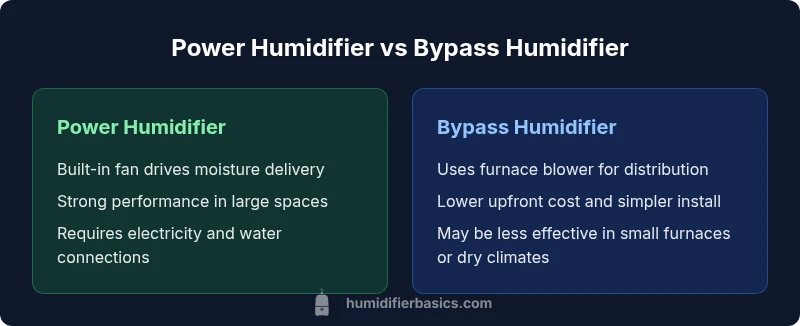
Power humidifier vs bypass: In most homes, a power humidifier (fan-powered) delivers higher humidity output because it uses an integrated fan to push air over the water panel. A bypass humidifier relies on the furnace blower to carry air through the humidifier, which can be less effective in smaller homes or with low airflow. Choose based on home size, climate, and energy considerations.
What are power humidifiers and bypass humidifiers?
In home HVAC terms, power humidifiers and bypass humidifiers are two common methods to introduce moisture into dry indoor air. The power humidifier, also called a fan-powered unit, uses its own small blower to push air across a humidifier panel and into the ductwork. By contrast, a bypass humidifier relies on the furnace blower to carry air through the humidifier, using the furnace’s airflow to distribute moisture. Understanding their basic design helps homeowners evaluate performance, installation requirements, and ongoing maintenance. According to HumidifierBasics, the choice between a power humidifier and a bypass model often hinges on factors like home size, climate, and existing HVAC configuration. In general, a power humidifier tends to deliver higher, more consistent humidity in spaces with limited airflow or larger volumes, while a bypass unit offers a simpler, typically lower-cost option for smaller homes or installations where the furnace runs frequently.
How they integrate with your HVAC system
Power humidifiers install in the duct system and connect to a dedicated electrical supply. They include a built-in fan or blower motor and often require a water line and a drainage connection. Bypass humidifiers mount directly on or near the furnace cabinet and rely on the furnace blower to move air through the unit. Because they don’t have a separate fan, bypass models typically integrate with fewer electrical components and can be simpler to retrofit alongside existing ductwork. The HumidifierBasics team notes that compatibility hinges on duct size, access to a drain, and the ability to route a water connection without compromising your furnace’s clearance or service access. Expect some coordination with your HVAC contractor to ensure a secure fit and proper controls, including humidistat integration and automatic shutoff when windows or doors are opened to prevent indoor over-humidification.
Performance differences at a glance
The most important factors are humidity output, distribution, and responsiveness to setpoints. Power humidifiers generally push more moisture into the supply air because of their own fan, which helps maintain steady humidity across larger spaces or homes with variable airflow. Bypass humidifiers lean on the furnace’s blower; in homes with low furnace runs or limited airflow, this can lead to slower humidity response and uneven distribution. Noise is another consideration: a power unit adds fan noise in the supply plenum, while a bypass unit mainly shares the furnace’s existing fan noise. Maintenance varies as well: power units require attention to the fan and water panel, whereas bypass units emphasize water panel cleaning and mineral control. For many homes, the choice comes down to how consistently you need humidity and how much you’re willing to invest in installation and upkeep.
Scenarios by home type and climate
- Large, multi-story homes in heating-dominant, dry climates: A power humidifier often delivers more reliable humidity on all floors because it doesn’t depend entirely on furnace blower cycles. It can maintain steady moisture levels even when the furnace cycles on and off.
- Small apartments or homes with high air exchange: A bypass humidifier can be sufficient if the furnace runs frequently and you don’t need very high humidity; it’s usually cheaper upfront and easier to service.
- Homes with retrofit constraints: If duct access is limited or you lack a convenient water drainage route, a bypass unit installed near the furnace may be easier to fit without major duct work. The HumidifierBasics guidance emphasizes assessing airflow, duct geometry, and available wall or cabinet space before deciding.
Installation considerations and compatibility
Successful installation depends on several practical factors. Power humidifiers require an electrical supply, a dedicated water line, and a drainage path for the condensate. They also need a properly sized duct section to ensure the mist is distributed evenly without causing pressure drops. Bypass humidifiers use a water line and drain as well, but lack the internal fan, so their installation hinges more on duct routing and furnace access. Both types benefit from a properly wired humidistat or a smart controller that adjusts humidity based on room conditions. Ensure your furnace can tolerate additional moisture load without triggering condensation issues or mold risk. A qualified HVAC pro can evaluate your specific system, test humidity delivery, and verify that controls keep relative humidity within safe ranges.
Maintenance, mineral deposits, and water quality
Water quality directly affects humidifier longevity and performance. Minerals in hard water can accumulate on the water panel and in the ductwork, potentially reducing efficiency or causing staining. Regular panel replacement, coil or pad cleaning, and periodic flushes help prevent mineral buildup. Distilled or demineralized water reduces mineral deposits, but is not always practical for whole-house installations. For both power and bypass models, routine maintenance includes inspecting the water panel, cleaning the reservoir if applicable, and ensuring the drain line is clear. The HumidifierBasics team recommends scheduling seasonal maintenance with an HVAC professional to sync with heating season patterns and to verify that the humidistat remains correctly calibrated.
Energy use, cost considerations, and value
From an energy perspective, a power humidifier adds a small, dedicated fan load to your system, which can influence seasonal electricity consumption. A bypass humidifier does not introduce an extra fan load, but it relies on the furnace blower, so its performance scales with how often your furnace runs. Because both devices influence home comfort, the value comes down to how consistently you need humidity and how much you are willing to invest upfront for installation and ongoing maintenance. When evaluating value, consider long-term humidity stability, potential health benefits from stable indoor moisture, and the risk of mold if humidity swings are frequent or excessive.
Best-use practices and decision framework
To pick between power humidifier and bypass humidifier, use a simple decision framework:
- Assess home size and layout; larger homes may benefit more from a power unit.
- Evaluate furnace airflow and running hours; limited airflow may favor a power unit for even distribution.
- Review water quality and maintenance tolerance; mineral-heavy water increases maintenance needs for either type.
- Compare initial costs and installation complexity.
- Plan for controls and smart integration to maintain steady humidity without overdoing it. HumidifierBasics suggests documenting your climate priorities and running a trial season to verify readings with a hygrometer.
Authority sources and further reading
For additional guidance on humidity control in homes, consult authoritative sources. These references provide foundational information on indoor air quality, moisture management, and HVAC integration. https://www.epa.gov/iaq/indoor-air-quality-humidifiers
https://www.niehs.nih.gov/health/topics/agents/humidity/index.cfm
https://www.energy.gov/energysaver/humidifiers
Comparison
| Feature | Power humidifier | Bypass humidifier |
|---|---|---|
| Airflow control | Built-in fan drives moisture delivery | Relies on furnace blower for distribution |
| Humidity delivery | Higher, more consistent output in larger spaces | Often lower without adequate furnace airflow |
| Installation complexity | Usually more complex (electrical, water, drainage, ducting) | Typically simpler (fewer electrical components) |
| Energy use | Adds dedicated fan energy to system | No extra fan energy; uses furnace power |
| Maintenance needs | Regular panel/fan maintenance and cleaning | Panel cleaning; mineral management varies with water quality |
| Best For | Large homes, dry climates, consistent humidity needs | Smaller homes, budget-conscious setups, adequate furnace airflow |
What's Good
- Higher humidity output, especially in large or dry spaces
- Faster response to humidity demands
- More consistent moisture distribution across multi-story homes
- Better control under strict humidity targets
Negatives
- Higher upfront cost and installation complexity
- Additional maintenance (fan, water panel) beyond bypass units
- Requires reliable water supply and drainage
- Potential for mineral buildup without proper water quality
Power humidifier is generally preferable for larger or drier homes; bypass is suitable for smaller spaces and tighter budgets.
Choose power humidifier when consistent, higher humidity across multiple rooms matters most. Choose bypass humidifier for simpler installs and lower upfront costs, provided airflow is adequate.
FAQ
What is a power humidifier and how does it differ from a bypass humidifier?
A power humidifier has its own fan to push air through the humidifier, delivering stronger humidity output. A bypass humidifier relies on the furnace blower to move air, which can mean slower, less uniform humidity in spaces with limited airflow. Your choice depends on home size, climate, and how much you value consistent moisture.
A power humidifier has its own fan for stronger moisture delivery, while a bypass uses the furnace blower and may be slower in some homes. Consider your space and climate when deciding.
Which is better for a small apartment with limited furnace use?
In small spaces with adequate furnace runs, a bypass humidifier can be enough and is usually cheaper to install. If you anticipate demand for higher humidity or the furnace runs infrequently, a power humidifier might provide more reliable moisture.
For small spaces with steady furnace use, bypass is often fine and cheaper; if you need higher humidity or less furnace activity, power may be better.
Can I retrofit my current furnace for a power or bypass humidifier?
Yes, both types can be retrofitted in many systems, but feasibility depends on duct layout, clearance, and electrical wiring. A licensed HVAC technician should assess compatibility, water supply, and drainage routing before installation.
Most furnaces can be retrofitted, but get a pro to confirm duct space, wiring, and water outlets first.
What maintenance do power and bypass humidifiers require?
Both types need periodic panel cleaning and water-quality checks. Power units add a fan that may accumulate dust, while bypass units rely on the furnace’s airflow, so monitor mineral deposits and replace panels as recommended by the manufacturer.
Both require cleaning and water-quality checks; power units add fan maintenance, bypass units depend more on the furnace’s airflow.
Do humidifiers affect mold risk in the home?
Improper humidity control can increase mold risk. Keep relative humidity within recommended ranges (generally around 30–50%). Use a humidistat and monitor humidity to avoid over-humidification.
Be careful with humidity targets; avoid letting moisture stay too high, use a humidistat to stay in the safe range.
Is it possible to have both a power and bypass humidifier in the same system?
It’s uncommon to install both, but some homes use a hybrid approach. A single system with adaptive controls can optimize humidity delivery based on demand, but this setup adds complexity and cost.
Hybrid setups exist but are complex and costlier; consult an HVAC pro to evaluate if it’s worth it.
The Essentials
- Assess your home size and furnace airflow before choosing
- Power humidifiers offer stronger, more even humidity delivery
- Bypass units are typically simpler and cheaper to install
- Water quality affects maintenance needs for either type
- Use a humidistat to prevent over-humidification and mold risk