Bypass Humidifier vs Power Humidifier: A Practical Comparison
Compare bypass humidifier vs power humidifier to decide which model fits your home. HumidifierBasics analyzes installation, moisture control, energy use, and maintenance for small to large spaces.


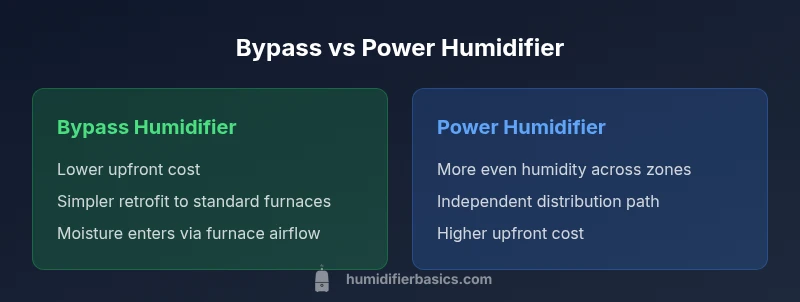
On balance, bypass humidifier vs power humidifier decision hinges on installation and space. A bypass humidifier is typically simpler and cheaper to install, while a power humidifier offers more even moisture distribution in larger homes. The HumidifierBasics team notes that the best choice depends on furnace setup, room size, and long-term maintenance requirements.
How bypass humidifiers work
Bypass humidifiers are typically mounted in a furnace's supply plenum or ductwork and rely on the furnace fan to push air through a water panel. A water line connects to the humidifier's fill valve, and as air moves over the wetted media, moisture is introduced into the airstream and carried through the ducts to living spaces. Because the humidity enters with the existing HVAC airflow, the system tends to warm the air quickly and requires some degree of furnace operation to function. In residential installations, bypass units are popular for their relatively simple design, compact footprint, and lower initial price. They generally integrate with standard thermostats and may share control logic with the HVAC system. From a maintenance standpoint, the main tasks involve cleaning the wetted media to prevent mineral buildup and replacing any filters or solenoid components as recommended by the manufacturer. Most homeowners notice a measurable improvement in indoor humidity during heating seasons, especially when outdoor humidity is very low. While bypass units are reliable, their performance depends on duct design and air distribution established by the furnace.
Key design differences between bypass and power humidifiers
Power humidifiers, by contrast, often feature their own dedicated water path and a separate discharge method from the furnace’s main airstream. They can use an inline fan or an integrated blower to push moisture into the duct system or directly into the living spaces, which tends to yield more consistent humidity across multiple rooms or zones. Because of this, power humidifiers generally offer tighter humidity control and better performance in larger homes or homes with long duct runs. The trade-off is a higher upfront cost, more complex installation, and more components that require maintenance. In both types, avoiding mineral buildup is essential, so using appropriate water treatment (in line with manufacturer recommendations) helps prevent scale and reduces service calls. Humidifier maintenance includes media replacement, cleaning, and watching for sediment in the drain lines—each type has its own service schedule that homeowners should follow for best results.
Suitability by home size and climate
Smaller or single-story homes with modest heating needs often do well with bypass humidifiers. They are easier to install in existing systems and typically meet the humidity targets during heating seasons with less risk of over-humidification in tight spaces. For larger homes, multi-story layouts, or climates with very dry air, power humidifiers generally perform better because they distribute moisture more evenly and can respond to changes in humidity across zones. In very humid climates or homes with moisture sensitivity concerns, either system benefits from a well-tuned humidistat and a furnace control strategy that prevents over-humidification. When assessing your climate, consider both indoor humidity goals and outdoor humidity patterns to choose the most reliable setup. The HumidifierBasics team emphasizes that the decision should balance long-term energy use, control precision, and the practical realities of your ductwork.
Installation considerations and retrofit tips
Retrofitting a bypass humidifier is commonly straightforward if the furnace area has accessible ductwork and a water line. Installers often route the bypass duct to the supply side, connect the fill valve to the cold-water line, and ensure the condensate drain has a proper slope for gravity drainage. Power humidifiers may require a dedicated power supply, a controller, and sometimes zoning considerations to avoid over-humidification in certain rooms. If you’re upgrading from a basic system, plan for potential wiring, a thermostat-compatible controller, and a review of your duct layout to ensure even distribution. For DIY enthusiasts, always shut off the water and power before starting, and consult the manufacturer’s installation guide. HumidifierBasics advises scheduling a professional inspection after installation to verify airflow balance and humidity targets are met.
Maintenance, minerals, and safety considerations
Mineral buildup is a common concern with both bypass and power humidifiers. Regular media replacement or cleaning prevents airflow restriction and scale. Use water conditioning options as recommended to minimize mineral deposits and ensure the unit drains properly. Safety considerations include checking for leaks, ensuring the drain line is clear, and confirming that humidity levels remain within the safe range for living spaces. The goal is stable humidity that reduces dry air discomfort without promoting mold growth or condensation on cold surfaces. Routine checks—ideally quarterly—help catch issues early and extend the system’s lifespan. Humidifier maintenance is usually simple, but neglect can lead to reduced efficiency or even damage to the furnace and ductwork.
Practical checklist to decide and prepare for installation
- Assess home size and number of zones that require moisture control.
- Check furnace compatibility and available space for a humidifier installation.
- Set a target humidity range and install a compatible humidistat.
- Plan for water quality considerations and mineral management.
- Schedule professional installation and a post-installation performance check. A well-chosen system aligns with your climate, budget, and comfort goals, while a less suited setup may underperform or require frequent maintenance. The HumidifierBasics team recommends documenting current humidity levels and tracking changes after installation to quantify benefits over time.
Authority sources
- https://www.epa.gov/indoor-air-quality-iaq/humidifiers
- https://www.niehs.nih.gov/health/topics/agents/humidity/index.cfm
- https://www.energy.gov/energysaver/humidifiers
Comparison
| Feature | Bypass Humidifier | Power Humidifier |
|---|---|---|
| Installation complexity | Lower; designed to bolt into the furnace plenum with a simple water line | Moderate to high; may require a dedicated power supply and controller |
| Moisture distribution | Relys on furnace airflow; distribution depends on duct design | Often provides more even humidity across zones with independent distribution |
| Energy use | Low to moderate; uses the furnace blower | Moderate; includes its own controlled distribution and air flow |
| Maintenance frequency | Typical maintenance of media and lines; fewer moving parts | More components to service; watch for mineral buildup in multiple paths |
| Best for | Small-to-mid sized homes with standard ductwork | Large homes, multi-story layouts, or where precise humidity matters |
| Cost impact | Lower upfront cost in many cases | Higher upfront cost due to installation and equipment |
What's Good
- Lower upfront cost in many installations
- Simpler retrofit for standard furnaces
- Fewer moving parts than some power units
- Quiet operation in typical setups
Negatives
- Moisture distribution depends on duct design
- Less precise control in large or multi-zone homes
- Potential mineral buildup if water quality is poor
- Requires adequate furnace airflow to be effective
Bypass humidifier is usually the safer default for typical homes; power humidifier excels in large, multi-zone layouts.
Choose bypass for straightforward installations and lower upfront costs. Opt for power when you need consistent humidity across multiple rooms or zones, especially in larger homes.
FAQ
What is the main difference between bypass and power humidifiers?
The main difference lies in where moisture is generated and how it is distributed. Bypass humidifiers use the furnace’s airflow to carry moisture through ducts, while power humidifiers add a dedicated distribution path and often provide more consistent humidity across spaces. Both require proper water quality and regular maintenance.
The key difference is where moisture is created and how it’s spread: bypass uses the furnace airflow, power humidifiers have their own distribution path. Regular maintenance and clean water are important for both.
Which humidifier is best for small homes?
For small homes, a bypass humidifier is typically the easiest and most cost-effective option. It integrates with existing furnaces and provides adequate humidity with standard duct layouts. If you need more precise control or have an atypical duct system, a power unit may still be a viable alternative.
For small homes, go with a bypass humidifier for simplicity and lower cost. It usually fits standard furnaces and ducts.
Do bypass and power humidifiers require a thermostat.
Yes, both types commonly work with standard thermostats and humidity controls, though power humidifiers may require a dedicated controller or zoning setup for optimal performance. Ensure your thermostat supports humidity management if you plan to use either system.
Most work with standard thermostats, but power humidifiers sometimes need a dedicated controller for best results.
Can I retrofit an existing furnace to use a bypass humidifier?
Retrofit is often feasible if there is accessible plumbing and duct space. An installer will connect a water line, mount the unit, and verify airflow. Always confirm compatibility with your furnace model and check for any needed duct adjustments.
Yes, you can often retrofit a bypass humidifier, but have a pro confirm compatibility with your furnace and ducts.
Is distilled water required for these humidifiers?
Distilled or demineralized water can reduce mineral buildup, but many homes use tap water safely with routine maintenance. Check your unit’s guidance on mineral deposits and consider a water treatment option if you have hard water.
You don’t always need distilled water, but using it can cut mineral buildup. Follow the manufacturer’s guidance on water quality.
The Essentials
- Assess room count and zone layout before choosing.
- Consider duct design and furnace compatibility.
- Weigh upfront cost against long-term humidity control needs.
- Prioritize water quality to minimize mineral buildup.