Humidifier and Fan Combo: A Practical Comparison for Home Air Quality
A data-driven comparison of integrated humidifier and fan combos vs separate devices, covering performance, maintenance, energy use, and best-use scenarios for 2026 homes.


The humidifier and fan combo offers a compact, all-in-one solution for improving indoor humidity and airflow in one step. For many homes, it provides a balanced mix of convenience and effective comfort, especially in small-to-mid sized rooms. This quick comparison points to integrated units as a strong default, while acknowledging that larger spaces may benefit from modular configurations.
The core concept: what a humidifier and fan combo is
A humidifier and fan combo combines moisture delivery with directed airflow, packing two functions into a single user experience. For homeowners seeking a simple path to more comfortable indoor air, this setup can help reduce dry skin, irritation, and static while promoting even humidity distribution. According to HumidifierBasics, integrating humidification and airflow control in one unit can save space and simplify maintenance for small to medium rooms. In 2026, many models emphasize smart humidity sensors, auto shut-off, and energy-efficient fans, all aimed at reducing energy use without compromising comfort. This article surveys how these combos differ from standalone devices, what performance you should expect, and how to choose the right arrangement for your space. It’s important to note that no single solution fits every scenario; placement, room size, climate, and occupant needs all shape outcomes. The HumidifierBasics team observes that apartments and bedrooms often benefit most from an integrated approach, while larger living areas may require more modularity.
How the integrated unit works: mechanics and trade-offs
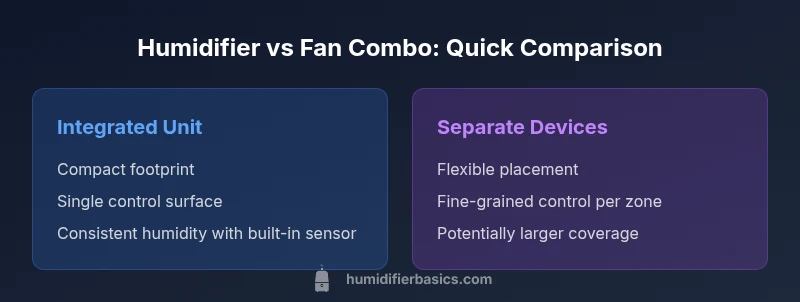
Integrated humidifier and fan combos rely on a shared chassis that houses a moisture source and a fan motor. The humidifier component releases water vapor, typically through a wick, evaporative disc, or ultrasonic membrane, while the fan distributes the resulting air across the room. The main trade-off is simplicity versus tunability: you enjoy a compact footprint and a single control surface, but you may lose the ability to tailor humidity targets to specific zones. Most models include a humidity sensor that automatically adjusts fan speed and mist output to reach a target RH (relative humidity). Placement remains critical—position the unit away from direct drafts and heat sources to avoid hot spots or condensation on walls. Additionally, integrated units can simplify maintenance because you clean one device; however, if the reservoir is small, you will refill more often. The net effect is convenience with a reasonable degree of control, especially for single-room applications.
Use-case scenarios: apartments, bedrooms, living spaces
Different spaces demand different configurations. In compact apartments, an integrated humidifier and fan combo often wins on space and ease of use; occupants can manage comfort with one device and a single power cord. In bedrooms, a quiet mode and night-time humidity target are common, supporting better sleep without wakeups. In open-plan living rooms, you’ll want to assess whether a single unit can influence humidity across several zones; if not, a modular approach with an additional portable fan might be required. For renters, an all-in-one unit reduces the risk of damaging walls or blinds through multiple devices. For colder climates, consider how well the unit handles low indoor humidity when outdoor air is dry. Across these scenarios, the key is to map heat sources, airflow pathways, and occupant routines to determine if a humidifier and fan combo can meet daily needs.
Integrated vs modular: architecture and performance implications
Architecture matters: an integrated unit is designed for a cohesive airflow pattern, often producing a more uniform humidity plume. A modular approach gives you flexibility—place the humidifier near the source of dryness and the fan in a location that maximizes air exchange. Performance differences show up in how quickly a space reaches the target humidity, how evenly it is distributed, and how much you notice mist or airflow at the far corners of the room. In practice, many homeowners find that a well-chosen integrated model works best for small-to-medium rooms, while larger spaces benefit from pairing a discrete humidifier with an adjustable fan or a ceiling fan with a stand-alone humidifier accessory. Always check airflow direction, ventilation interactions with windows, and whether the device meets any regional humidity guidelines.
Humidification performance: output and humidity control
Performance hinges on the device’s rated moisture output, which is expressed as gallons per day or milliliters per hour, and the sensitivity of the humidity control system. Integrated units with smart sensors can adjust mist output to stabilize RH around a user-set value. In practice, expect a moderate to strong impact in small rooms up to about 300 square feet; beyond that, you may see diminishing returns unless multiple devices work in concert. Humidifier and fan combo units often rely on a confluence of water delivery, fan velocity, and room airflow. The HumidifierBasics analysis indicates that achieving a comfortable humidity range in dry winter air typically requires careful placement and avoidance of direct drafts from vents. Users should verify that the unit’s water quality warnings, auto shutoff, and filter or membrane maintenance features are up to date.
Airflow, cooling, and comfort
Airflow patterns influence comfort as much as humidity levels do. A strong fan helps distribute moisture more quickly, but excessive airflow can create drafts or a cool sensation that makes the humidity feel lower than it is. The ideal setup balances mist output with fan speed to create a comfortable, uniform humidity gradient. In small rooms, a compact integrated unit can generate a pleasant climate with minimal disruption; in larger spaces, you may see more pronounced air mixing when multiple air currents intersect. Noise and vibration contribute to perceived comfort; choose models with soft-mount brackets or insulated housings if possible. Ultimately, the best outcomes come from aligning the device’s airflow direction with your seating areas, condensation risks, and seasonal temperature changes.
Maintenance and hygiene considerations
Maintenance is essential to safe, effective performance. For a humidifier and fan combo, you should adhere to a regular cleaning schedule that includes emptying and drying the reservoir, descaling mineral buildup, and replacing any filters or membranes as recommended by the manufacturer. Humidifiers harbor mold and bacteria if neglected, so use distilled or dem mineralized water where possible and ensure the unit dries between uses. The fan component should be cleaned to remove dust that can reduce airflow and worsen odor. If you have sensitive occupants, consider models with antimicrobial coatings or self-cleaning cycles. Always unplug the device before maintenance and store it dry to prevent microbial growth. A simple monthly inspection of seals, hoses, and connections helps prevent leaks and ensures safe operation.
Noise, vibration, and user experience
Noise is a common concern with combined units, especially at higher fan speeds or when the reservoir is full. Read decibel ratings in the product specs and look for models with quiet-motor configurations or vibration-damping feet. In bedrooms, low-noise modes and night settings can foster uninterrupted sleep. If you tend to sleep with a fan on, you might prefer a slower, steadier air move rather than high-volume blasts. User experience also depends on control layout: intuitive interfaces, clear indicator lights, and reliable humidity sensors reduce trial-and-error tuning. Finally, ensure the unit’s physical footprint fits your furniture arrangement without blocking air intakes or vents.
Energy use and cost considerations
Energy efficiency matters when choosing a humidifier and fan combo. A well-designed integrated unit can deliver humidity with modest energy use by combining functions in a single motor and optimized airflow path. The alternative—two separate devices—can incur higher energy use if both motors run continuously, though some configurations allow staggered operation to save power. Over time, maintenance costs like demineralization cartridges or filter replacements add up; the HumidifierBasics analysis shows that recurring costs vary by model and water quality. When evaluating price, consider both upfront cost and ongoing expenses; a cheaper unit may incur higher running costs, while a premium model with durable components could pay off in the long run.
Safety and best practices
Safety guidance includes keeping the device away from electrical outlets, avoiding overwatering, and ensuring proper ventilation to prevent excess humidity buildup. If you have pets or children, choose units with tip-over protection and accessible water reservoirs. Always follow manufacturer guidelines for cleaning intervals, filter replacements, and storage. Be mindful of water quality; hard water can contribute to mineral deposits and white dust, so distilled water is often recommended. If you notice excessive condensation on walls or windows, reduce humidity targets or increase ventilation. By adhering to these practices, you reduce the risk of mold growth and ensure a healthier indoor environment.
Setup tips and installation considerations
Placement is critical for performance. Position the unit away from direct drafts, windows, and heat sources, and aim for a central location that optimizes air mixing. Ensure the reservoir is easily accessible for refills and cleanings, and consider using a tray or mat to catch spills. If your space allows, pair your integrated unit with a ceiling fan or portable fan to augment air movement without overloading a single device. For renters, check lease restrictions regarding permanent fixtures and cords. Documentation from HumidifierBasics emphasizes setting realistic humidity targets and testing after a few days to gauge comfort and dryness levels.
Buying guide: what to look for in a humidifier and fan combo
Key criteria include humidity control accuracy, noise level, water quality handling, ease of cleaning, and warranty coverage. Look for units with automatic humidity control, a robust shutdown feature, and clear maintenance reminders. Consider the reservoir size relative to room area; a larger space needs either a larger reservoir or the option to connect to a continuous water source. Check compatibility with your existing furnishings and décor, and confirm energy efficiency ratings. Finally, read user reviews and compare claimed performance against independent testing results when possible. By evaluating these factors, you can select a humidifier and fan combo that aligns with your climate, lifestyle, and budget.
Common pitfalls and how to avoid them
Common mistakes include choosing a unit that’s too large for the room, neglecting regular cleaning, and underestimating the importance of proper placement. Avoid relying on a single device to control humidity for multiple rooms; zone dynamics can render a single unit insufficient for even distribution. Don’t forget to check water quality and mineral buildup, which can affect odor and efficiency. Finally, be realistic about noise tolerance and energy use; if you require near-silent operation, you may need to invest in higher-end models with sound-dampening features.
Comparison
| Feature | Integrated humidifier and fan unit | Separate humidifier + standalone fan |
|---|---|---|
| Footprint/installation | Compact, integrated | Flexible placement for two devices |
| Humidity control | Central control with sensor feedback | Zonal control possible with multiple devices |
| Maintenance | One unit to clean and refill | Multiple devices to maintain |
| Noise profile | Moderate noise depending on model | Variable by device; can be quieter per unit |
| Water source flexibility | Built-in reservoir, limited capacity | External water options with larger reservoirs |
| Price range | Mid-range for single-unit setups | Variably priced; two devices can add cost |
| Best for | Small rooms and renters | Larger spaces and multi-zone needs |
What's Good
- All-in-one design reduces setup time and clutter
- Coordinated humidity and airflow in a single unit
- Easier to manage for renters with simple replacements
- Space-saving footprint and fewer cords
- Fewer components to monitor
Negatives
- Less control over humidity targets per room
- If either function fails, both functions may be affected
- Potentially higher upfront cost for integrated units
- Noise and heat from one combined unit in small spaces
Integrated units generally win for compact spaces, while separate devices suit larger, multi-zone rooms.
The HumidifierBasics team recommends prioritizing an integrated humidifier and fan combo for small to medium rooms, balancing convenience with adequate humidity control. For larger homes or zones with distinct climate needs, modular setups may deliver more precise comfort and flexibility.
FAQ
What is a humidifier and fan combo?
A humidifier and fan combo is a device that both adds moisture to the air and circulates it with a built-in fan. This integration aims to stabilize humidity levels while improving overall air distribution, particularly in single rooms. It’s designed for convenience and compact spaces.
A combined humidifier and fan adds moisture and moves air in one unit, ideal for quick setup in small rooms.
Are humidifier and fan combos better for small spaces?
Yes, they are often a good fit for small apartments or bedrooms because they save space and reduce clutter. They also simplify maintenance since there’s only one main device to manage.
Yes, for small spaces a single unit lowers setup and maintenance effort.
Can I use a humidifier and fan combo in a bedroom?
Absolutely. In bedrooms, look for quiet operation, a stable humidity target, and auto shutoff for safety during night use. Ensure ventilation can handle the added humidity.
Great for bedrooms if you pick a quiet model with good humidity control.
What maintenance is required for a combo unit?
Regular cleaning of the reservoir and any filters is essential to prevent mold and mineral buildup. Dry the unit between uses and replace components per the manufacturer’s schedule.
Regular cleaning and drying keep the unit safe and efficient.
Should I prioritize integrated or separate devices for a large living room?
For large spaces, a modular approach often works better, with a separate humidifier and a powerful fan or ceiling fan to cover zones. This can provide more consistent humidity across areas.
In big rooms, consider separate devices for even coverage.
How should I place a humidifier and fan combo for best results?
Place the unit away from direct drafts, vents, and heat sources. Position to optimize airflow toward seating areas and avoid corners where humidity may condense.
Place in the center of the room away from drafts for best results.
What about energy use and cost with a combo unit?
Integrated units can be energy-efficient due to a shared motor, but two devices may add up energy costs depending on usage. Compare models and consider long-term maintenance.
Energy use varies; compare models and consider long-term maintenance.
Are there safety concerns with humidifier and fan combos?
Safety basics include keeping away from water and electrical outlets, using distilled water if possible, and ensuring adequate ventilation to prevent excess humidity.
Follow safety guidelines, use distilled water, and ventilate appropriately.
The Essentials
- Choose integrated units for space-saving convenience
- Consider modular setups for multi-zone control in large rooms
- Regular cleaning is essential for both configurations
- Placement and air-flow paths determine comfort more than specs alone
- Balance upfront costs with ongoing maintenance