Winter Humidifier Settings: Achieving Ideal Indoor Humidity
Learn the ideal winter humidifier settings to maintain healthy indoor humidity. This practical guide covers RH targets, room-by-room adjustments, and maintenance tips to prevent dryness, condensation, and mold.


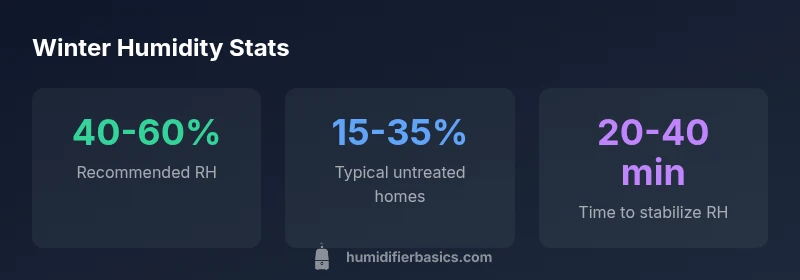
In winter, aim for an indoor relative humidity of about 40-60% in living areas, with bedrooms at about 40-50%. Use a hygrometer to monitor RH and adjust your humidifier gradually to avoid over-humidification and window condensation. Start from the middle of the target range and fine-tune based on room activity and ventilation.
Understanding winter humidity and why it matters\n\nHumidity is a core factor in indoor air quality, especially in colder months when heating dries the air. If you're wondering what should my humidifier be set at in winter, you’re not alone—the right range depends on your climate, home size, and occupancy, but general targets help you start safely. In most homes, maintaining indoor RH around 40-60% during winter supports comfort, reduces dry skin, and minimizes condensation on windows. A hygrometer is your best friend here; it provides the objective data you need to dial in the perfect setting without guesswork. Throughout this guide we’ll refer to the winter setting as a baseline you can adapt by room and season. Humidity levels outside this range can cause problems: too dry irritates airways, too wet invites mold. The HumidifierBasics team emphasizes gradual adjustments and regular monitoring to avoid overshooting the target.
Baseline RH targets for most homes\n\nExperts commonly cite a winter indoor RH target of roughly 40-60%. This range balances comfort with the risk of mold or condensation, especially in rooms with poor airflow. In practice, many homes drift toward the lower end of that range during the cold season, often landing around 30-50% in bedrooms or near windows. The point isn’t a single number; it’s a zone you stay within while accounting for indoor activities, cooking, showering, and the performance of your heating system. Humidifier usage should aim to fill the gap created by dry winter air, not simply push humidity higher than necessary. If you’re asking what should my humidifier be set at in winter for an entire house, consider a central approach and room-by-room adjustments guided by a hygrometer. The HumidifierBasics analysis notes that targets vary with humidity loads from occupants and pets; start in the middle of the recommended zone and fine-tune from there.
How to determine your target: room-by-room guidance\n\nNot all spaces require identical humidity, especially in colder climates where radiant heat and air leaks change moisture dynamics. Begin with main living areas at a comfortable 40-60% RH, then set bedrooms to about 40-50%. Kitchens and bathrooms can run a touch lower (30-50%) if you vent properly after cooking or showering. To establish room-specific targets, place a digital hygrometer in each space for 24-48 hours and note the average RH. If you measure 42% in the living room and only 32% in the bedroom despite the same device, you know you need a different humidification plan for each zone. When adjusting, make small changes (5-10 percentage points) and re-check after an hour or two; winter humidity responds slowly to changes, so patience pays off. The goal is a consistent, comfortable range across rooms, without triggering condensation on windows or furniture.
Practical steps to adjust: dial, test, and monitor\n\nBefore turning a humidifier up or down, verify that your device is clean, using distilled water when possible to minimize mineral buildup. Start at mid-range settings and observe RH using a hygrometer for several hours. If the reading stays between 40-60%, you’re in a safe zone. If you see readings creeping toward the high end (near 60-65%), back off slightly to avoid condensation. For smaller spaces, a lower target around 40-50% may be ideal. In crowded homes or with pets, expect the RH to drift toward the higher end of the range, but still monitor closely. Remember: dry air can irritate skin and sinuses, while excessive moisture fosters mold growth. Keep windows and doors sealed with drafts minimized to maintain stable humidity levels.
Common winter mistakes and how to avoid them\n\nOne common error is over-humidifying, which creates condensation on windows and encourages mold. Another pitfall is relying on a single humidity target for an entire house; older homes with poor insulation require more nuanced control. Another mistake is neglecting proper humidifier maintenance: mineral buildup reduces efficiency and can backfire by releasing impurities. Using tap water can introduce minerals and VOCs that irritate airways; filter or use distilled water if possible. Finally, forgetting to test RH at different times of day—busy mornings and nighttime hours may show different needs. The result is a humidity profile that is inconsistent and hard to manage. The fix is routine measurement, room-by-room targets, and periodic equipment checks.
Humidifier types and recommended settings\n\nDifferent humidifier technologies respond differently to winter conditions. Ultrasonic humidifiers generally provide fine mist but can release minerals if you don’t use distilled water; evaporative models are more self-regulating, as their output depends on ambient humidity. In both cases, aim for the 40-60% RH band and adjust to avoid condensation on windows. Warm-mist units can add a bit more perceived moisture, but they introduce burn risk and require careful placement away from children and pets. For most households, cool-mist ultrasonic or evaporative models paired with a hygrometer offer the best balance of safety, efficiency, and control. Choose a unit with adjustable output and a built-in humidistat for accuracy, and always follow the manufacturer’s guidance on water type and maintenance.
Monitoring and maintenance tips for consistent winter humidity\n\nConsistency comes from consistent practices. Clean your humidifier at least once a week, replace filters as recommended, and run the unit with distilled or demineralized water to minimize mineral residue that can affect output. Change the water daily if your area has particularly hard water or you notice white dust around the unit. Calibrate the built-in humidistat if available, but rely primarily on an external hygrometer for truth. Replace worn seals or gaskets to prevent leaks. Finally, keep heat sources from directly blowing onto the unit so the mist reaches the room evenly. Regular checks keep RH stable in winter and protect furniture and wood from excessive moisture.
When to use additional methods to control humidity\n\nSometimes a humidifier isn’t enough. Improve humidity with moisture-retaining houseplants, air-drying laundry indoors, or using a properly vented bathroom exhaust. If you notice persistent condensation, reduce moisture or increase ventilation. In large homes, zone humidification with multiple devices can help balance RH more effectively than a single unit. Pair humidification with air cleaning and filtration to maintain a healthier indoor environment, especially if occupants have allergies or respiratory issues. The goal is a stable, comfortable RH rather than simply higher numbers.
Quick-start checklist for winter humidity\n\n- Place a hygrometer in a central living space and aim for 40-60% RH. \n- Set main rooms to 40-60% RH, bedrooms to 40-50% RH, kitchens and bathrooms to 30-50% with ventilation. \n- Run humidifiers in key living areas with a target RH within the recommended range and re-check after 1-2 hours. \n- Clean and maintain devices weekly; use distilled water to minimize mineral deposits. \n- Monitor windows for condensation and adjust settings or ventilation as needed. \n- Re-test RH at different times of day because humidity fluctuates with activity.
RH targets by room during winter
| Room/Scenario | Recommended RH | Notes |
|---|---|---|
| Living areas | 40-60% | Avoid over-humidifying to prevent condensation |
| Bedrooms | 40-50% | Lower at night if sensitive to drafts |
| Kitchens/Bathrooms | 30-50% | Ventilate after cooking/showering |
FAQ
What is the ideal indoor humidity level in winter?
Most homes benefit from a target of 40-60% RH during winter. Use a hygrometer to confirm and adjust gradually.
Aim for 40 to 60 percent humidity in winter and check with a hygrometer.
How do I know if my humidifier is set correctly?
Monitor RH with a hygrometer and ensure readings stay within 40-60%. Make small adjustments if needed and re-check after a few hours.
Use a hygrometer to verify you’re in the 40-60% range and adjust slowly.
Can I set my humidifier too high?
Yes. RH above 60% increases mold risk and condensation. Dial back to stay under 60%.
Yes—don’t let humidity go over 60%.
Should all rooms have the same humidity?
Not necessarily. Living spaces often benefit from 40-60%, bedrooms around 40-50%. Ventilate kitchens/bathrooms to manage spikes.
Rooms can have different targets; don’t force one number everywhere.
What about drafts and humidity loss in winter?
Cold drafts can lower RH; seal leaks where possible and use targeted humidification in key rooms.
Drafts pull humidity out—seal gaps and use humidifiers where needed.
Which humidifier type is best in winter?
Cool-mist units are common and safe, while evaporative models offer self-regulating output. Choose based on room size and safety needs.
Cool-mist is usually safest; pick according to room size and maintenance.
“Maintaining steady humidity in winter reduces respiratory irritation and mold risk, but avoid excess moisture that leads to condensation. Use a hygrometer to verify performance and adjust gradually.”
The Essentials
- Set winter RH to 40-60% for most homes
- Use a hygrometer to verify RH across rooms
- Adjust in small increments (5-10%) and re-check
- Adopt room-by-room targets instead of a single house-wide setting
- Maintain humidifier with distilled water and regular cleaning