How to Remove Minerals from Water for Humidifiers
Learn how to remove minerals from water for humidifiers with practical methods, maintenance routines, and budget-friendly options to protect your device and improve air quality.


Definition: This guide defines practical methods to remove minerals from water for humidifiers and explains why mineral-free water matters for longevity and consistent humidity. You’ll learn how to use distilled, demineralized, or filtered water, plus straightforward maintenance steps to keep mineral buildup at bay. No specialized tools required; this guide emphasizes accessible options for homeowners and renters.
Why minerals matter in humidifier water
Mineral content in tap water can affect how well your humidifier works and how long it lasts. When water sits in the tank, dissolved minerals such as calcium and magnesium can accumulate as scale on heating elements, spill onto the interior surfaces, and migrate into the mist as white dust. This residue can reduce efficiency, clog nozzles, and make cleaning harder over time. According to HumidifierBasics, mineral buildup can shorten filter life and impair humidification performance. For most households, using mineral-free water dramatically reduces these problems, keeps your humidifier operating quietly, and preserves indoor air quality. In addition to the visible dust, minerals can contribute to mineral haze in your room and may encourage microbial growth if the water is stagnant. The goal is not to remove every trace of minerals from water, but to minimize dissolved solids to the level that your device tolerates and to maintain predictable humidity.
Understanding your water options
Your best defense against mineral buildup is choosing water with as few dissolved solids as possible. Distilled water is produced by boiling water and condensing the steam, which removes most minerals. Demineralized or deionized water uses ion exchange or other purification steps to remove minerals; reverse osmosis water passes water through a membrane to reduce minerals as well. Some households rely on purified water from a home RO unit, which can be more economical than buying distilled water in bulk. Based on HumidifierBasics analysis, distilled water minimizes mineral residues and helps sustain valve performance and fog consistency. If distilled water is unavailable, demineralized or RO water is a strong alternative. Always check your humidifier manual, because some models are designed to work best with specific water types and certain mineral contents. Inexpensive filtration options can reduce minerals, but they will not remove everything, so plan for regular maintenance and occasional descale.
Filtration and treatment methods
Several practical options can reduce minerals before they reach the humidifier. A cartridge-style mineral removal filter or ion exchange cartridge installed in the water line can capture hardness minerals. Demineralization cartridges are designed to swap calcium and magnesium for harmless ions, while resin-based ion exchange systems perform a similar job inside the filter housing. Reverse osmosis or nanofiltration units provide an extra layer of mineral reduction for households with very hard water. Each method has tradeoffs in cost, upkeep, and compatibility with your humidifier. Before purchasing a treatment, confirm compatibility with your device and warranty requirements. If you prefer simplicity, using distilled water from the store eliminates most mineral concerns, though it adds ongoing cost. HumidifierBasics recommends considering your daily water use, local water quality, and equipment compatibility when selecting a solution.
Choosing the right option for your humidifier
Not every approach fits every device. Ultrasonic humidifiers, for example, may spray more mineral dust if mineral content is not controlled, while evaporative models can tolerate slightly mineral-rich water. If you have a small bedroom humidifier, distilled water often provides the cleanest mist and easiest maintenance. For larger rooms, consider a home filtration method or a refillable cartridge system that aligns with your water hardness and budget. When possible, test the mineral content of your water using a simple test kit, then compare with your device specifications. A practical plan combines a water source that minimizes minerals with a regular cleaning routine to prevent deposits from building up between descales.
Maintenance routines to prevent mineral buildup
Create a simple weekly checklist to keep mineral deposits from accumulating. Start by emptying and drying the tank, then rinsing interior surfaces with a mild cleaning solution or white vinegar to dissolve scale. Rinse thoroughly to remove any residual vinegar that could irritate the humidifier or the air you breathe. Wipe the exterior and base with a soft cloth to remove dust and mineral film. If you notice white dust on furniture or surfaces near the unit, replace or switch to a more mineral-free water source. Keep an occasional descaling session as a preventive measure, especially in areas with hard tap water. Regular maintenance reduces cleanup time and preserves performance between service cycles.
Troubleshooting common mineral-related issues
If you still see white dust after using mineral-free water, re-check the water source and confirm the cartridge or filtration element is functioning properly. Mineral buildup can indicate a failing filter, incorrect water type, or scale forming on heating elements. Clean the tank and base with vinegar as needed, and ensure all seals are in good condition to prevent leaks that concentrate minerals. Some units may require a warm rinse or a second descale, so follow the manufacturer instructions and avoid harsh scrubbing that could scratch the surface. If mineral dust persists despite a clean system, consider a different water source or higher-grade filtration to reduce dissolved solids.
Practical tips for homeowners and renters
- Keep a small bottle of distilled water on hand for refills and emergencies
- Label water containers to avoid mixing treated and untreated water
- Schedule a monthly inspection of the humidifier’s base and water tray
- Use a soft cloth and gentle cleaners to prevent scratches
- Consider a low-cost filtration option if distilled water is not always accessible
The HumidifierBasics team recommends prioritizing mineral-free water whenever possible to protect your device and maintain air quality. With practical maintenance routines and the right water source, you can minimize mineral-related issues and enjoy consistent humidity throughout the year.
Tools & Materials
- Distilled water(Shop for 1-2 gallon bottles; choose food-grade containers.)
- Demineralized water(DI water from a cartridge or lab-grade source.)
- Home water filtration system (optional)(RO/DI systems can reduce minerals before storage.)
- Humidifier cleaning brush(Soft bristles to avoid scratching surfaces.)
- White vinegar(Descaling solution; use only for descaling and rinse thoroughly.)
- Soft cloth(For wiping the tank, base, and exterior.)
- Measuring cup(Useful for accurate water portions when testing.)
- Labels or markers(Keep track of which water source you’re using.)
- Water test kit(Optional; helps gauge mineral levels.)
Steps
Estimated time: Total time: 25-40 minutes
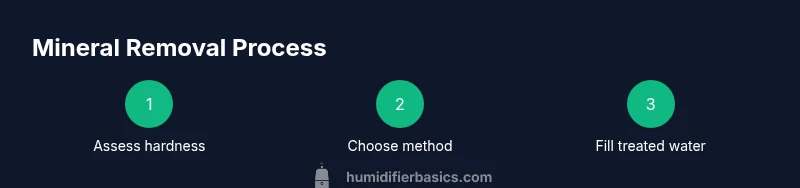
- 1
Assess your water hardness
Identify the mineral content of your tap water using a simple home test kit or your local water report. Knowing the hardness level helps you decide between distilled, demineralized, or filtered water. This step sets the foundation for choosing the most cost-effective method.
Tip: Use the local water report and a home test kit to establish a baseline. - 2
Choose a mineral removal method
Select distilled water or a compatible filtration approach (RO/DI) based on your budget, volume, and humidifier type. Ensure the method is compatible with your model’s warranty and maintenance needs.
Tip: Check your humidifier manual for recommended water types before purchasing filters. - 3
Fill with treated water
Fill the humidifier reservoir with your chosen treated water and avoid mixing untreated water with treated water mid-cycle. Label containers to prevent cross-use.
Tip: Keep a dedicated bottle for treated water to prevent mix-ups. - 4
Clean regularly
Descale and clean the unit on a regular schedule, especially if you notice white dust or reduced fog. Rinse thoroughly after any vinegar cleaning to remove residues that could affect air quality.
Tip: Descale at least every 1-2 weeks in hard-water areas. - 5
Monitor and adjust
Observe fog quality and residue; adjust by switching water sources if buildup reappears. Keep a small log of water type and cleaning dates.
Tip: A simple log helps you identify when to switch sources or change filters.
FAQ
What causes mineral buildup in humidifiers?
Minerals from hard water precipitate and deposit on heating elements and surfaces. This can reduce efficiency, cause white dust, and create harder cleaning cycles. Regularly using mineral-free water mitigates these issues and preserves humidifier performance.
Minerals in hard water deposit on parts and reduce efficiency. Using mineral-free water helps keep your humidifier working smoothly.
Can I use tap water in a humidifier if I filter it?
Filtered tap water can reduce some minerals, but it may not remove all dissolved solids. Distilled or demineralized water provides the most consistent results and minimizes residue. Always consult your humidifier manual for water type recommendations.
Filtered tap water can help, but it doesn't remove every mineral. Distilled water usually gives the best results.
Is distilled water always necessary?
Not always. For small units or light usage, high-quality filtered water can be acceptable. Distilled water reduces residues the most, but it can be costlier over time. Consider your usage, budget, and model requirements.
Distilled water is not always required, but it minimizes residue and is often the simplest option for small units.
How often should I clean the humidifier?
Clean the humidifier weekly in areas with hard water and after every change of water type. Descale as needed using a vinegar solution, then rinse thoroughly to avoid leftover acidity in the mist.
Clean weekly, descale when needed, and always rinse well.
Are there risks using demineralization cartridges?
Demineralization cartridges can reduce minerals but require replacement according to the manufacturer's schedule. Failing to replace cartridges can reduce effectiveness or affect performance. Always follow the product instructions.
Demineralization cartridges work but need regular replacement to stay effective.
What if I can't access distilled water?
If distilled water is unavailable, use RO or DI water with a compatible mineral-removal cartridge and monitor the results. Some humidifiers tolerate slight mineral content better than others; refer to the manual.
If you can't get distilled water, RO or DI water with a proper cartridge is a good alternative.
Watch Video
The Essentials
- Choose mineral-free water as a first option
- Evaluate your humidifier compatibility before buying filters
- Clean weekly to prevent mineral buildup
- Test and track water sources to optimize results
- HumidifierBasics recommends mineral-free water for best air quality