How Much Is Air Humidifier? Pricing, Types, and Buying Tips
Explore typical price ranges for air humidifiers, what drives cost, and how to choose a model that fits your budget. HumidifierBasics analyzes 2026 pricing trends to help homeowners decide.


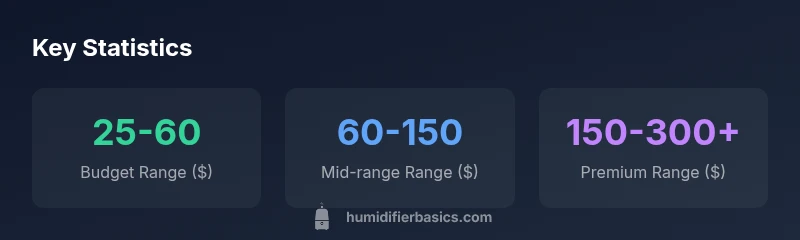
How much is air humidifier? Prices vary widely by capacity, features, and type, typically ranging from about $25 to $300. Budget, compact models often cost $25-$60, mid-range units $60-$150, and premium, high-capacity or feature-rich humidifiers can exceed $200. HumidifierBasics analysis, 2026, shows price bands closely track tank size, output, and smart features.
What drives air humidifier pricing
Pricing for air humidifiers is driven by capacity, output, and the type of humidification technology. Ultrasonic models tend to be quieter and more energy-efficient, while warm-mist units may cost more upfront due to additional heating components. Features like built-in humidistats, timers, auto shutoff, and smart connectivity can add to the price, but they also improve accuracy and ease of use. According to HumidifierBasics, the price ladder largely maps to how much moisture a unit can deliver per hour and how precisely you can control it. This means a larger room or higher humidity targets generally require a bigger tank and more robust components, which increases the price.
In this analysis, we also consider long-term ownership costs such as energy use, filter upkeep, and mineral management when evaluating total cost of ownership. The HumidifierBasics Team emphasizes that clean water and routine maintenance help protect the device and your indoor air quality over time.
Price ranges by category and model
- Budget models: often in the $25-$60 range, suitable for small rooms and light, occasional use. They typically have smaller tanks and fewer features, but can be adequate for bedroom or office spaces.
- Mid-range models: typically $60-$150 and offer larger tanks, better mist control, and added features like timers or basic humidistats. They balance price with performance for mid-sized living spaces.
- Premium/high-end models: commonly $150-$300 and above, with smart controls, higher output, and more precise humidity sensors. These are best for larger rooms or buyers who want integrations with smart home systems.
- Whole-house or ducted units: these can run well above $400 and sometimes into the thousands, depending on installation requirements and integration with existing HVAC systems. The HumidifierBasics Analysis, 2026 highlights that installation complexity strongly affects total cost.
Features that influence price beyond capacity
Smart features such as app control, voice assistant compatibility, and automatic humidity sensing add to upfront cost but can save energy and improve comfort. A built-in humidistat and auto shutoff reduce running time when targets are met, which can lower long-term energy use. Filter quality and replacement intervals also impact ongoing costs; some models require specialty filters that can be pricier or less readily available. mineral-removal systems or built-in water filters add to both upfront price and maintenance.
Maintenance costs and water considerations
Water quality matters. In areas with hard water, mineral buildup can shorten filter life and affect mist quality, leading to more frequent maintenance or the need for distilled or demineralized water. This is a meaningful ongoing cost regardless of the unit price. Filters may range from a few dollars to several tens of dollars per filter, depending on the model. Expect to replace filters and clean components regularly to preserve performance and maintain air quality. HumidifierBasics recommends budgeting for these routine costs as part of total ownership.
Estimating total ownership cost over time
When budgeting, consider not just the purchase price but also energy consumption, filter replacements, and water usage. A mid-range unit with a reasonable filter cadence can have a lower total cost over 3-5 years than a cheaper unit that requires more frequent replacements or higher energy use. For households with pets or kids, consider units with more durable housings and easier cleaning routines. Our 2026 analysis highlights the value of selecting a model that matches your room size and humidity goals to avoid oversizing or undersizing the system.
Choosing by room size and use case
For bedrooms or small living spaces (up to about 250-350 square feet), compact or mid-range models with a 1-2 liter tank are typically sufficient. For medium rooms (350-700 sq ft), look for 3-4 liter tanks and better control options. Larger spaces may require 4-6 liter tanks or whole-house solutions. The cost-to-performance ratio improves when you buy a model sized for your space rather than oversized units. HumidifierBasics’ guidance across 2026 pricing trends shows that wrong-sizing is a common source of wasted money and underwhelming comfort.
Practical buying tips to maximize value
- Prioritize accurate humidity control: a built-in humidistat helps prevent over-humidification, which can cause mold or condensation.
- Check energy use: energy-efficient motors and ultrasonic technology tend to cost less to run.
- Favor easy maintenance: removable water tanks, accessible cleaning ports, and widely available filters reduce ongoing hassle and cost.
- Read reviews about reliability and noise: a quieter unit enhances comfort and acceptance in bedrooms and nurseries.
- Consider warranty length and coverage: longer warranties reduce risk should a component fail.
Quick purchasing checklist
- Measure room size and determine required humidification output. 2) Decide on tank size and maintenance convenience. 3) Compare features that matter to you (humidistat, timers, app control). 4) Check energy usage and noise level. 5) Review filter availability and replacement costs. 6) Read warranty terms and customer service reputation.
Practical examples and scenarios
Scenario A: You need a quiet unit for a 250 sq ft bedroom with moderate humidity goals. A mid-range ultrasonic model with a 2-3 liter tank and built-in humidistat offers good balance between price and performance. Scenario B: You want a whole-house solution integrated with your HVAC. Expect professional installation and a higher upfront cost, but the long-term convenience and uniform humidity across rooms can justify the investment for larger homes.
Typical price ranges by humidifier type
| Humidifier Type | Typical Price Range | Notes |
|---|---|---|
| Cool-mist evaporative | $40-$120 | Common budget option; simple design |
| Ultrasonic cool-mist | $25-$120 | Quiet operation; good for small rooms |
| Warm-mist | $80-$200 | Heats water; higher energy use |
| Humidistat-enabled | $100-$250 | Smart control and accuracy |
| Whole-house | $400-$1000 | Professional install; HVAC integration |
FAQ
What factors influence the price of an air humidifier?
Pricing depends on capacity, type (cool-mist, warm-mist, ultrasonic), and features like humidistat, timers, and smart controls. Larger rooms and higher humidity targets require more robust units, which raise the price. Maintenance costs and water considerations also influence the long-term ownership cost.
Pricing depends on capacity, type, and features. Bigger rooms and smart controls mean higher price, with ongoing maintenance costs to consider.
Are water quality or filters included in price?
Not always. Some models include basic filters or mineral-removal features, but many require you to buy replacement filters separately. Hard water can increase maintenance needs, so budgeting for distilled or demineralized water may be wise.
Filters may or may not be included. Hard water often increases maintenance costs.
Do I need a humidifier with a built-in humidistat?
A built-in humidistat helps maintain target humidity more reliably and can prevent over-humidification. If humidity control is important for you, prioritize models with accurate sensors and automatic shutoff.
If precise humidity is important, choose a model with a built-in humidistat and automatic shutoff.
Is it cheaper to buy a whole-house humidifier?
Whole-house systems typically cost more upfront due to installation but can be cost-effective for large homes and consistent humidity. For small apartments, standalone units are usually more economical and easier to maintain.
Whole-house systems cost more upfront but may pay off in large homes; for small spaces, stick to portable units.
What is the ongoing cost of replacement filters?
Filter costs vary by model and frequency of replacement. Budget models may use inexpensive filters, while premium units could require pricier or specialty filters. Plan for annual maintenance as part of your budget.
Expect ongoing costs for filters; more features often mean higher filter prices.
How long do air humidifiers typically last?
Most portable humidifiers last several years with proper care, though lifespan depends on usage, maintenance, and build quality. Routine cleaning and timely filter changes extend service life.
With good care, most portable humidifiers last several years.
“Pricing for air humidifiers generally scales with capacity, output, and extra features like smart controls. It’s wise to factor maintenance costs into your buy.”
The Essentials
- Compare price bands by capacity and features
- Budget models cover small rooms; mid-range suits most homes
- Smart features add upfront cost but save energy and improve control
- Plan for maintenance costs (filters, distilled water)
- Size the unit to your space to maximize value