Humidifier vs Dehumidifier for Asthma: A Practical Comparison
Compare humidifiers and dehumidifiers for asthma management, learn safe humidity targets, and gain practical maintenance tips to reduce triggers and improve indoor air quality.


Choosing between a humidifier or dehumidifier for asthma depends on your home’s humidity level and triggers. Aim for 30-50% relative humidity: use a humidifier if humidity is consistently below 30%, and a dehumidifier if it stays above 50% to reduce mold and dust mites. For many patients, a humidity monitor and gradual adjustments are safer than relying on one device alone.
How humidity shapes asthma symptoms
For many people with asthma, humidity influences airway reactivity and mucus consistency. Very dry air can irritate the nose and lungs, triggering coughing and wheeze. Damp air encourages mold growth and dust mites, two common allergy triggers. The choice between a humidifier or dehumidifier for asthma becomes practical only after you measure your space and observe how symptoms respond to humidity shifts. According to HumidifierBasics, maintaining stable humidity within a comfortable range reduces exposure to common triggers and supports easier breathing. If your space frequently swings between too dry and too humid, you may want to start with a simple humidity monitor and a plan to adjust gradually rather than relying on a single device. The goal is to stay within an accessible RH window that minimizes airway irritation and allergen activity while preserving comfort.
How humidifiers work and when they help asthma
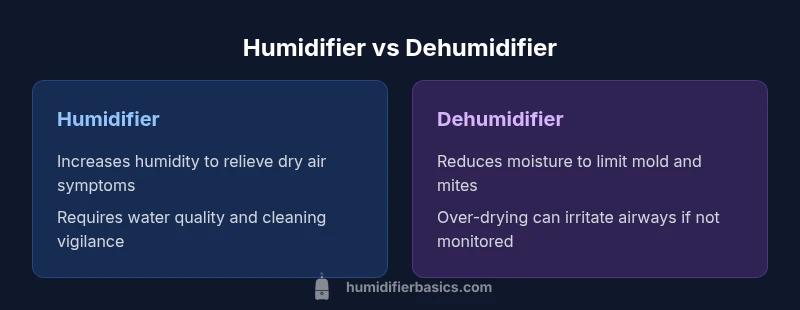
Humidifiers add moisture to dry air, which can ease congestion and throat irritation when humidity is too low. They come in several technologies, including evaporative units, cool-mist (often ultrasonic) designs, and warm-mist devices. Each type has trade-offs: evaporative models can self-regulate moisture to some degree, while ultrasonic and warm-mist units may deliver faster relief but require more careful water quality and cleaning. For people with asthma, the key is to avoid introducing minerals or mold spores. Use distilled or demineralized water if possible, clean the reservoir regularly, and ventilate the room to prevent stagnation. If you notice heightened coughing or wheezing after humidifier use, reassess humidity levels and room ventilation. Regular monitoring with a hygrometer helps ensure you stay within safe ranges.
How dehumidifiers work and when they help asthma
Dehumidifiers pull moisture from the air, lowering relative humidity to reduce mold growth, dust mites, and musty odors—common asthma triggers in damp environments. Modern models range from compact, portable units to whole-room systems. When used correctly, a dehumidifier supports clearer air and can ease respiratory symptoms tied to damp basements, bathrooms, or humid climates. Important caveats: dehumidifiers can over-dry air if set too aggressively, which may irritate airways. Always monitor RH and adjust gradually. For asthma management, pairing dehumidification with good ventilation and prompt mold cleanup is essential to minimize irritants and maintain comfortable breathing conditions.
Key decision factors: humidity levels, triggers, and space
When deciding between a humidifier and a dehumidifier for asthma, focus on four factors: current humidity level, known triggers, room size, and ventilation. A hygrometer is a low-cost, high-impact tool to quantify RH. If RH regularly falls below 30%, a humidifier can ease nasal passages and throat irritation; if RH exceeds 50%, a dehumidifier helps limit mold growth and dust mites. Space size matters: larger rooms require higher-capacity devices, while smaller rooms may be adequately served by portable units. Ventilation is crucial: even with humidity control, insufficient fresh air can trap allergens indoors. In many homes, climate and season dictate the best path, but humidity stabilization remains the core objective that supports asthma management.
Dry air scenarios and humidifier use
Winter months, forced-air heating, and arid indoor environments often drop RH below 30%. In these cases, a humidifier can help restore comfortable moisture levels that ease nasal drainage and throat irritation. Choose a unit with appropriate output for the room size, and prefer models with built-in humidity controls or a hygrometer. Clean water reservoirs regularly to minimize mineral buildup and bacteria growth. Also, consider the use of distilled water to limit mineral dust from ultrasonics. Pair humidification with air exchange to prevent stagnation, and monitor symptoms to avoid over-humidification.
Damp environments and dehumidifier use
Basements, bathrooms, and coastal homes with high humidity frequently exceed 50% RH, promoting mold and dust mites. A dehumidifier actively lowers moisture to curb these triggers. Start with a modest target (for example, 45-50% RH) and adjust based on comfort and allergen control. Ensure good drainage or a continuous drainage hose to avoid overflow, and regularly clean the filter and reservoir to prevent mold. For asthma, the goal is a stable, mold-free environment; dehumidification should be part of an overall moisture-management plan that includes ventilation, prompt leak repair, and routine mold remediation when needed.
Monitoring humidity and triggers with tools
Effective humidity management hinges on measurement and observation. A simple hygrometer provides real-time RH readings and helps you avoid extremes. Track how symptoms respond to humidity changes over several days or weeks before deciding to buy a device. Consider pairing humidity control with other air-quality strategies: regular cleaning to reduce dust, using HEPA-filtered vacuums, and reducing triggers like strong VOCs from cleaners. When asthma symptoms persist despite humidity control, seek guidance from a healthcare professional to refine your environmental strategy.
Safety, maintenance, and mold prevention for asthma
Whatever device you choose, safety and maintenance are non-negotiable for asthma care. Use clean water, sanitize reservoirs monthly, and replace filters per manufacturer instructions. Dry-out and clean the reservoir between uses to prevent mold and bacteria. Avoid placing devices near sleeping areas if noise is disruptive, and ensure the unit has automatic shutoff features when full to prevent overflow. Always air out the room regularly and maintain good ventilation to complement humidity management. By combining consistent cleaning with mindful usage, you can reduce mold and dust mite exposure while preserving healthy air quality.
Room-by-room guidance: bedrooms, living areas, and offices
Different rooms have different humidity needs and exposure risks. A bedroom may benefit from discreet, quiet humidification to ease nighttime symptoms, while living rooms in humid climates may require dehumidification to curb dampness. Offices with poor ventilation might benefit from balanced humidity and improved air exchange. In all spaces, avoid over-reliance on a single device. Use humidity readings to guide adjustments, and tailor the approach to each room’s use, occupants, and sensitivity to triggers.
Cost, energy use, and practical tips
Humidifiers and dehumidifiers vary in price, energy consumption, and maintenance needs. When budgeting, consider upfront cost, ongoing energy use, and filter or desiccant replacements. Look for energy-efficient models with auto-shutoff, humidity sensing, and easy-to-clean design. Larger units typically have higher running costs but may offer better control for big rooms or open-plan layouts. For asthma management, prioritize reliability, ease of maintenance, and clear humidity readouts over flashy features that don’t directly improve air quality.
Step-by-step decision framework
- Measure RH in the key living areas with a reliable hygrometer. 2) Note asthma triggers present in your home (mold, dust, pollen, pet dander). 3) Assess room size and ventilation; select a device with appropriate capacity. 4) Start with a moderate humidity setting and adjust gradually while monitoring symptoms. 5) Integrate humidity control with regular cleaning, ventilation, and healthcare guidance for a comprehensive strategy.
Practical start-up plan for the season
Begin with a low-cost humidity assessment: place a hygrometer in the main living area and a bedroom. If RH stays consistently below 30%, consider a portable humidifier for that space and monitor response. If RH stays consistently above 50%, implement a dehumidifier and target 45-50% RH while ensuring adequate ventilation. Schedule a monthly check to confirm humidity targets are maintained and to clean devices. This practical plan provides a safe, incremental approach to improve asthma-related air quality.
Comparison
| Feature | humidifier | dehumidifier |
|---|---|---|
| Humidity control | Adds moisture when RH is low | Reduces moisture when RH is high |
| Energy usage | Moderate to variable by model | Moderate to variable by model |
| Upfront cost | $20-150 typical | $40-200 typical |
| Best for asthma triggers | Dry air relief; mucus ease | Damp spaces, mold and mite reduction |
| Maintenance | Regular cleaning and water replacement | Regular cleaning and filter checks |
What's Good
- Enables precise humidity control to support asthma comfort
- Standalone devices are affordable and easy to deploy
- Clear, measurable impact when paired with a hygrometer
- Useful across multiple rooms and spaces in the home
Negatives
- If misused, can worsen symptoms or promote mold
- Requires ongoing cleaning and maintenance
- Does not address other asthma triggers like pollen or VOCs
Humidity control should be tailored to your space; neither device is universally best for asthma
Use humidity readings to guide your choice, and combine with ventilation and cleaning. For many households, gradual adjustments and regular monitoring yield the best asthma-related air quality improvements.
FAQ
Is a humidifier safe for asthma patients?
Humidifiers can be safe for many asthma patients when used correctly and cleaned regularly. It is important to avoid over-humidification and prefer distilled water to reduce mineral dust. Always consult your healthcare provider for personalized guidance.
Humidifiers can be safe for many with asthma when used properly and cleaned regularly; avoid over-humidifying and use clean water. Talk to your doctor for advice tailored to you.
Can a dehumidifier help with asthma?
Dehumidifiers help by reducing dampness that supports mold and dust mites, common asthma triggers. Use them judiciously and monitor humidity to prevent air from becoming too dry, which can irritate airways.
Dehumidifiers can help by cutting dampness and mold, but monitor humidity to avoid making air too dry.
What humidity level should I target for asthma?
A practical target for many homes is to stay around 30-50% relative humidity. Individual needs vary, so adjust based on symptoms and comfort, using a hygrometer for precise guidance.
Aim for about 30 to 50 percent humidity and adjust based on how you feel and any symptoms you notice.
Should I run a humidifier or dehumidifier continuously?
Continuous operation is generally not recommended. Use humidity readings to guide when to run the device, and set reasonable on-off schedules to maintain stable RH without overshooting.
Don’t run it all the time—let the humidity readings tell you when to turn it on or off.
How often should I clean humidifiers and dehumidifiers?
Clean these devices at least once a week during regular use and after any illness in the household. Deep clean monthly, and replace filters as recommended by the manufacturer.
Clean weekly, deep-clean monthly, and replace filters as advised.
Are there asthma-friendly models or features to look for?
Look for units with easy-to-clean reservoirs, antimicrobial components, and accurate humidity sensors. Models with quiet operation, low energy use, and certified indoor-air-quality features are preferable.
Choose models that are easy to clean, quiet, and have good humidity sensors for accurate control.
The Essentials
- Measure humidity before buying any device
- Aim for a safe RH window (roughly 30-50% as a practical target)
- Choose humidifier for dry air, dehumidifier for damp air
- Regular cleaning prevents mold and bacteria buildup
- Pair humidity control with good ventilation for best results