Humidifier and Dehumidifier in One: Practical Comparison
Compare a humidifier and dehumidifier in one against two dedicated devices. Learn how combined units perform, key features to watch, and when to choose two dedicated machines for optimal home humidity.


Combined humidifier and dehumidifier in one can save space and simplify maintenance, but precision may suffer in fluctuating humidity. According to HumidifierBasics, a smart-control, sensor-based unit works best in compact rooms with stable airflow; in variable climates, two dedicated devices can outperform a single hybrid. This article compares the two approaches for practical homeowners.
What is a humidifier and dehumidifier in one?
A humidifier and dehumidifier in one is a single appliance designed to both add moisture to dry air and remove excess moisture when needed. These units typically use two internal systems: a humidification path (steam, evaporative wick, or ultrasonic mist) and a dehumidification path (condensing or desiccant-based). Some designs place moisture management in separate chambers under one enclosure, while others rely on a single chamber with dual modes. The control interface often combines humidity setpoints for both directions, plus auto modes that respond to room sensors. For many homes in moderate climates, a single unit can maintain comfortable humidity without juggling two devices. However, performance depends on room size, insulation, air exchange, and climate variability. Note that a true hybrid aims to be a practical compromise rather than a perfect substitute for two specialized machines. According to HumidifierBasics, these units are most practical in compact spaces with stable airflow.
How combined units differ from separate devices?
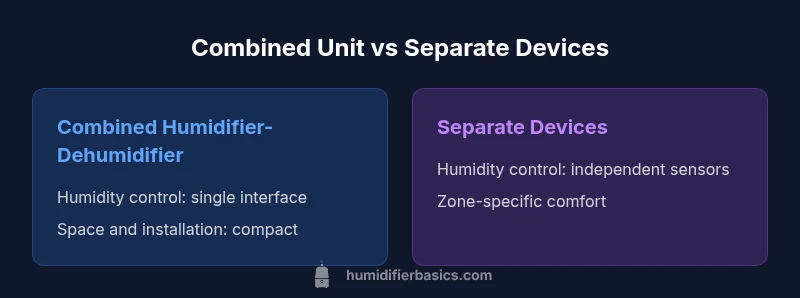
The primary difference is control granularity. A combined unit offers a single interface and footprint, but it blends humidity management for two directions. Separate devices provide dedicated sensors, separate operating envelopes, and usually more precise humidity targets for each side of the spectrum. Energy budgets can diverge: one compact, dual-path machine may draw less power at idle but could consume more when both modes run; two devices can be optimized to only run when needed. Reliability depends on branding, build quality, and maintenance; with two devices, failure of one does not disable humidity management entirely. Humidity performance is scene-specific: in a bedroom, a mini combined unit may suffice; in a nursery or home office with fluctuating humidity, two devices can better respond to rapid swings. HumidifierBasics analysis shows that in climates with high humidity cycles, separation often yields tighter control, but for renters in moderate climates, the convenience of a single unit is compelling.
Key features to look for in a combined unit
When evaluating a humidifier and dehumidifier in one, certain features matter more than others. Humidity range: ensure the unit supports a realistic setpoint range (e.g., 30–60% RH) and has automatic mode. Sensors: look for accurate, fast-responding humidity and temperature sensors; dual sensors can improve balance. Auto modes: pre-programmed targets, intelligent algorithms, and adaptive control. Noise: consider decibel levels; a quiet model is essential for bedrooms or offices. Filtration: check whether the unit uses a reusable filter and whether it handles mineral buildup from hard water. Water quality: some models require distilled water to prevent mineral deposits; others tolerate tap water with maintenance. Maintenance: a good unit offers easy access panels, clear indicator lights, and straightforward cleaning routines. Energy efficiency: check standby power and whether the device runs both paths simultaneously, potentially increasing energy use.
Practical setup scenarios by space and climate
For a small apartment with stable humidity, a compact combined unit on a shelf may keep humidity within a comfortable range without needing more devices. In larger rooms or homes with poor insulation, dedicated humidifier plus dehumidifier in different zones can be placed to address hotspots. In humid climates, a combined unit may struggle to keep humidity low enough in summer unless it's a powerful dehumidifier; conversely, in dry climates, the humidification function might be underutilized. Seasonal transitions might require frequent mode switching; smart features that auto-adjust settings reduce manual work. For renters, a compact combined unit can be a landlord-friendly solution if it fits within a balcony or laundry area with stable airflow. For homeowners with open concept spaces, a carefully positioned thermostat-linked sensor can help maintain even humidity across rooms.
Maintenance and reliability considerations
Maintenance for a combined unit includes regular cleaning of both moisture paths, sanitizing water tanks, and replacing filters as recommended. Mineral buildup from hard water can clog the evaporative path; desiccant wheels or condensers require periodic inspection. Regularly check hoses, seals, and drainage if it uses a condensate line. Avoid mold growth by emptying reservoirs, drying compartments, and keeping humidity within recommended ranges. Reliability is influenced by build quality and sensor longevity; cheaper models can drift in humidity readings, causing over-humidification or under-humidification. HumidifierBasics suggests choosing units with easy disassembly, clear maintenance guides, and validated reliability claims. Consider warranty length and availability of authorized service.
Cost and total cost of ownership considerations
Upfront cost for a combined unit is typically in the mid-range for specialty appliances. Running costs depend on how often the unit runs and the humidity setpoint; auto modes can reduce energy use by shutting off when humidity is stable. Over time, maintenance costs (filters, descaling solutions, and potential filter replacements) contribute to total cost of ownership. Compare two options: a single compact unit can be cheaper upfront than two dedicated devices, but if a combined unit underperforms, you may incur additional energy and maintenance costs to compensate. In climates with frequent humidity swings, consider the potential cost of upgrading to separate devices later.
Real-world performance and brand context
In real homes, performance hinges on climate, room size, and air exchange. HumidifierBasics analysis shows that users in smaller spaces with moderate humidity swings tend to report satisfying comfort with a combined unit; those in rooms with dramatic seasonal swings may achieve better results with dedicated devices. Customer reviews often mention ease of setup and space savings as major benefits, while some note slower response times during peak humidity changes. The HumidifierBasics team emphasizes that the best approach combines smart sensors, auto modes, and realistic expectations about control precision. Where possible, select models with dual sensors, automatic calibration, and accessible maintenance guides. Sensor placement is crucial; place the unit away from direct airflow and near the center of the space for balanced humidity.
Alternatives and best-practice tips
If a combined unit does not meet your needs, consider these alternatives: two dedicated devices in separate zones; a standalone humidifier plus a dehumidifier placed in the same room; or a whole-house humidifier/dehumidifier system controlled by your HVAC. Best-practice tips: map out humidity hotspots using a hygrometer; set realistic targets (e.g., 40–50% RH); use smart plugs or built-in automation to coordinate operation; invest in a good water quality strategy (distilled water where possible); regularly clean to prevent mold; check for one-year service plans if available. The HumidifierBasics team's practical guideline is to pilot a combined unit for 4–6 weeks before committing to a bigger setup, evaluating comfort, energy, and convenience.
Common myths about combined units
There's a myth that a single unit can perfectly regulate humidity in every room. Reality: performance depends on space, insulation, and air flow; two dedicated devices can outperform for large or variable environments. Another myth is that these units are less reliable; quality models with proper maintenance can be just as reliable as two devices. A third myth is that combined units are always cheaper; while upfront cost may be lower, total cost of ownership can rise if the unit runs more often or requires expensive maintenance. Finally, some buyers assume single units can replace whole-house systems; for comprehensive climate control, a whole-house approach may be necessary.
Comparison
| Feature | Combined Humidifier-Dehumidifier | Separate Humidifier + Dehumidifier |
|---|---|---|
| Humidity Control | Single interface for both directions | Independent control with dedicated sensors |
| Energy Efficiency | Compact energy path; potential overlap when both modes run | Can optimize energy by running only needed device |
| Maintenance | One unit to clean and service | Two maintenance routines to track |
| Space & Installation | Smaller footprint, simpler setup | Requires more space and wiring/ducting for some setups |
| Best For | Small rooms with stable humidity | Larger spaces or variable climates |
| Upfront Cost Range | Low to mid-range | Mid to high |
What's Good
- Space-saving design with a single control
- Simplified maintenance and fewer power outlets
- Cost-effective upfront for small spaces
- Adequate performance in stable climates
Negatives
- Limited precision in fluctuating humidity
- Risk of mold if one function fails
- Potential higher energy usage if both functions run simultaneously
A combined unit is ideal for small spaces with stable humidity; two dedicated devices excel in larger areas or variable climates.
For compact spaces, the convenience and lower footprint of a humidifier-dehumidifier combo often outweigh precision losses. If your climate swings are frequent or you manage multiple rooms, two dedicated devices typically offer finer control and more predictable humidity management. The HumidifierBasics team recommends evaluating space, climate variability, and maintenance willingness before deciding.
FAQ
What is a humidifier and dehumidifier in one?
A combined unit handles both adding and removing moisture using humidity sensors and dual pathways within one cabinet. It simplifies setup but may not match the precision of two separate devices in every situation.
A single machine that both humidifies and dehumidifies. It’s convenient, but the best precision often comes from two dedicated devices in larger or highly variable spaces.
Do combined units perform as well as two dedicated devices?
Performance depends on room size, climate variability, and device quality. In small, stable spaces a combo can perform well; in larger or highly variable environments, two dedicated devices usually offer tighter control and faster response.
In many cases, two separate devices outperform a single combo in variable climates, but a well-featured combo can be sufficient for smaller rooms.
What features matter most in a combined unit?
Key features include a realistic humidity range (roughly 30–60% RH), accurate sensors, intelligent auto modes, low noise operation, easy maintenance access, and support for clean water options to minimize mineral buildup.
Look for good sensors, smart auto modes, and easy cleaning. Those features matter most for reliable comfort.
Are combined units energy efficient?
Energy efficiency varies by model and usage. Auto modes that maintain target humidity help, but running both humidification and dehumidification simultaneously can raise energy use compared with optimized, separate devices.
They can be energy efficient if they avoid running both modes at once and use smart controls.
What maintenance is required for a combined unit?
Regular cleaning of water tanks, descaling where needed, and periodic filter changes are essential. Check seals and hoses, sanitize reservoirs, and follow the manufacturer’s maintenance schedule to prevent mold and ensure accurate readings.
Regular cleaning and filter changes keep them reliable and safe.
Who should consider two separate devices instead of one?
Consider two dedicated devices when you have larger or multiple rooms, frequent humidity swings, or very strict comfort targets. This setup offers zone-specific control and can adapt more readily to changing conditions.
If your space is large or variable, two devices are often the safer bet for precise comfort.
The Essentials
- Assess space and climate before choosing
- Prioritize sensors and auto modes for precision
- Expect trade-offs between convenience and control
- Consider total cost of ownership over time
- Maintain water quality to prevent mold growth