CarePod vs Canopy Humidifier: An In-Depth Comparison
Analytical comparison of carepod vs canopy humidifier to help homeowners choose based on design, performance, maintenance, energy use, and value.


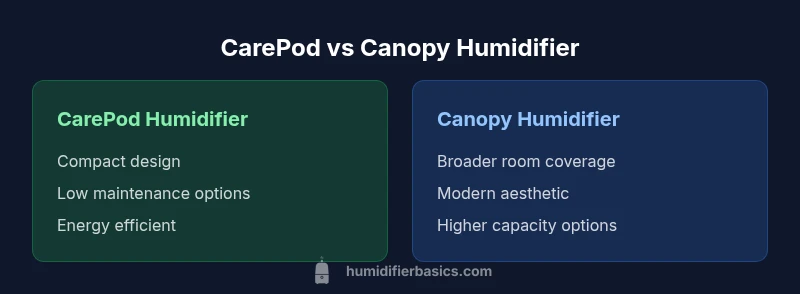
CarePod vs Canopy Humidifier: the decision rests on room size, maintenance tolerance, and budget. The CarePod typically delivers a compact, energy-efficient option ideal for desks or small bedrooms, while Canopy models emphasize broader room coverage and modern aesthetics. For exact needs, review our detailed chart and scenarios to see which fits your space and lifestyle.
CarePod vs Canopy Humidifier: Core Differences
According to HumidifierBasics, the carepod vs canopy humidifier decision hinges on room size, maintenance tolerance, and budget. When evaluating carepod vs canopy humidifier, homeowners should consider room coverage, noise, and ease of cleaning to avoid overbuying. In practice, CarePod units tend to favor compact footprints and simple operation, making them ideal for desks, nightstands, and small bedrooms. Canopy models, by contrast, often offer larger water capacities and more room-filling mist, which can better serve open living spaces or studio apartments. Both families emphasize safe operation and straightforward refilling, but the differences in design philosophy influence ongoing costs, maintenance frequency, and perceived value over a typical 1- to 3-year ownership window. Throughout this guide, we compare the two side-by-side with an eye toward practical tradeoffs you’ll encounter in daily use. The goal is to help homeowners and renters pick the option that reduces hassle while keeping humidity comfortable and stable.
In short, carepod vs canopy humidifier choices should align with real living conditions rather than abstract specs. HumidifierBasics’s research suggests that matching room size and user behavior yields the best long-term satisfaction. When you’re deciding, think about where the device sits most days, how often you refill, and how much maintenance you’re willing to perform. These practical factors often trump glittery specs in day-to-day comfort and health.
Design and Build: Form factor, materials, and aesthetics
The CarePod tends to prioritize a compact, portable footprint that fits neatly on a nightstand, desk, or small shelf. Its design usually emphasizes lightweight plastics, rounded edges, and a neutral color palette that blends with most interiors. The canopy-inspired Canopy humidifier, meanwhile, often presents a taller cylinder or sculptural form that makes a visual statement in living rooms or open-plan spaces. Materials across both families are typically BPA-free plastics, with some premium variants offering metal accents or glass tops. Maintenance-friendly layouts, such as simple water-fill ports and straightforward tank latches, are common across both options, but canopy models may include larger reservoirs and spill-prevention features for easier all-day use. The resulting aesthetic influence can affect where you place the device and how often it’s seen by guests, ultimately shaping your daily experience.
Humidification Technology and Output: Mist types and modes
CarePod humidifiers are commonly configured as compact, ultrasonic devices that emit a cool mist with a fine, barely perceptible spray. The Canopy line often offers similar ultrasonic performance but may provide additional options like adjustable mist direction or even evaporative-style options in select models. The practical upshot is that carepod vs canopy humidifier setups can deliver comparable humidity control in small rooms while canopy models tend to scale more easily for larger areas. The technology choice matters for mineral dust and spray visibility: ultrasonic devices can disperse tiny aerosol particles more evenly but may require mineral absorption or filtration if you have very hard water. The Canopy family, with its broader footprint, can sometimes offer better reach in open spaces while maintaining quiet operation with smart control modes in higher-end variants.
Coverage and Room Size: What spaces suit which
For many households, the carepod vs canopy humidifier decision is driven by room size. CarePod units excel in bedrooms, home offices, and compact apartments where a single device covers 100–250 square feet efficiently. Canopy models are preferable for larger living rooms, open-plan layouts, or studio apartments where sustained humidity in 300–600 square feet (or more, depending on model) matters. In practice, the right choice balances target humidity stability with the need to refill and clean. If you frequently move your unit between rooms, a carepod humidifier’s smaller tank may be easier to manage; if you have a large, airy space, Canopy’s higher capacity and wider mist dispersion can minimize hot and cold spots.
Noise Levels and User Experience
Both carepod and canopy humidifiers prioritize quiet operation, but real-world noise varies by model and water quality. In most cases, compact carepod humidifiers operate at the lower end of the decibel spectrum, suitable for bedrooms or workspaces where a soft hum is acceptable. Canopy humidifiers, depending on the pump design and fan speed, can introduce a slightly higher baseline noise, particularly on higher mist settings. For sensitive sleepers or light-stemmed desks, you’ll want to compare decibel ratings or customer reviews for the specific model you’re considering. In daily use, many users don’t notice either option when set to a comfortable mist level, especially with a stable surface and proper placement away from direct line of sight.
Maintenance and Cleaning: Frequency and ease
CarePod and canopy humidifiers share routine maintenance tasks, including regular tank refills, lid cleaning, and periodic filter changes where applicable. The carepod humidifier family often emphasizes lower-maintenance variants with fewer parts to clean, whereas canopy models may require more attention due to larger reservoirs and more complex mist-control components. A practical habit is to empty the tank at least every 24 hours if you’re in a dry environment and clean the tank and lid every 1–2 weeks, depending on water hardness. Regular descaling with a mild vinegar solution can prevent mineral buildup and extend the unit’s life. Both families respond well to a simple wipe-down routine that keeps grime and mold at bay.
Water Quality, Filtration, and Mineral Buildup
Water type matters for carepod vs canopy humidifier performance. Tap water with high mineral content can lead to white dust accumulations on nearby surfaces. Some CarePod models feature mineral absorption filters or demineralization cartridges; canopy humidifiers may include similar filtration options, though not all variants rely on filters. If you use well water or hard city water, distilled or demineralized water can reduce residue and improve long-term performance. In practice, filtration needs and maintenance frequency correlate with water hardness and run-time. For most households, switching to distilled water for heavy use days and using a recommended cleaning schedule keeps both devices running smoothly and reduces cleanup time.
Energy Use and Running Costs
CarePod humidifiers typically emphasize energy efficiency due to their smaller size and compact heat loss profile, which can translate to lower electricity costs in quiet, daily operation. Canopy humidifiers, with larger reservoirs and more extensive misting capabilities, may consume modestly more energy, especially when run on higher settings for extended periods. From a total-cost perspective, the difference in energy primarily matters if you operate either device for long hours or in larger spaces. If you’re optimizing for energy, choose the carepod humidifier for small rooms and light daily use, and reserve canopy models for larger spaces or higher humidity targets. Budget considerations should include initial price, filter replacements, and any optional smart features.
Safety and Health Considerations
Safety is a core concern when evaluating carepod vs canopy humidifier options. Both families are designed with tip-over resistance, auto shutoff when water runs dry, and cool-mist operation to minimize burn risk. Pet owners and households with children should prioritize units with stable bases and non-slip mats, as well as models with easy-access water-till and clear indicator lights for maintenance. Minerals and mold can develop if humidifiers are neglected; therefore, adhering to a cleaning schedule and using the recommended water type reduces health risks. Both devices generally support safe operation in typical household humidity ranges, provided you monitor humidity with a hygrometer and avoid over-humidification that could promote mold growth or dust mite activity.
Price, Warranty, and Value
Price is a practical differentiator between carepod vs canopy humidifier options. CarePod devices are usually lower in upfront cost and simpler to replace, while canopy humidifiers sit at a mid-to-higher price tier but offer features like larger tanks and advanced controls that can justify the expense for larger rooms. Warranty length varies by brand and model but commonly ranges from one to three years, with some premium canopy options offering extended coverage or service plans. In value terms, the better option aligns with how long you expect to own the device, how much you’ll use it weekly, and whether you prefer a minimalist device or a feature-rich model with app integration and scheduling.
Real-World Scenarios: When to Choose CarePod vs Canopy
If you live in a small apartment, a carepod humidifier is often the most practical, delivering sufficient humidity without crowding a shelf or desk. For larger living spaces, a canopy humidifier can provide more uniform humidity and reduce the number of devices required to cover multiple zones. If you travel frequently or move the unit between rooms, a lower-maintenance carepod may simplify logistics. In homes with children or pets, choosing a model with a straightforward cleaning routine and reliable auto shutoff can offer peace of mind. Economic considerations like price and energy use should not overshadow personal comfort; the right choice balances daily usability with long-term savings and hazard-free operation.
How to Decide: A Simple Framework
To decide, start by mapping your space: room size, ceiling height, and air-flow patterns. Next, list your maintenance tolerance: are you willing to descale weekly or prefer monthly care? Then consider energy sensitivity: will you be running the unit all day or just at night? Finally, match features to your priorities—automatic shutoff, timers, or app control—and evaluate total cost of ownership over 1–3 years. By following this framework, you can confidently choose carepod vs canopy humidifier that aligns with your lifestyle, health goals, and budget, ensuring consistent humidity and comfort across your home.
Common Myths About Small Humidifiers
There are a few misconceptions about carepod vs canopy humidifier options that can lead to overbuying. Size does not always equal capability; a compact unit can effectively humidify a modest bedroom with proper placement and run-time. Water quality matters more than brand hype, and routine cleaning trumps gimmicks in preserving performance. Also, not all larger canopy models are inherently better for every space—some rooms may benefit more from strategic placement and zoning rather than a bigger reservoir. By debunking these myths, you can approach carepod vs canopy humidifier choices with clarity and confidence.
Care and Maintenance Checklist for Longevity
Create a simple monthly routine: empty the tank, rinse and wipe the interior, and check for mineral buildup. Every 2–3 months, do a more thorough descale with mild vinegar solution if you notice white dust or reduced mist output. Replace filters as recommended by the manufacturer, and inspect seals for wear to prevent leaks. Keep the unit away from direct heat and sunlight to preserve plastic integrity. A dry, clean storage space reduces the risk of mold during off-seasons. With these steps, your carepod or canopy humidifier will remain efficient and reliable throughout the humidifying season.
Comparison
| Feature | CarePod Humidifier | Canopy Humidifier |
|---|---|---|
| Design intent | Compact, desk-friendly | Larger footprint with sculptural form |
| Output type | Ultrasonic cool-mist | Ultrasonic or evaporative depending on model |
| Water capacity | Smaller reservoir | Larger reservoir for extended run time |
| Best for | Small rooms and desks | Open-plan rooms and living spaces |
| Maintenance | Often low-maintenance variants | May require more frequent filter changes |
| Noise level | Low to moderate | Low to moderate (varies by model) |
| Energy use | Lower energy draw | Moderate energy draw (depending on capacity) |
| Price range | Lower upfront cost | Higher upfront cost (feature-rich options) |
| Smart features | Basic controls | App control and scheduling on select models |
What's Good
- Compact design fits tight spaces and desks
- Lower upfront cost and simpler operation
- Energy-efficient options are common
- Fewer parts to service in basic models
Negatives
- Limited coverage in large rooms
- More frequent replenishment for small tanks
- Some models rely on filters that require replacement
- Higher-end canopy models can be pricier
CarePod is best for small spaces; Canopy wins larger rooms
Choose CarePod for compact spaces, easy maintenance, and lower cost. Opt for Canopy when you need broader coverage and a more premium design for larger living areas.
FAQ
Which humidifier is better for a small bedroom: carepod or canopy?
For a small bedroom, a CarePod humidifier is usually the more practical pick due to its compact size and lighter maintenance. It provides sufficient humidity without crowding the nightstand. If you prefer a more statement look or expect to humidify a larger area soon, Canopy might still work, but expect a larger footprint and higher initial cost.
For a small bedroom, a CarePod is typically the better pick because it fits on a nightstand and is easier to maintain. Canopy works too if you plan to scale up later, but it takes more space.
Are both safe for pets and children?
Yes, both CarePod and Canopy humidifiers are designed with safety features like auto shutoff and cool-mist operation. Always supervise and place units out of reach of little hands and paws. Use distilled water to minimize mineral dust and clean regularly to prevent mold growth.
Both are designed to be safe around kids and pets when you follow setup and cleaning guidelines.
Can I use tap water in these devices?
Tap water can be used in many models, but mineral buildup and white dust can occur. If your water is hard, using distilled or demineralized water reduces residue and extends filter life where applicable. Check your model’s guidance on water type for best results.
You can use tap water, but distilled water helps prevent mineral dust and keeps the device cleaner longer.
Do both require filters, and how often should they be replaced?
Many canopy models rely on filters, while some carepod variants are filter-free or offer optional filtration. Replacement frequency depends on water quality and usage; follow the manufacturer schedule and monitor for reduced mist output. Regular maintenance extends life and performance.
Filters are common on canopy models; carepod options may be filter-free or filter-based—follow the manual for replacement timing.
Which is quieter, a carepod humidifier or a canopy humidifier?
Both are designed for quiet operation, but actual noise depends on model and settings. In general, CarePod devices tend to produce slightly less noise at low mist levels due to smaller fans, while some canopy models can be very quiet at medium settings. Check the measured decibel levels for your favorite models.
Both are quiet, but CarePod often edges out canopy in very quiet settings at low mist levels.
What maintenance steps most improve long-term performance?
Regular emptying and cleaning of the water tank, periodic descaling to prevent mineral buildup, and timely filter changes (where applicable) are the most impactful maintenance steps. Keeping the exterior dry and monitoring for any leaks also helps preserve performance.
Clean the tank, descale when needed, and replace filters regularly to keep performance up.
The Essentials
- Prioritize room size when choosing carepod vs canopy humidifier
- Consider maintenance frequency and water type for long-term value
- Balance upfront cost with features and running costs
- For small spaces, select CarePod; for larger spaces, choose Canopy