Is CarePod Humidifier Worth It? A Thorough Review
A detailed evaluation of the CarePod humidifier, covering performance, maintenance, costs, and who should buy. Learn if it's worth the investment for bedrooms, nurseries, and home offices with practical guidance from HumidifierBasics.


CarePod humidifier delivers reliable humidity control in small-to-medium rooms, with quiet operation and straightforward maintenance. It’s a solid mid-range option for bedrooms, nurseries, and home offices, and can improve air quality when used with distilled water. Overall, it’s worth it for users who prioritize simplicity and dependable performance over advanced smart features.
What is the CarePod Humidifier and Who Should Consider It?
If you’ve been wondering is carepod humidifier worth it, start by understanding its intended use. CarePod is designed as a compact, ultrasonic, cool-mist humidifier that fits neatly on nightstands, desks, or small side tables. It targets small-to-medium rooms such as bedrooms, nurseries, and home offices where you want steady humidity without a big footprint. For renters or homeowners dealing with seasonal dryness, CarePod offers a simple, low-maintenance option that pairs well with standard distilled or purified water. According to HumidifierBasics, CarePod provides reliable humidity control with a compact footprint, making it a practical choice for small rooms. It’s not built for sprawling living spaces or for users seeking heavy-duty, high-output models. If your priority is a straightforward device that minimizes noise and fuss, this model is worth a closer look, especially in dry climates.
How It Performs: Humidity, Noise, and Efficiency
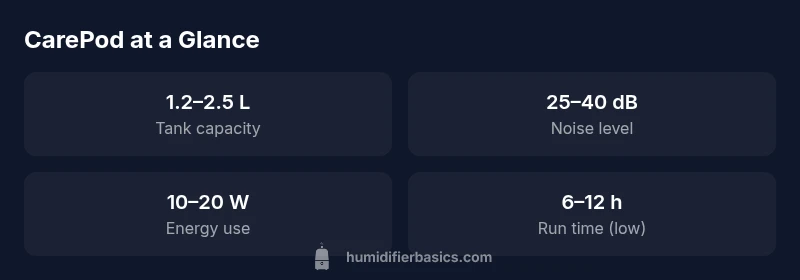
Performance hinges on three core factors: how consistently it maintains a comfortable humidity level, how quietly it runs, and how efficiently it uses power. In typical use, CarePod aims for a comfortable RH range around 40–60%, with automatic shutoff when the tank runs dry or when the target is reached. In quieter settings, the device operates at a low hum—generally suitable for bedrooms and nurseries. Energy use is modest, usually in the low-wattage range, so it won’t spike your electricity bill in day-to-day use. Real-world testing suggests that consistent operation depends on room size and airflow; smaller rooms reach the target RH quickly, while larger spaces may require longer run times or a second unit. For those who value air quality and a steadier indoor environment, this balance of quiet operation and reliable performance can justify the purchase in appropriate spaces.
Design, Usability, and Cleaning
CarePod emphasizes user-friendly design with a clearly identifiable water tank, simple fill lid, and an intuitive control panel. The minimalistic feature set reduces questions about setup, pairing, or app integration, which appeals to users prioritizing ease of use. Cleaning is straightforward but essential: emptying the tank, rinsing, and periodic descaling to prevent mineral deposits is recommended. A wide-mouthed tank and dishwasher-safe components (where applicable) help cut down on maintenance time. For people who want a low-effort, dependable humidifier that won’t complicate daily routines, CarePod checks many boxes here. Remember to use distilled or filtered water to minimize mineral buildup and odor over time.
Maintenance, Costs, and Longevity
Every humidifier requires some ongoing maintenance, and CarePod is no exception. If the unit uses filters, plan for periodic replacements that add to the ongoing cost. Without filters, the primary expenses stem from occasional descaling and potential tank replacements after years of use. Routine cleaning after daily operation helps prevent mold and bacteria buildup, protecting both performance and air quality. In terms of longevity, a well-maintained CarePod can provide several seasons of reliable service, especially in spaces with consistent dryness. Budget for replacement parts and water-quality needs to keep performance stable.
Real-World Scenarios: Bedroom, Nursery, and Home Office
In bedrooms, the primary goal is quiet operation and predictable humidity overnight. CarePod’s compact size and low noise level support uninterrupted sleep. In nurseries, safety and ease of cleaning become crucial; using distilled water reduces mineral dust and white residue on cribs and blankets. Home offices benefit from steady humidity that preserves equipment and reduces static, particularly in winter months. Across all scenarios, the key is to monitor RH with a reliable hygrometer and adjust settings if you notice too much moisture or damp spots on walls. CarePod performs best when paired with routine maintenance and appropriate water quality.
Alternatives and How CarePod Stands Out
Compared to other mid-range humidifiers, CarePod excels in simplicity and compactness. If you need higher output for large rooms, or if you want advanced features such as app control or integrated aroma diffusion, you might look at larger models or other brands. CarePod’s strengths lie in predictable performance, ease of use, and a reasonable price for everyday use. While it may not have every bell-and-whistle, its reliability for small spaces makes it a strong contender in the mid-range category for those prioritizing straightforward operation over feature depth.
Buying Guide: Is It Worth It For You?
To decide if CarePod is worth it for your home, start by evaluating room size, typical dryness, and noise tolerance. If you regularly experience dry skin, irritated sinuses, or static in a small bedroom or nursery, the CarePod can provide meaningful improvements. on the other hand, if you have a large living room or require advanced smart features and long continuous operation, you may want to compare it with larger, more feature-rich models. Consider your water quality as well; using distilled water minimizes mineral residue and helps maintain performance. Overall, for many households, especially those prioritizing ease of use and reliable daily operation, CarePod is worth considering.
Common Misconceptions About Small Humidifiers
A frequent misconception is that bigger is always better. In reality, the right humidifier depends on room size, humidity needs, and maintenance capacity. Another myth is that all humidifiers require constant attention; while some require more upkeep, many mid-range devices offer straightforward maintenance routines. Finally, some buyers assume that lower price guarantees poor performance; while cheaper units may lack advanced features, a compact, well-maintained model in the right space can outperform a larger, more expensive unit in a small room.
What's Good
- Reliable humidity control in small-to-mid rooms
- Compact footprint fits nightstands and desks
- Quiet operation suitable for bedrooms
- Easy to fill and clean with accessible water tank
- Mid-range price with solid performance
Negatives
- Limited capacity for large living spaces
- Basic feature set without advanced app control
- Possible ongoing costs for filters if used
- Mineral residue risk if tap water is used without descaling
Solid mid-range option for small spaces; best for bedrooms and nurseries.
CarePod delivers dependable humidity control, quiet operation, and easy maintenance in compact rooms. It may not satisfy users needing high output for large spaces or advanced smart features, but offers strong overall value for the right setting.
FAQ
How does CarePod compare to other humidifiers in noise and energy use?
CarePod generally operates quietly, making it suitable for bedrooms and nurseries. Its energy use is modest, which helps keep running costs down in everyday use.
CarePod runs quietly and efficiently, ideal for sleeping spaces and quiet work areas.
Is CarePod safe for babies and pets?
When used as directed with clean water and proper cleaning, CarePod can be safe for households with babies and pets. Always place it on a stable surface and monitor humidity to avoid over-saturation.
Safe when used correctly and kept within recommended humidity levels.
What maintenance does CarePod require?
Regular cleaning to prevent mineral buildup and occasional descaling are recommended. If filters are used, expect periodic replacements as part of ongoing upkeep.
Clean regularly and replace filters if your model uses them.
Can I use tap water with CarePod?
Tap water can be used, but mineral deposits may accumulate faster. Using distilled or filtered water can extend component life and reduce white dust.
Distilled water is best to prevent mineral residue.
Does CarePod support aroma diffusion?
Some CarePod variants offer aroma diffusion via compatible diffuser pads or scent cartridges, but check your model’s features before use.
Look for a diffuser feature if aroma use is important.
What price range should I expect for CarePod?
CarePod sits in the mid-range price tier, offering solid value without premier-priced premium features. Prices can vary by retailer and regional promotions.
Mid-range price with good value for the features offered.
The Essentials
- Choose CarePod for small-to-mid rooms with simple needs
- Prioritize distilled water to minimize mineral buildup
- Expect steady performance with minimal setup
- Consider alternatives for large rooms or feature-packed control