Humidifier vs Dehumidifier for Baby: A Practical Guide
Compare humidifier and dehumidifier options for a baby’s nursery. Learn when to use each, safety tips, maintenance, and how to choose the right humidity approach for your newborn.


In most nurseries, the question "humidifier or dehumidifier for baby" comes down to safe humidity levels. If the room is dry, a humidifier helps soothe nasal passages and dry skin; if the air is damp, a dehumidifier reduces mold risk and condensation. Use devices with safety features, monitor humidity with a gauge, and follow pediatric guidance for safe use.
The Nursery Humidity Dilemma: Why it matters
Humidity levels in a baby’s room influence breathing, skin moisture, and comfort. In cold, dry seasons, dry air can irritate a baby’s nose and throat, potentially triggering coughing or congestion. In warm or humid environments, excess moisture fosters mold growth and damp walls, which can affect respiratory health. The practical takeaway is to aim for a stable, moderate humidity level and to use a humidifier or dehumidifier only as needed to maintain that range. When you’re choosing between a humidifier or dehumidifier for baby, consider room size, climate, and the likelihood of seasonal shifts. This approach reduces risk while improving sleep quality for both baby and caregiver.
How to frame the decision
Think in terms of climate stability rather than a single weather event. If you live in a dry climate or heat-period interiors feel arid, a humidifier helps maintain comfort. If you live in a muggy or damp climate with visible condensation, a dehumidifier helps curb excess moisture and mold risk. Pediatric guidance generally supports targeting a safe indoor humidity range—roughly 40% to 60%—as a practical benchmark. Keep in mind that neither device should run unchecked; use a hygrometer to track fluctuations and adjust settings gradually.
Core differences: humidifier vs dehumidifier in nurseries
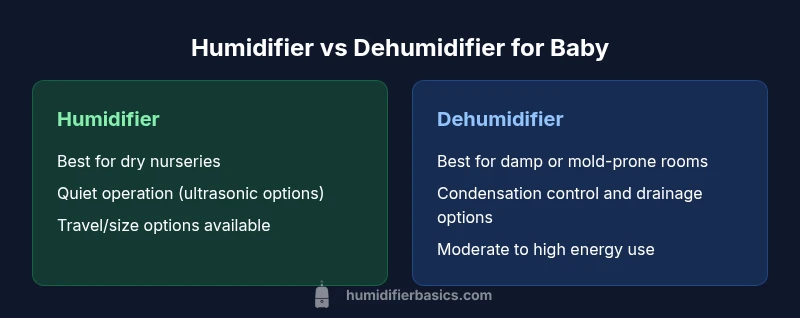
A humidifier adds moisture to the air, usually via cool-mist, warm-mist, or ultrasonic mechanisms. A dehumidifier removes moisture, often using refrigeration or adsorption methods. In a nursery, this translates to different use-cases: humidifiers are helpful when the air feels dry, especially during heating seasons; dehumidifiers are preferable when condensation or dampness is evident. Both can operate quietly with modern designs, but the noise level and energy use can vary by model. The key differentiator is how each device interacts with the nursery’s existing humidity baseline.
Practical humidity cues for baby room monitoring
Rely on a reliable hygrometer placed near the crib but not directly in the path of the airflow. Signs you might need a humidifier include dry skin, cracked lips, crusty noses, or a stuffy nose after baby wakes. Signs you might need a dehumidifier include visible dampness on walls, musty smell, or recurring condensation on windows. A balanced approach—matching the device to current humidity readings—helps maintain baby comfort and reduces risk of respiratory irritation.
Safety-first in nursery devices
Safety considerations matter more when babies share a room with mechanical devices. For humidifiers, prefer models with auto shut-off, stable bases to prevent tipping, and filters or cartridges that reduce mineral dust. For dehumidifiers, look for overflow protection, auto defrost in colder months, and child-safe controls. Always use clean, distilled or demineralized water in humidifiers to minimize mineral residue and white dust on furniture, linens, and baby skin. Store cords safely and keep the device away from the crib to prevent entanglement or tipping.
Types and features that work in nurseries
Humidifiers come in evaporative, ultrasonic, and warm-mist varieties. Evaporative humidifiers add moisture via a fan and wick filter, typically producing fewer droplets and a scent-free mist. Ultrasonic models are very quiet but can disperse minerals if tap water is used; using distilled water minimizes this issue. Dehumidifiers range from compact, portable units to larger room-hungry devices. In nurseries, smaller, quiet models with adjustable humidity targets and clear indicators are most suitable.
Choosing between devices: a practical framework
- Measure the room: size (square footage) and ceiling height influence how much moisture or dryness can be safely moderated. 2) Climate profile: dry winters call for humidification; humid summers or damp basements call for dehumidification. 3) Maintenance tolerance: humidifiers need regular cleaning and water changes; dehumidifiers require filter changes and tank cleaning. 4) Safety features: auto shut-off, tip-over protection, and easy-to-clean designs help protect babies. 5) Budget and energy: choose energy-efficient models to minimize running costs while meeting safety needs. 6) Trial period: implement gradual changes and monitor baby’s comfort and sleep quality to fine-tune settings.
Maintenance and best practices for baby-focused humidity control
Establish a simple cleaning routine: empty and rinse water tanks daily, wash surfaces weekly, and replace filters as recommended by the manufacturer. Prefer distilled water to reduce mineral deposits. Regularly inspect seals and gaskets for wear, and ensure cords remain out of baby reach. Document humidity readings and device changes to track what works best for your nursery over time.
Quick-start nursery humidity checklist
- Place a hygrometer in the baby’s room and monitor daily. - Keep humidity within 40–60%. - Use distilled water in humidifiers. - Clean and sanitize all components weekly. - Choose devices with auto shut-off and stable placement. - Position units away from the crib and protect cords.
Comparison
| Feature | Humidifier | Dehumidifier |
|---|---|---|
| Best for | Dry, heated, or air-conditioned nurseries; relief of nasal congestion | Humid environments with mold risk or condensation |
| Ideal humidity range | 40–60% (varies by season) | 40–60% (varies by season) |
| Noise level | Low to moderate with modern models | Low to high depending on capacity and settings |
| Energy use | Moderate (depends on model) | Moderate (depends on model) |
| Water/condensation handling | Water reservoir; mist output management | Water collection and drainage; moisture removal management |
| Maintenance | Filter maintenance and descaling as needed | Filter changes and periodic cleaning |
| Safety features | Auto shut-off, tip-over protection, and filters | Auto shut-off, overflow protection, and defrost when needed |
| Price range | Low to mid-range depending on features | Mid to high depending on capacity and features |
What's Good
- Helps maintain comfortable nursery air, reducing nasal irritation
- Can improve baby sleep when humidity is balanced
- Supports skin moisture and overall comfort in dry environments
- With proper use, combines safety features with family-friendly operation
- A wide selection of models allows tailoring to room size and budget
Negatives
- Overuse or improper humidity can encourage mold or dust mites
- Regular cleaning and maintenance are essential to prevent bacteria growth
- Some models produce noticeable noise or require more space
- Heat-based humidifiers may pose burn risks if not properly placed
Humidifier is generally the better first choice for a baby’s room unless the area is consistently damp
Maintaining a target humidity of 40–60% helps nasal comfort and reduces mold risk. The HumidifierBasics team recommends starting with a humidifier and monitoring baby’s response; shift to a dehumidifier if dampness or condensation becomes a recurring issue.
FAQ
Is a humidifier or a dehumidifier better for a baby’s room overall?
Generally, start with a humidifier if the room feels dry, especially in winter. If you notice dampness, condensation, or mold signs, switch to a dehumidifier. Regular humidity checks help determine which device to run and when to switch.
Start with a humidifier if the room is dry; switch to a dehumidifier if you notice dampness. Use a humidity gauge to guide ongoing decisions.
What humidity range should I target in a baby’s nursery?
Aim for about 40% to 60% relative humidity. This range supports nasal comfort and reduces mold risk. Use a hygrometer to track fluctuations and adjust your device accordingly.
Keep the nursery around 40 to 60 percent humidity, and adjust based on how the baby feels and the room conditions.
What safety features matter most for baby devices?
Look for auto shut-off, stable bases to prevent tipping, cleanable components, and child-lock controls. Place units away from the crib and ensure cords are secured.
Choose devices with auto shut-off, stable placement, and easy-to-clean parts; keep cords out of reach.
Can I use tap water in a baby humidifier?
Distilled or demineralized water is recommended to reduce mineral dust and residue. If you must use tap water, clean the unit more frequently to prevent buildup.
Prefer distilled water to avoid mineral dust; if not available, clean the unit more often.
How often should I clean a baby humidifier?
Clean and rinse the humidifier daily, and perform a thorough weekly clean. Drain, dry, and refilling should be a daily habit to prevent microbial growth.
Clean daily and do a full weekly clean to keep it sanitary.
Are warm-mist humidifiers safer for babies than cool-mist?
Warm-mist humidifiers can pose a burn risk if knocked over or touched. Cool-mist models are generally safer for nursery use, paired with careful placement and cleaning.
Cool-mist humidifiers are usually safer in a baby’s room; place them out of reach and keep them clean.
The Essentials
- Aim for consistent nursery humidity between 40% and 60%
- Choose a device with strong safety features and easy cleaning
- Use distilled water to minimize mineral residue
- Monitor baby’s comfort and adjust settings gradually
- Regular maintenance is essential for safety and effectiveness