What to Fill Your Humidifier With: A Practical Guide
Learn which water types work best for humidifiers, how to choose between distilled, filtered, tap, and boiled water, and how to maintain a clean, safe humidifier for healthier indoor air.


You will learn exactly what to fill your humidifier with and why water quality matters for performance and safety. The guide covers distilled, filtered, tap, and boiled options, plus practical tips for different models and rooms. By the end, you’ll know how to choose a water type that minimizes mineral buildup and supports clean, comfortable humidity.
Understanding why water quality matters for humidifiers
Humidifiers are designed to add moisture to the air, but the quality of the water you feed into them determines more than just mist clarity. Poor water quality can accelerate mineral buildup, clog filters, and even spread airborne minerals into your living space. The HumidifierBasics team emphasizes that choosing the right water type protects the device and your indoor air quality. In practice, this means looking beyond cost and convenience to how minerals, additives, and microbial content interact with your humidifier’s components. Water with high mineral content can leave white dust on furniture and surfaces, while mineral-laden deposits can reduce nebulizer efficiency and shorten component life. If you want a simple starting rule: begin with clean water that minimizes mineral load, and adjust your choice based on your device’s design and maintenance schedule. This section will break down the common water options and how they align with typical humidifier designs, so you can make an informed choice every time you fill up. The insights here come from the HumidifierBasics Analysis, 2026.
Water types explained: distilled, filtered, tap, boiled
When deciding what to fill your humidifier with, you’ll encounter several water types. Distilled water is created to remove minerals, offering the lowest mineral load for most devices. Filtered water passes through home filtration systems and can reduce some dissolved solids, though it may still carry minerals if the filter isn’t strong. Tap water is the most convenient option for many households but can contain minerals like calcium and magnesium that contribute to white residue and deposits. Boiled water is essentially treated tap water that has been heated to a boil and cooled; while it can kill some microbes, it does not remove minerals, so mineral buildup remains a concern. Each type interacts differently with your humidifier’s components, particularly ultrasonic and evaporative models. If you own an ultrasonic humidifier, mineral dust can become visible in the mist, which is often a sign to switch to distilled or demineralized water. In practice, your device’s manual will guide you toward its preferred option; when in doubt, start with distilled water and observe the results. This guidance aligns with HumidifierBasics recommendations for 2026.
Pros and cons of each water type
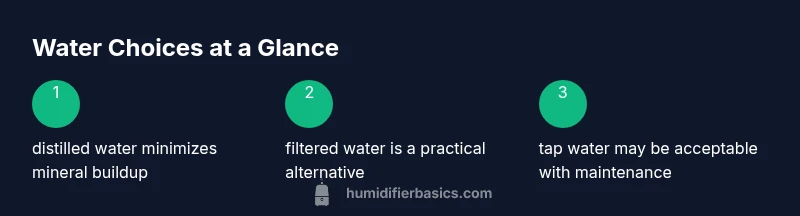
Distilled water: Pros include minimal mineral content, fewer white residues, and less risk of clogging; Cons are cost and the need to source it regularly. Filtered water: Pros are better accessibility and lower mineral load than tap water, but mineral content varies with filter quality. Tap water: Pros include convenience and cost; Cons include higher mineral content and potential impurities that can affect mist and device longevity. Boiled water: Pros include reduced microbial content, but minerals remain; Cons include extra steps and no significant mineral reduction. For most households and humidifier types, distilled water offers the simplest path to minimal residues, especially in high-humidity environments. If you cannot consistently access distilled water, use filtered water and monitor deposits; clean the unit more frequently to prevent mineral buildup. This section mirrors HumidifierBasics’ practical approach for 2026.
How to prepare water for safe humidifier use
Preparing water properly is a small but essential step that pays off in device longevity and air quality. Start with clean water from a trusted source. If you choose distilled water, you can fill the reservoir directly; if you choose filtered or tap water, consider letting water settle and degassing to reduce dissolved gases that can create mist texture differences. Some humidifiers require pre-filtered water or demineralization cartridges; check your model’s guidance. Fill the reservoir to the indicated maximum line with the chosen water type. Then reseal the unit, reattach power, and run a short test cycle to confirm mist output is even and free of unusual odors. Always wash your hands before handling water to avoid introducing contaminants. Humidifier manufacturers often publish care schedules; following them reduces scaling and microbial growth between uses. If you notice white dust or musty smell, switch water type or clean more often. This is consistent with best practices advocated by HumidifierBasics for 2026.
Maintenance routines to prevent mineral buildup
Regular maintenance is the most reliable defense against mineral buildup. Establish a routine: empty the reservoir daily, rinse with clean water, and dry the interior between uses. Schedule a more thorough cleaning at least once a week for non-detergent cleansers, using mild vinegar or a dedicated cleaning solution according to the manufacturer’s directions. Vinegar can dissolve mineral deposits, but never mix cleaners that could react or leave harmful residues in the mist. After cleaning, rinse thoroughly and let dry. Replace filters and cartridges as recommended by the device’s manual. Keep the area around the humidifier dry and free of clutter to avoid accidental tipping or spill. Consider using distilled water if mineral buildup recurs despite cleaning. Document your maintenance routine so you know when to perform each task and to track any changes in mist quality or device performance. HumidifierBasics follows these routines in 2026.
Common mistakes and how to avoid them
Many homeowners fill with water straight from the faucet and neglect cleaning, which accelerates mineral buildup and reduces device life. Another common mistake is neglecting to empty and dry the reservoir between uses in humid climates; residual moisture can promote microbial growth. Using essential oils in non-oil-safe humidifiers can cause damage and release irritating compounds. Running a humidifier with dirty water or a dirty reservoir can irritate eyes and lungs, especially in sensitive households. Finally, ignoring the device’s manual about water type and cleaning intervals increases the risk of clogging filters, motor strain, and abnormal mist. To prevent these issues, choose the recommended water type, follow a consistent cleaning schedule, and replace filters on time. This guidance reflects HumidifierBasics’ experience with 2026 maintenance cycles.
Room and device considerations: choosing water by model
Different humidifier designs respond differently to water quality. Ultrasonic models tend to emit fine mineral dust if using hard water; many owners therefore prefer distilled water to reduce visible residue. Evaporative models use a wick or screen; these often tolerate tap water better because minerals are absorbed or trapped by the wick, but scaling can still occur. In bedrooms or nurseries, or in homes with pets, distilled water reduces the risk of mineral residue on fabrics and furniture, making it a safer default choice. Always consult your model’s manual for recommended water types and maintenance intervals. Humidifier selection should align with room use and occupant sensitivity, a principle HumidifierBasics emphasizes in 2026.
Safety notes and allergy considerations
Water quality can impact indoor air quality, particularly for people with allergies or asthma. Mineral dust from hard water can irritate eyes and lungs; use distilled or demineralized water if mineral content is high in your area. Clean and dry the unit to prevent mold growth, especially in damp climates or poorly ventilated rooms. When cleaning, avoid harsh chemicals inside the reservoir; follow manufacturer directions and use non-abrasive cleaners. If a family member has a sensitivity to odors, keep humidity at moderate levels and ensure good room ventilation. For households with pets or children, store cleaning supplies out of reach and never let them handle the humidifier components. This practical safety guidance aligns with HumidifierBasics’ 2026 recommendations.
Practical recommendations and quick-start guide
Here is a concise set of practical steps to begin using your humidifier with confidence. Start by unplugging and emptying the reservoir, then choose a water type based on the device design and mineral concerns. Fill to the maximum line with distilled water if possible; otherwise, use filtered water and monitor mist quality. Run the unit for 10-15 minutes and observe the mist. If you notice white residue on surfaces or a dusty aura, switch to distilled water and clean more frequently. Keep a simple cleaning schedule and a small toolkit handy: microfiber cloths, a mild cleaning solution, and a soft brush. This approach balances effort, cost, and performance while protecting your humidifier from mineral buildup and your indoor air from dust. The HumidifierBasics team endorses this practical starter plan for 2026.
Tools & Materials
- Clean, empty humidifier reservoir(Ensure reservoir is dry before filling)
- Measuring cup or bottle with graduated markings(For accurate water volume if needed)
- Distilled water or preferred water type(Optional but recommended for mineral-minimizing.)
- Soft microfiber cloth(For wiping spills and exterior surfaces)
- Mild cleaning solution or vinegar (optional)(For mineral deposits during routine cleaning)
- Non-abrasive brush or sponge(To scrub reservoir nooks during cleaning)
Steps
Estimated time: 15-25 minutes
- 1
Power down and unplug
Before touching the unit, switch it off and unplug from the wall. This prevents electrical shock and ensures the reservoir can be safely opened for cleaning or refilling.
Tip: Wait a few seconds after unplugging to avoid accidental contact with wet surfaces. - 2
Empty and rinse the reservoir
Pour out remaining water and rinse the reservoir with clean water. This removes stale water that could harbor microorganisms and reduces odor.
Tip: Use a gentle stream and avoid splashing water onto electrical components. - 3
Choose your water type
Select distilled water for minimal mineral buildup, or filtered/tap water if distilled isn’t available. Consider your device’s recommendations in the manual.
Tip: If you’re unsure, start with distilled water and monitor mist quality for a week. - 4
Fill to the recommended line
Pour the water into the reservoir up to the max fill line indicated by the manufacturer. Do not overfill, as spillage can damage components.
Tip: Use a measuring cup for accuracy on smaller reservoirs. - 5
Reassemble and power up
Reseat the reservoir, plug the unit back in, and run a short test cycle to verify even mist and no unusual odors.
Tip: Place the humidifier on a stable, water-safe surface away from electronics. - 6
Monitor and adjust
Observe mist texture and room humidity. If you notice mineral dust or cloudy mist, switch to distilled water and clean more often.
Tip: Keep a simple log of water type and cleaning dates for maintenance.
FAQ
Can I use tap water in a humidifier?
Tap water is convenient but often contains minerals that can leave white dust and cause deposits. It may be acceptable for some devices, but distilled or demineralized water reduces buildup and maintenance. Check your model’s guidance and monitor residue.
Tap water can be used, but it may cause mineral buildup. If you see dust or deposits, switch to distilled water and clean more often.
Is distilled water really necessary?
Distilled water minimizes mineral content and is the simplest way to reduce residue and cleaning. If distilled water isn’t available, filtered water is a practical alternative, with regular cleaning to manage minerals.
Distilled water is the safest option for minimizing mineral buildup; if unavailable, use filtered water and clean more often.
What happens if I use mineral-rich water?
Mineral-rich water can leave white dust on surfaces, clog filters, and shorten the humidifier’s life. It may also affect mist quality and could irritate sensitive individuals over time. Prefer distilled or demineralized water when possible.
Mineral-rich water can cause deposits and dust; switch to distilled water to avoid buildup and maintain performance.
How often should I change the water?
Change water daily if possible, especially in humid climates or when symptoms of mineral buildup appear. Always clean and dry the reservoir between uses to prevent microbial growth.
Change the water daily when possible and clean the reservoir regularly to prevent growth.
Can I use essential oils in a humidifier?
Only use essential oils if your unit is designed for them. Most humidifiers are not oil-safe and adding oils can damage components and pose health risks. For scent, consider alternatives like aroma diffusers designed for oils.
Only use essential oils if the device is built for it. Otherwise, oils can damage the humidifier and aren’t recommended.
Does boiled water help or hurt?
Boiling water can reduce some microbes but does not remove minerals; the mineral load remains and may still cause deposits. Boiling can be a helpful preliminary step in some situations, but distilled water remains the clearer choice for mineral management.
Boiling water helps with microbes but doesn’t remove minerals; distilled water is generally better for mineral control.
Watch Video
The Essentials
- Choose water types based on mineral content and device design
- Distilled water generally minimizes residue and maintenance
- Clean regularly to prevent mineral buildup
- Follow the manufacturer’s water type recommendations
- Monitor humidity and adjust water choice as needed