How Long Should a Humidifier Run? A Practical Guide
Learn how long a humidifier should run to reach and maintain comfortable indoor humidity. This guide covers runtimes by room size, humidifier type, water quality, and safety tips from HumidifierBasics.


You will learn how long a humidifier should run to reach and maintain comfortable indoor humidity, how to estimate runtime for different models, and how to tailor run-time to room size, humidity goals, and safety considerations. We’ll cover evaporation rates, water quality, and practical guidelines for daily usage.
Why runtime matters for comfort and health
Maintaining comfortable indoor humidity hinges on running your humidifier for the right amount of time. If you run it too little, air can feel dry, causing irritation in skin and nasal passages. If you run it too long, you risk excess moisture that may promote mold growth and dust mites. The HumidifierBasics team emphasizes that understanding runtime is not just about comfort, but about health and home safety. By aligning run-time with the size of the room, the device’s output, and the current humidity, you can create a stable, healthy environment without wasted energy or unnecessary risk. This section explains the core ideas you’ll use to set a sensible daily running plan and how to interpret changes in humidity as you adjust usage.
How long a humidifier should run per day: a baseline approach
There isn’t a one-size-fits-all number for daily run time because anything from the size of the room to the unit type changes outcomes. A practical starting point is to observe how long it takes to move the room’s humidity to a comfortable level after turning the unit on, then schedule cycles that maintain that level. The HumidifierBasics guidelines suggest using a humidistat or a hygrometer close to the humidifier to track shifts accurately. From there, you can refine the daily run time to balance comfort with energy use and safety.
Factors that affect runtime you should know
Several factors influence how long a humidifier should run. Room size is foundational: larger spaces require more air moisture and potentially longer run times. Humidifier type matters: evaporative units can self-regulate to some extent, while ultrasonic models may deliver a higher initial jump in humidity. Water quality matters too; mineral-heavy tap water can affect output and trigger more frequent cleanings. Environmental conditions, such as outdoor humidity, indoor air leakage, and the presence of occupants, also change the needed runtime. Understanding these factors helps you tailor usage precisely rather than relying on guesswork.
Types of humidifiers and their typical runtime implications
Different humidifier technologies deliver moisture differently. Ultrasonic humidifiers are quiet and efficient but can distribute fine mineral dust if water isn’t clean. Evaporative humidifiers rely on a wick and a fan, which can feel less aggressive and naturally cap runtime as the air approaches the target humidity. Warm-mist models release moisture through heated water, which can be more energy-intensive but may offer quicker relief in very dry environments. Knowing the type you own will guide your expectations about daily running time and maintenance needs.
A practical method to estimate runtime using room size and target humidity
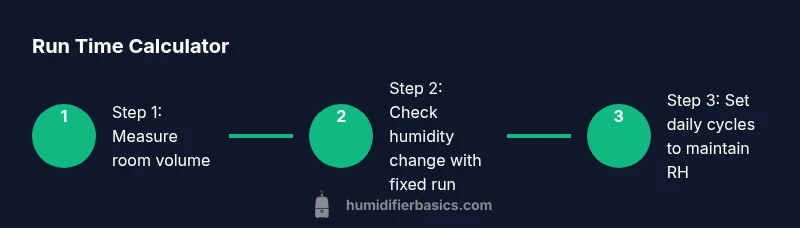
A reliable approach blends room measurements, your device’s capacity, and a measured change in humidity. Start by determining the room’s square footage and ceiling height to estimate volume. Then, observe how humidity rises over a fixed period when the humidifier runs. With typical devices, you adjust daily run hours until the hygrometer shows a steady humidity in the comfortable range. This practical method avoids guesswork and helps you set an efficient routine.
Winter vs. summer usage and occupancy effects on runtime
Seasonal changes drive different humidity needs. In winter, homes tend to dry out faster due to heating, increasing run time. In summer, higher outdoor humidity can reduce the needed runtime to maintain comfort. Occupants also matter: more people and activities generate moisture, which may lower the required run time. Track these patterns across weeks so your daily plan adapts to changing conditions.
Maintenance and safety considerations that influence runtime
Regular cleaning and mineral management affect how long your humidifier runs effectively. Mineral buildup can reduce output and efficiency, causing you to run longer to reach the same humidity. Always use clean water, ideally distilled, to minimize mineral residues. Safe usage practices—placing the humidifier away from walls and out of reach of children and pets, and turning it off if you notice condensation—help prevent unintended moisture accumulation and mold growth.
Tools & Materials
- Humidifier(Any type (ultrasonic, evaporative, or warm-mist) but ensure it’s appropriate for room size.)
- Hygrometer or room humidity monitor(Place near the humidifier intake or in the breathing zone for accurate readings.)
- Water source(Distilled water recommended to minimize mineral buildup.)
- Timer or smart plug(Helpful for scheduling and tracking run time.)
- Cleaning supplies(Vinegar or mild detergent; soft brush for mineral deposits.)
- Measuring cup(For measuring water or vitamin additives if applicable to manufacturer guidelines.)
Steps
Estimated time: 2-4 hours
- 1
Set a humidity target
Choose a comfortable humidity level (usually around 40-50%). Use a hygrometer to confirm the current room humidity and identify the delta you need to achieve. This baseline informs all further steps and helps prevent over-humidification.
Tip: Document your target humidity in a simple note so you can adjust over time. - 2
Check current humidity
Place the hygrometer in the room away from direct airflow. Record the current RH (relative humidity) reading before starting the humidifier. This gives you a starting point to measure how quickly the humidity increases.
Tip: Keep the device at breathing height and away from the humidifier’s spray to avoid skewed readings. - 3
Review the unit’s output and water quality
Review the manufacturer’s rated output (often given as a range) and consider water quality. Distilled water can improve efficiency and reduce mineral dust, which affects perceived humidity changes.
Tip: If using tap water, be prepared for mineral buildup and more frequent cleaning. - 4
Run a controlled trial period
Run the humidifier for a fixed window (e.g., 1-2 hours) and observe the change in RH. Note the starting and ending humidity levels and how much the RH rose.
Tip: Use a timer or smart plug to ensure precise trial duration. - 5
Calculate daily runtime
Based on the trial, estimate how many hours per day are needed to maintain the target RH given typical daily humidity changes. Plan cycles (e.g., two 1-hour runs or a continuous 3-hour cycle) that maintain the level.
Tip: Aim for short, frequent cycles if the room tends to fluctuate. - 6
Fine-tune and automate
Set up a humidistat or smart controller to automate cycles. Regularly recheck RH and adjust run times seasonally or as occupancy changes.
Tip: Automation reduces risk of forgetting to adjust the unit.
FAQ
How long should a humidifier run to reach comfortable humidity?
It varies by room size and device type. Start with a short trial to observe how quickly RH rises, then adjust run times to maintain the target humidity. Use a hygrometer for accurate measurements.
Run a quick humidity check with a hygrometer, observe the change, and adjust how long you run the humidifier to stay within your target range.
Is it safe to run a humidifier all day?
Yes, provided you keep humidity within a safe range (not too high) and perform regular cleaning. Monitor humidity and clean the unit daily if used continuously.
You can run it all day if humidity stays in the safe zone and you clean the unit regularly.
How can I reduce runtime while maintaining humidity?
Increase moisture efficiency by using a larger, properly sized unit, set a humidity target, and automate with a humidistat. Seal drafts and reduce unnecessary moisture sources.
Use a humidistat to keep humidity steady and reduce needless running.
Do ultrasonic and evaporative humidifiers differ in runtime?
Ultrasonic units can deliver a quick humidity rise but may require more frequent cleaning for mineral dust, while evaporative units gradually raise humidity and often self-regulate better.
Ultrasonic units rise humidity quickly, evaporatives tend to be steadier but may need more maintenance.
Should I use distilled water?
Distilled water minimizes mineral buildup and dust, reducing cleaning frequency and maintaining consistent output.
Yes, distilled water is better for performance and health.
How often should I clean a humidifier?
Clean at least weekly during heavy use and more often if you notice Mineral deposits or strange odors. Always unplug before cleaning.
Clean regularly to prevent mold and mineral buildup.
Watch Video
The Essentials
- Set a realistic humidity target and measure progress with a hygrometer.
- Runtime depends on room size, humidifier type, and water quality.
- Use distilled water to reduce mineral buildup and improve efficiency.
- Automate runtime with humidistats or smart plugs to maintain consistency.
- Regular cleaning is essential to sustain proper humidity and reduce health risks.